A solid 72 hour go bag list covers water and a way to make more, a trauma kit, something to keep you warm and dry, light and phone power, three days of food that needs little or no cooking, a simple cutting tool, and copies of your documents with some cash. Build it in that order, and stop when it reaches a weight you can carry for a couple of miles.
Want to build your own as you read? Use my free go bag builder to pack one item at a time, see what is still missing, and share your list with a link. Prefer a plain version with no brands? Use the free printable go bag checklist.
Most 72 hour go bag lists are a pile of items with no order, which is how beginners end up with a heavy bag full of gadgets and no water. I will give you the order I use to decide what earns a place, where it is worth spending money, and where the cheap option is the right call. I am a Pennsylvania Advanced EMT, I teach Wilderness First Aid and CPR as an HSI Level 2 Instructor, and I am FEMA CERT trained. That background shapes one rule: the basics you can carry beat the advanced gear you left at home.
I may earn a commission if you buy through links on this page.
Quick Verdict: where to start
Severe bleeding is the one problem on this list that can kill in minutes, so cover it before anything else.
They weigh almost nothing and turn water you find along the way into a backup supply.
Free Updates
I send an email when something’s genuinely worth your time: a new guide, a real price drop on something I recommend, or an actual safety alert. No spam, no daily digest, unsubscribe anytime.
Why you pack this ahead of time
Picture an ordinary weekday evening. Your phone buzzes with an emergency alert: a wildfire has jumped a ridge a few miles away and your neighborhood is under an evacuation order. You have maybe ten minutes. You will find your keys, your phone, and probably the wrong shoes. You will not stop to compare flashlights.
That is the whole point of a go bag. It is a decision you make once, on a calm weekend, so you do not have to make forty small decisions under pressure. The same logic applies to floods, hazmat spills and long winter power failures: you end up away from your usual supplies, services may be overloaded, and you rely on what you carry.
This is the beginner grab-and-go bag for roughly the first three days. If you want a bigger, longer-range pack, that is a different system, and I cover the trade-offs in my bug-out bag decision guide. If you are brand new to all of this, start with my new-to-prepping guide or take the kit quiz.
The seven-question framework
The American Red Cross sizes its evacuation kit for three days, and Ready.gov tells people to plan for several days. That window is where “72-hour” comes from. For every possible item, I ask the same questions in this order. Each one is a gate: if the bag fails an earlier gate, nothing later matters yet.
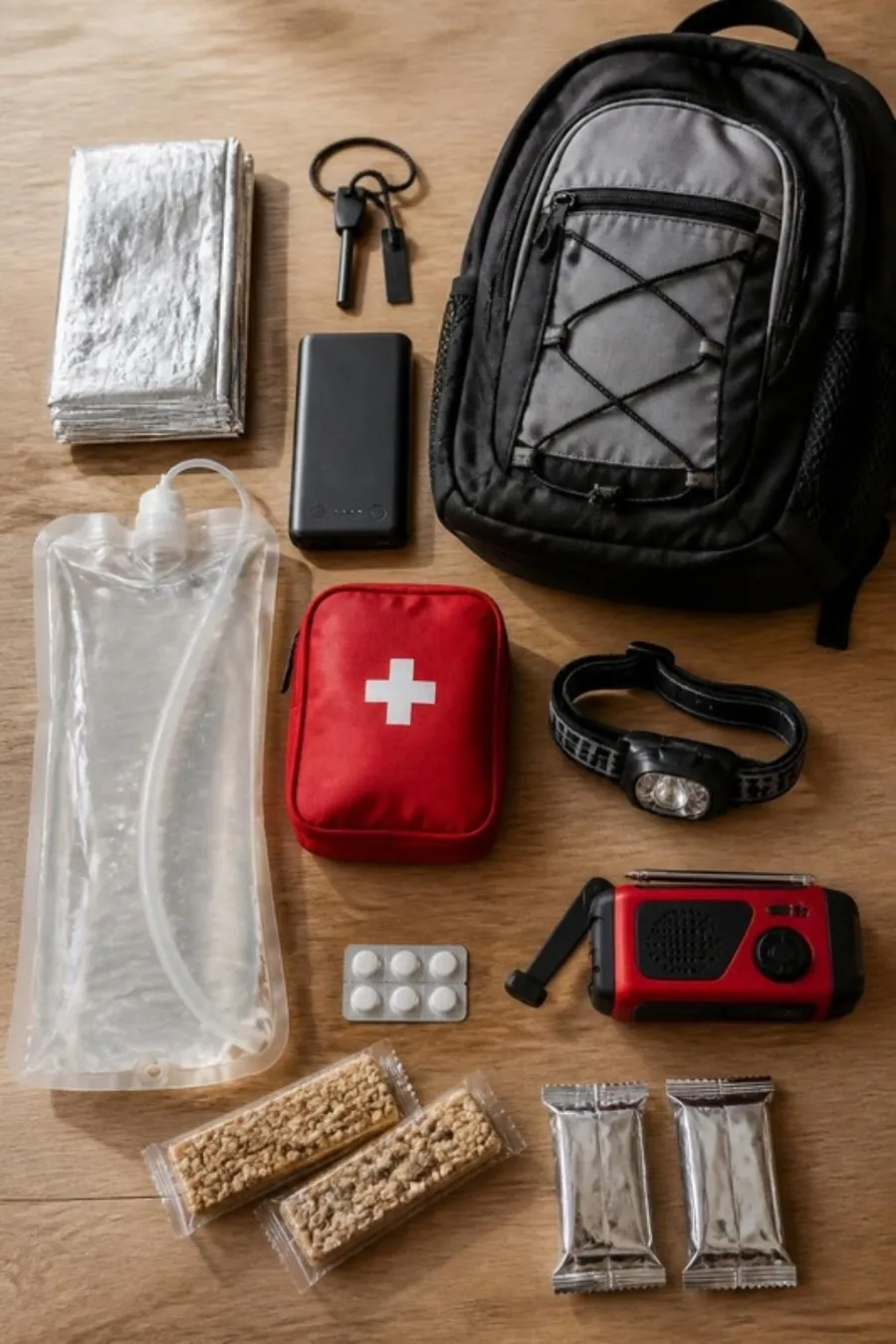
- Water. Can I drink safely for three days?
- Medical. Can I stop serious bleeding and handle common injuries and my own medications?
- Warmth and shelter. Can I stay dry and keep my body temperature up overnight?
- Light, power and communication. Can I see, get alerts, and keep a phone alive?
- Food. Do I have three days of calories I can eat with little or no cooking?
- Tools. Can I cut things and make a fire if I have to?
- Documents. Can I prove who I am and pay for things if power and networks are down?
The order follows how fast each failure hurts you. Severe bleeding can be fatal within minutes. Exposure can become dangerous within hours. Dehydration takes a day or two. Three hungry days are miserable but rarely life-threatening, which is why food sits fifth.
1. Water: the heaviest thing you cannot skip
Ready.gov and the Red Cross use the same number: one gallon of water per person per day. The Red Cross lists a three-day supply for an evacuation kit and two weeks for home. Three gallons weighs roughly 25 pounds, because water runs about 8.3 pounds per gallon, and most beginners cannot carry that comfortably on foot.
Reader-supported: I may earn a commission if you buy through links on this page, at no extra cost to you. Disclosure.
The fix is to split the job. Keep the full gallons at home, and in the bag carry some water plus a way to make more. A collapsible container like the HydraPak Seeker 2L holds two liters and packs flat when empty. Pair it with Aquatabs purification tablets, which cost little and weigh next to nothing. Follow the dose and wait time printed on the package, and strain cloudy water through a clean cloth first, because tablets do not remove sediment or chemicals.
| Option | What it solves | Trade-off |
|---|---|---|
| Reused sturdy bottles | Carrying water at no cost | Rigid, and takes space even when empty |
| HydraPak Seeker 2L | Collapsible 2-liter container | Costs more than a bottle, saves bag space |
| Aquatabs | Light, compact purification | Needs wait time; does not remove sediment or taste |
| Pump or gravity filter | Handles questionable water better | Heavier, more to maintain |
When the cheap pick is right: if your bag lives in a car or you are never far from a store, two reused bottles and a pack of tablets is plenty. For a longer comparison, read tablets vs. filters and my emergency water filter guide, and use the emergency water calculator to size your home supply.
2. Medical: where I would spend first
The Red Cross lists a first aid kit and a seven-day supply of medications among its basic items. I would go a step further. A box of bandages and aspirin covers minor problems but not a serious bleed, and bleeding is the problem you have the least time to solve. Evacuations also involve cars, glass, ladders and crowded roads, and ambulances may not reach you quickly. A kit with a real tourniquet and bleeding-control supplies fills that gap.
The Adventure Medical Kits Mountain Series Explorer ($86.49) is the first aid kit I would start a beginner with. It is built for one to four people for up to seven days. It has no tourniquet and no burn gel, so I add a separate tourniquet below. It is a trail kit with only 10 adhesive bandages, so add a box of ordinary bandages for a household. For bleeding-control kits, see my comparison of the Mountain Man Medical Sweetwater and Yellowstone.
For the bleed itself, add a dedicated tourniquet. I point to the CAT tourniquet ($34.99, from North American Rescue, sold by Mountain Man Medical) because it is one of the tourniquets accepted by the Department of Defense Stop the Bleed program and listed on the CoTCCC recommended devices list, the standard used in military and tactical medicine. Mountain Man Medical also sells a blue Trainer version, which is for practice only, so make sure you buy the real one. Buying it separately is inexpensive and covers the one job that cannot wait.
Two honest warnings. First, a tourniquet only helps if you know how to use it, so take a hands-on Stop the Bleed, first aid or CPR class. Second, pack your own prescriptions: no kit includes them. Add a printed list of what you take and the doses.
When the cheap pick is right: if you already own a good first aid kit, add a quality tourniquet and gloves rather than starting over.
3. Warmth, shelter and fire
Being cold and wet makes every other problem worse. It slows your thinking, and a windy night can turn into an emergency even at moderate temperatures. The Red Cross includes an emergency blanket in its basic supplies, and it is the best weight-to-value item in the bag.
| Factor | North American Rescue Emergency Survival Wrap | BattlBox SOL Heavy Duty Emergency Blanket XL |
|---|---|---|
| Price | $8.99 | $15.99 |
| Size | 96 x 60 inches, 3.7 oz | Extra large (98 x 58 inches), 8 oz |
| Build | Laminated polyethylene and Mylar, wind- and waterproof, orange on one side for visibility | Heavy duty, intended for repeat use |
| Best for | A spare in every bag and car | The main blanket in your bag, or sharing with a second person |
Bare foil sheets are fine for one night and pack tiny, but they tear and are awkward to refold. The North American Rescue wrap is a sturdier laminated sheet at nearly the same size as the XL and less than half the weight. The SOL XL is heavier and built for repeat use, including as a ground sheet or rain shelter. Size matters more than people expect, because a blanket that barely covers one person leaves gaps, and gaps lose heat.
When the cheaper pick is right: as the spare. At $8.99, one for each bag and car is a sensible habit. If you only buy one for your main bag and want it to hold up to repeat use, the XL is the better call.
Fire is a backup for warmth, signaling and boiling water, not a first-day plan, and it only belongs where it is safe and legal. If you are evacuating from a wildfire, do not light open fires. The BattlBox SOL Mag Striker with Tinder Cord ($13.99) is a spark-and-tinder tool that does not rely on fuel, so it can work when a cheap lighter will not. Carry more than one way to start a fire, because any single method can fail when it is wet or out of fuel. For example, pair a lighter with matches you have waterproofed (dipped in wax or kept in a sealed waterproof case), and add a striker as a third option. My fire starter guide goes deeper on the options.
4. Light, power and communication
Ready.gov’s kit list includes a flashlight with extra batteries, a battery-powered or hand-crank radio, and a NOAA Weather Radio with tone alert. I turn that into three items.
A headlamp
I prefer a headlamp to a handheld flashlight because it frees both hands for carrying, first aid and walking in the dark. Look for one with a low or red mode, and pack spare batteries in a separate bag so it cannot switch on inside your pack. Any reliable headlamp from a known brand does the job. The Black Diamond Spot 400 is a dimmable, AAA-powered option, and a two-pack of Energizer headlamps is a lower-cost way to give each bag its own.
A NOAA or hand-crank radio
When cell networks are congested or down, a weather radio still delivers official alerts. Look for one with the NOAA weather band and a hand crank or solar option so it does not depend on batteries, and test it at home. The Midland ER310 is one crank-powered AM/FM weather radio to compare.
A power bank
Your phone is your map, light and contact list, so keep it charged. The BattlBox Goal Zero Venture 75 ($119.95) is a rugged power bank. Its listed specs are 19,200 mAh (71.04 Wh), a 60W USB-C Power Delivery port, two USB-A ports, an IP67 dust and water rating, and a weight of 20.35 ounces. As a rough guide, that capacity should recharge a typical modern phone about three to four times, though your phone’s battery and charging losses change that. It has USB outputs only, no AC outlet, so it will not run a CPAP.
| Factor | Small, inexpensive power bank | BattlBox Goal Zero Venture 75 |
|---|---|---|
| Price | Typically a fraction of the cost | $119.95 |
| Capacity | Varies, often smaller | 19,200 mAh / 71.04 Wh |
| Ports | Varies | USB-C 60W PD, USB-A x2 |
| Weight | Varies | 20.35 oz |
When the cheap pick is right: if you only need to keep one phone alive for a night or two, a cheaper bank you already own works fine. The Venture 75 is for people who want more headroom and a sturdier build for a bag that gets tossed in a trunk. It is also heavier at 20.35 ounces, so skip it if every ounce counts. Whichever you choose, top it off every few months, because batteries slowly lose charge in storage. For whole-house outages, see my backup power guide.
Check price: Goal Zero Venture 75
5. Food: Little or No Cooking
Ready.gov calls for at least a several-day supply of non-perishable food, and the Red Cross specifies three days for evacuation. For a go bag, choose food that needs little or no cooking, no can opener and as little extra water as possible. Protein bars are the simple baseline: cheap, light and ready to eat. They get old by day two, which is where a real meal option helps.
Nutrient Survival sells shelf-stable emergency food meant for long storage, which suits a bag you pack once and check twice a year. The example I priced is its Blackout Basics Bucket ($199.99). It is listed at about 1,467 calories and 105 grams of protein a day for 14 days, in six resealable pantry packs: two shakes, powdered milk, potato, tomato and apple cinnamon oatmeal. Three days is about 4,400 calories, roughly $43 of the bucket. You still buy the whole bucket, so the other 11 days become a home shelf. The shakes mix with cold water, but the potato, tomato and oatmeal need hot water, and you may not have a stove, so keep the protein bars as your no-cook baseline. That is a reduced ration, so add bars if you are bigger, more active or carrying the bag far. Eat something you already know you tolerate, since a stressful week is a bad time to discover a food upsets your stomach.
When the cheap pick is right: almost always, for the first version of your bag. Add meals later. My guides on freeze-dried vs. dehydrated vs. MRE and MRE shelf life explain the differences.
Check price: Nutrient Survival Blackout Basics Bucket
6. Tools: keep it simple
The Red Cross lists a multi-purpose tool among its basic items. In a go bag, a knife is a utility tool for cutting cord, opening packaging, preparing food and trimming tape or cloth for a dressing. Two sensible options are the Buck 112 Slim Select and the SOG Escape. Check each listing for blade length, lock type and weight, and follow your state and local carry rules, since some places restrict certain knives. Any decent knife you already own works too. A folding knife, a fixed blade knife, or both is a sound choice: a folder is more compact, and a fixed blade is sturdier for heavy cutting. In some situations a hatchet can also be very useful, for example for splitting wood or clearing debris, but it adds weight, so treat it as optional for a 72 hour bag.
Add a whistle: Ready.gov lists one to signal for help, it weighs almost nothing, and it carries farther than your voice. Add a couple of N95 masks as well. Ready.gov recommends dust masks to help filter contaminated air, and in a wildfire, smoke is the main hazard.
Check price: Buck 112 Slim Select
7. Documents, cash and medications
This is the unglamorous part, and it often decides how smoothly recovery goes. Ready.gov recommends copies of important family documents, such as insurance policies, identification and bank account records, plus cash. Put these in a waterproof zip pouch:
- Documents: copies of your ID and insurance cards.
- Contacts: a printed list of key phone numbers, since your phone may die, and a paper map of your area.
- Cash: small bills. Card readers and ATMs may be down.
- Medications: the Red Cross recommends a seven-day supply, plus a written list of doses. Rotate them so they do not expire.
My page on FEMA, Red Cross and state resources links to official guidance and local contacts.
What changes for your household
The framework stays the same. What changes is the quantity and a few extra items.
| Household factor | What to adjust |
|---|---|
| Kids | Pack a bag for each person who can carry one, scaled to their size. Add diapers, formula or snacks, a comfort item and clothes in their sizes. Adults carry the water. |
| Pets | Food, water, a bowl, a leash, a copy of vaccination records and a recent photo of your pet. |
| Medications | A seven-day supply, a written list of doses, and any medical devices or supplies you depend on. |
| Cold climate | A warm layer, hat, gloves and a sleeping pad. Add to the blanket, do not replace it. |
| Hot or dry climate | More water capacity, sun protection and electrolyte supplies. Treat water access as the main constraint. |
Sizing the bag to what you can carry
This is the part most checklists skip. A bag you cannot carry is a bag you will leave behind. Pack it, weigh it, and walk a mile or two with it. If it hurts, remove items starting from the bottom of the priority list. Water is your biggest swing: a 2-liter reservoir weighs a little over four pounds when full, while three gallons adds about 25 pounds. That is why the bag carries less water and more purification capacity, and why you keep the rest of your water at home or in the car if you evacuate by vehicle.
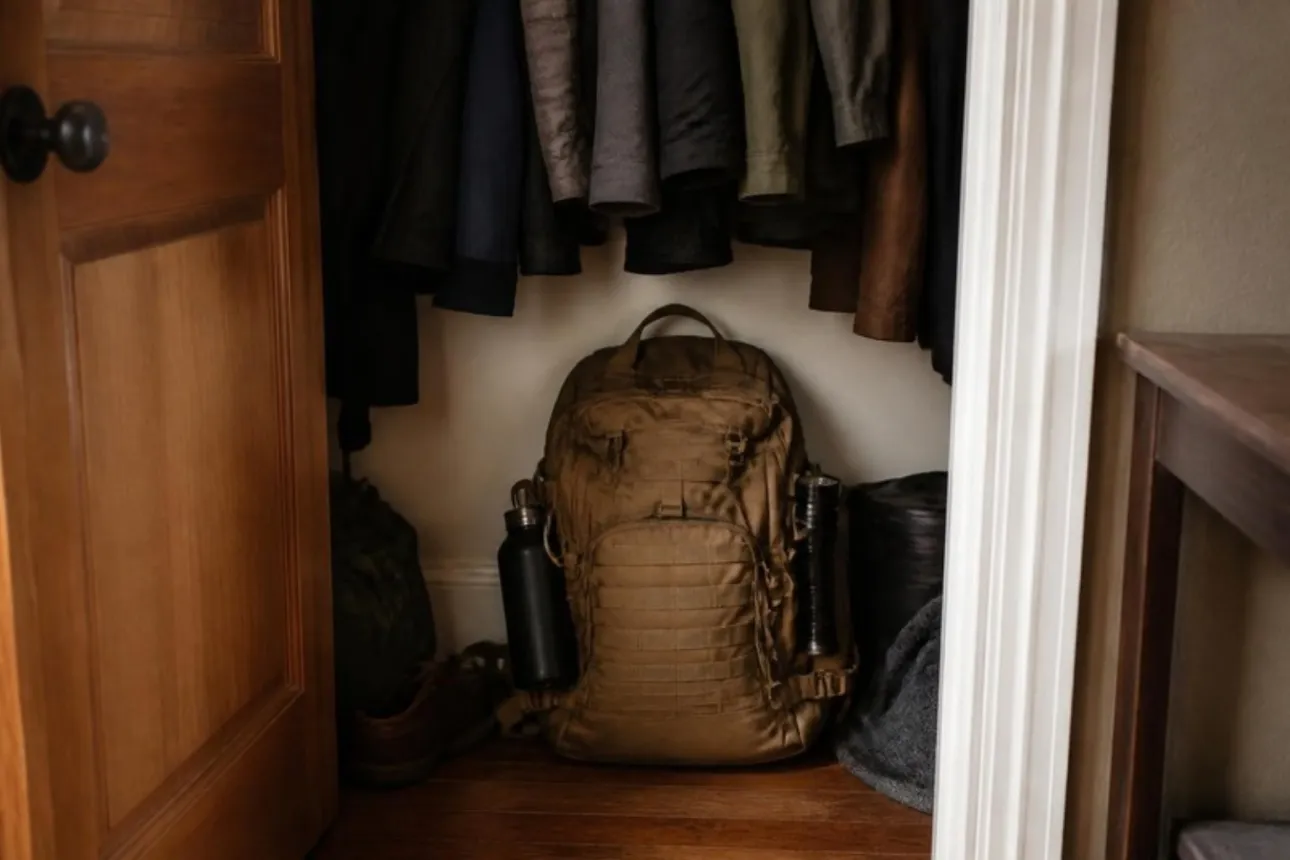
Stop adding when all seven gates are covered, the weight is manageable, and you can find any item in the dark. If you want to add something, remove something of equal weight. A second blanket is fine. Five different fire starters is a hobby.
The full 72 hour go bag list at a glance
| Priority | Item | Weight impact | Where to buy |
|---|---|---|---|
| 1. Water | 2L container plus purification tablets | Moderate when full | HydraPak Seeker 2L, Aquatabs |
| 2. Medical | First aid kit plus a tourniquet, plus your medications | Light to moderate | Adventure Medical Kits Mountain Series Explorer, CAT tourniquet |
| 3. Warmth | Emergency blanket | Very light | North American Rescue Emergency Survival Wrap ($8.99) or BattlBox SOL XL ($15.99) |
| 3. Fire | Lighter plus a spark striker with tinder | Very light | BattlBox SOL Mag Striker ($13.99) |
| 4. Light | Headlamp plus spare batteries | Light | Black Diamond Spot 400, Energizer headlamp 2-pack |
| 4. Comms | NOAA or hand-crank radio | Light to moderate | Midland ER310 |
| 4. Power | Phone power bank | 20.35 oz for the Venture 75 | BattlBox Goal Zero Venture 75 ($119.95) |
| 5. Food | Three days of food: protein bars plus a pantry-pack meal option | Moderate | Nutrient Survival |
| 6. Tools | Utility knife, whistle, N95 masks | Light | Buck 112 Slim Select, SOG Escape, Fox 40 whistle, 3M 8210 N95 |
| 7. Documents | Waterproof pouch with copies, contacts, map and cash | Very light | Print at home, any waterproof pouch |
Level-up items for later
Once the basics are packed and the bag is comfortable to carry, these are the next upgrades, roughly in order of value:
- A warm layer and sleeping pad, if you live where nights get cold. They do more than a blanket, but add weight and bulk. A closed-cell foam pad such as the Therm-a-Rest Z Lite Sol folds flat and does not need inflating.
- A hygiene kit with soap, toilet paper, wipes and sanitation bags, such as a portable toilet waste bag set. The Red Cross lists sanitation and personal hygiene products among its basic supplies.
- A compact lantern for lighting a room or shelter. See my emergency lantern guide.
- A Faraday bag, only if you have a specific reason. Read what needs EMP protection before spending money.
If you would rather buy a pre-made kit than build one, that is fine. Open it and inventory it, swap in a real trauma kit if it lacks a tourniquet, and add your own medications, documents and cash. A bag that exists beats a perfect bag that does not. You can see how I research and evaluate gear on my how we test page.
Free Updates
I send an email when something’s genuinely worth your time: a new guide, a real price drop on something I recommend, or an actual safety alert. No spam, no daily digest, unsubscribe anytime.
FAQ
What should be in a 3-day go bag?
Water and a way to purify more, a trauma kit with a tourniquet, an emergency blanket and fire starter, a headlamp, radio and power bank, three days of food that needs little or no cooking, a simple knife and whistle, and a pouch with document copies, contacts and cash, plus your medications. The list above puts them in priority order.
What should I stockpile for 72 hours?
Plan on one gallon of water per person per day, which is three gallons per person, and three days of non-perishable food that needs little or no cooking. The Red Cross uses three days for an evacuation kit and two weeks for home. Store the larger supply at home and carry a smaller amount plus purification in the bag. My water calculator helps you size the home supply.
What are the five most important survival items?
For a beginner, in my order: a trauma kit with a tourniquet, water plus purification, a way to stay warm and dry, food, and a way to get information (a radio and a charged phone). If you can only buy one thing this week, buy a CAT tourniquet and take a class.
What is the difference between a go bag and a bug-out bag?
A go bag is a short-term grab-and-go bag for about three days, built around evacuating to a shelter, a hotel or a relative’s home. A bug-out bag is a larger system for longer or more self-reliant scenarios. Build the go bag first, then read my bug-out bag guide if you want to go further.
How often should I refresh my go bag?
Ready.gov advises replacing expired items regularly and rethinking your needs every year. I recommend a check twice a year, tied to something easy to remember like the clock changes: swap food and batteries, test the radio and headlamp, recharge the power bank, rotate medications and update documents and cash.
How much should a 72-hour go bag weigh?
There is no official number. Aim for a weight you can carry comfortably for a few miles, and keep it lighter if you are older, injured or carrying a child. Water is usually the biggest variable. Pack it, weigh it, and walk with it before you decide it is finished.
The Prep Verdict is reader-supported. If you buy through a link on this page, I may earn a commission at no extra cost to you. See my full disclosure for details. I only recommend products I’d put in my own emergency supplies.