Household Water Calculator
Figure out how much water your household needs to store for a power outage, boil-water notice, or other short-term emergency: sized for your specific household, not a generic one-size-fits-all number.
Enter your household size and a few details below, and this tool will estimate your total water need, break it down into a daily drinking/sanitation split, and suggest a container plan. It’s a planning estimate based on published emergency-preparedness guidance, not medical or emergency-management advice: see the methodology section below for exactly where every number comes from.
Your Water Storage Plan
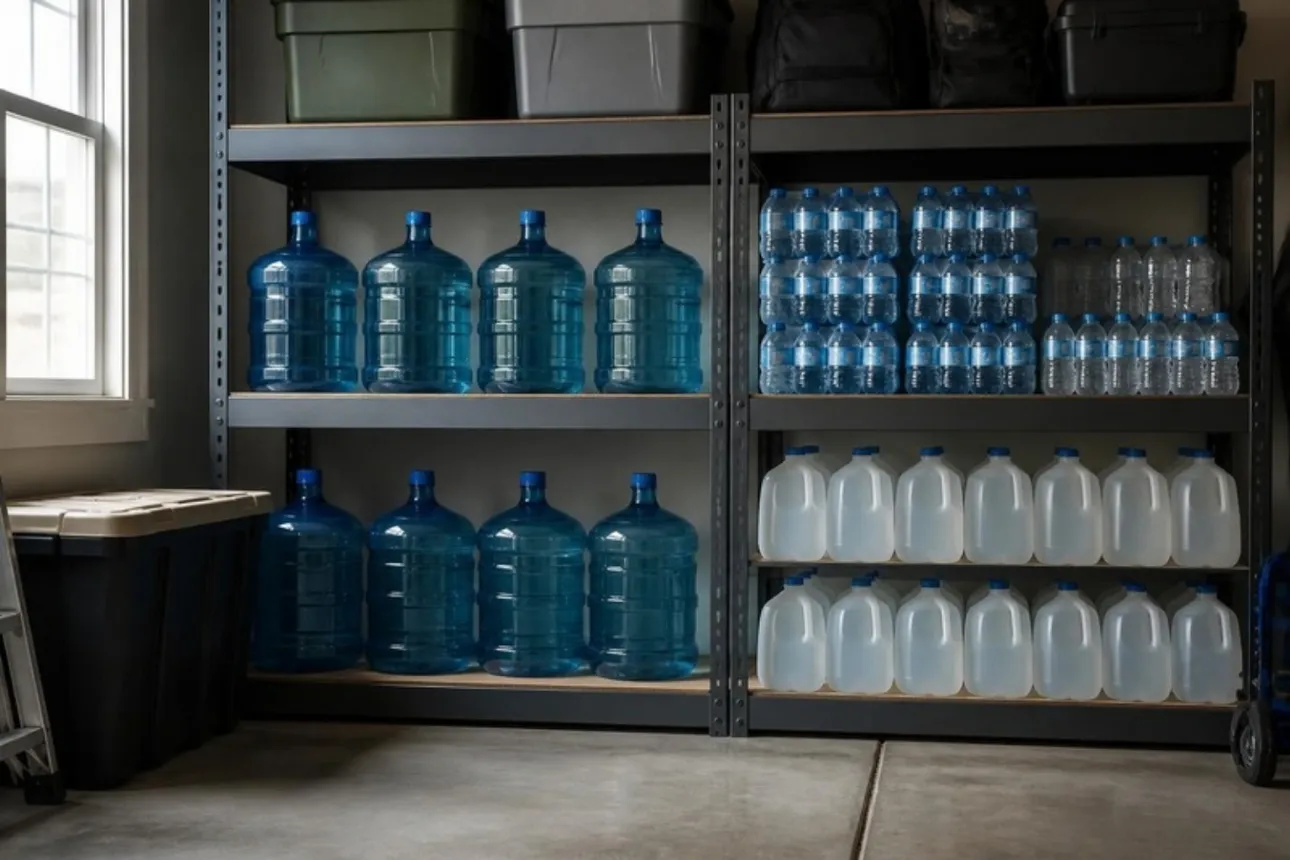
Suggested container plan
Once you know roughly how much you need to store, the next decision is what to store it in and how to purify more if you run out: both covered in these two guides:
Best Emergency Water Filter for a Home Power Outage
Sized and rated for keeping a household hydrated through a real outage, not a backpacking trip.
Read the full guide →Water Purification Tablets vs. Filters
Which one you need first, and when you genuinely need both.
Read the full guide →Where these numbers come from
- Baseline (1 gallon per person per day): Ready.gov’s water guidance states: “Store at least one gallon of water per person per day for several days, for drinking and sanitation.”
- Hot climate / high activity (2×): the same Ready.gov guidance notes water needs “can double” in hot climates or with high physical activity: applied here as a straight multiplier.
- Vulnerable household members (+25%): Ready.gov states children, nursing mothers, and sick people “may need more water” but does not publish a specific figure. I’ve also added elderly household members to this group on my own judgment: older adults often have different hydration needs too, even though Ready.gov’s own guidance doesn’t name that group specifically. This tool applies a 25% planning cushion as this site’s own conservative buffer. It is explicitly not an official government multiplier, and you should treat it as a starting point, not a guarantee.
- Pets: no major authority publishes an official per-pound pet-water figure. Not Ready.gov, the Red Cross, the ASPCA, or the Humane Society (now Humane World for Animals); their own disaster-prep guidance just says to keep extra water on hand without a specific number. This tool uses a widely-repeated animal-welfare rule of thumb (roughly 40–60 ml/kg/day, about 1 oz. per pound per day) converted into three size tiers: small (≤20 lbs) ≈ 0.15 gal/day, medium (21–50 lbs) ≈ 0.4 gal/day, large (51–90+ lbs) ≈ 0.7 gal/day. A planning convention, not an official recommendation.
- Drinking/sanitation split (50/50): an even split is a simple planning convention, not a precise clinical measurement: actual drinking-water needs vary by person and sanitation needs vary by household setup.
This calculator gives a planning estimate based on the published guidance cited above. It is not medical advice, and it is not a substitute for guidance from FEMA, the Red Cross, or a medical professional if you have specific health needs in your household. When in doubt, storing more than the estimate is always the safer choice.