·
Independently tested & researched
Updated September 2026
Quick Verdict: The complete home water system
Survivor Filter Pro
The active workhorse for volume and everyday household use.
Aquatabs
A 100-tablet container that outlasts several emergencies before running out.
Add a HydraPak Seeker+ Gravity Filter Kit as a hands-free backup filter that also stores the water it makes. Full system: under $250.
If you’ve searched “best emergency water filter,” you’ve probably landed on a list of backpacking filters — the Sawyer Squeeze, the MSR Guardian, a Grayl bottle. Those are great products, but they’re built to solve a different problem: one person, filtering a liter at a time, on a trail. A multi-day outage at home is a household problem — several people, days at a time, and a water heater or a bathtub full of stored water instead of a stream.
That’s the gap almost nobody online actually addresses. This isn’t a “here’s one filter, buy it” pick. It’s a system: an active filter for volume, a chemical backup for redundancy, and a hands-free second filter that handles storage too. Here’s how the pieces fit together, and which specific products we’d actually put in a household kit.
How much water does your household actually need?
Before picking a filter, size the problem. FEMA and the Red Cross both recommend one gallon of water per person, per day — half for drinking, half for cooking and basic hygiene — with at least a three-day supply as the floor, more if anyone in the household is pregnant, nursing, sick, or if you live somewhere hot. For a family of four, that is a minimum of 12 gallons sitting in reserve before you even get to filtration.
Filtration matters for two reasons beyond that stored supply: it is what turns questionable water (a cloudy tap during a boil-water advisory, a rain barrel, a creek if things get bad enough) into something safe to drink, and it is your backup once the stored gallons run out.
The three-piece system
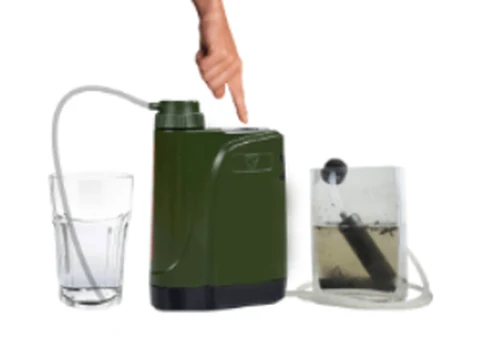
| Best for | Price | Key spec | |
|---|---|---|---|
| Survivor Filter Pro | Active filtration — turns any questionable water source into drinking water on demand | ~$65 to 70 | 0.01-micron triple-stage filter, 500 mL/min, rated for ~26,000+ gallons before replacement |
| Aquatabs | Cheap, shelf-stable chemical backup for when you do not want to pump, or the filter is tied up | ~$8 to 15 per 100-tablet container | One 397mg tablet treats 4 gallons in 30 minutes; 3-year shelf life |
| HydraPak Seeker+ Gravity Filter Kit | Hands-free backup filtration — filters water without pumping while doubling as your storage container | $150 | Dual-bag gravity system, 63mm filter removes 99.99% of bacteria/cysts, ~1,500L filter life, no pumping required |
None of these substitute for the others. The filter handles volume and works with almost any water source; the tablets are your zero-moving-parts backup (worth having even if you never plan to use them as your primary method — pumps can break, tablets cannot); and the gravity filter kit is your hands-free second filtration method, doubling as the container that holds the water it produces.
Survivor Filter Pro — the workhorse
The Survivor Filter Pro comes in two versions: a battery-powered electric pump (the one we link below and default to for a home kit) and a fully manual hand-pump model with the same core filtration for anyone who’d rather not depend on batteries. Either way it’s a pump-style filter, not a squeeze or straw filter, which matters for a home setup because it can process water faster than gravity alone without anyone sucking water through a straw for a whole household’s needs — the electric version does the pumping for you, while the manual version takes some arm strength but needs no power source.
Key specs:
- 0.01-micron triple-stage filtration (carbon, ultra-filter, cotton pre-filter) — finer than the 0.1-micron rating on most trail-focused competitors like the Sawyer Squeeze, which matters more for viruses and finer sediment than it does for bacteria alone.
- 500 mL/min flow rate — slower than some hollow-fiber trail filters, but steady, and the carbon stage means it actually addresses taste and odor, not just pathogen removal.
- Rated for roughly 26,000 gallons before the filter stages need replacing, which for a home-emergency-only use case (as opposed to daily use) is functionally a many-years supply.
- Removes bacteria, protozoa, microplastics, heavy metals, and chemicals; effective against viruses as well — the broadest contaminant coverage of the three products here.
The honest tradeoff: it’s heavier and slower than an ultralight trail filter, and the pre-filter clogs faster in visibly dirty or turbid water. For a home kit that’s mostly filtering stored or tap water rather than a muddy creek, that tradeoff barely matters. (Specs below are the official electric-model numbers, confirmed directly against the manufacturer’s listing for that SKU.)
Check Price: Survivor Filter Pro (Electric) See the Manual Version
Aquatabs — the backup that cannot break
A pump has moving parts. Tablets do not. Aquatabs are NaDCC-based purification tablets, WHO-certified, and dead simple: one 397mg tablet treats 4 gallons of water in 30 minutes, with a 3-year shelf life so a box bought today is still good well past your next home inventory check. They eliminate 99.9999% of bacteria, 99.99% of viruses, and 99.9% of cysts.
The honest pitch here is not “instead of a filter” — it is “in addition to one.” If the filter pump seizes, someone is out with it, or you just do not want to stand there pumping water for a family of five, drop a tablet in a jug and wait half an hour. At roughly a dime a tablet for the 4-gallon dose, keeping two or three containers in a kit is a rounding error next to the filter cost.
HydraPak Seeker+ Gravity Filter Kit — hands-free filtration that doubles as storage
This is the piece most “best emergency filter” lists skip entirely: a way to filter in bulk without standing at a pump. Fill the kit’s “dirty” bag from a tap, rain barrel, or any questionable source, hang it, and gravity pushes the water through a 63mm Plug-N-Play filter cap into a “clean” bag you can pour or dispense straight from — no pumping, no batteries. The filter removes 99.99% of bacteria and parasitic cysts, is rated for roughly 1,500 liters before replacement, and flows at over a liter per minute, and the clean bag doubles as your storage container once filtration is done.
The Survivor Filter Pro is faster for a quick refill, but it needs someone actively pumping. The Seeker+ Gravity Filter Kit is slower but hands-free — hang it and come back to clean water waiting in the attached bag. It is also real redundancy: if one filter clogs or breaks, you are not down to tablets alone.
Building your kit: what we would actually buy
For a household of 3-4 planning for a multi-day outage: one Survivor Filter Pro as the primary active filter, a 100-tablet Aquatabs container as backup (it will outlast several emergencies before it is used up), and a HydraPak Seeker+ Gravity Filter Kit as a hands-free second filtration method that also stores the water it produces. That is a complete system for under $250, on top of whatever gallons of stored water you are already keeping per the FEMA guidance above.
FAQ
How long does a Survivor Filter Pro last?
The manufacturer rates the filter stages for roughly 26,000 gallons of use before replacement is needed — for occasional home-emergency use rather than daily filtration, that is typically a multi-year lifespan.
Are Aquatabs safe to drink every day, or just in an emergency?
Aquatabs are designed for emergency and travel water purification, not as a daily replacement for a home water treatment system. For short-term emergency use — days to a couple of weeks — they are an EPA-recognized approach to making questionable water safer to drink.
Do I need both a filter and purification tablets?
For a home kit, yes — treat them as redundant, not duplicate. A pump filter can jam or break; tablets have no moving parts to fail, but need 30 minutes of wait time and will not remove sediment or improve taste the way a filter does. Having both covers each one weak point.
How much water should I store before I even need to filter anything?
FEMA and the Red Cross recommend at least one gallon per person per day, with a minimum three-day supply — more if you can manage it, and more per person if anyone in the household is pregnant, nursing, or ill.
The Prep Verdict is reader-supported. If you buy through a link on this page, we may earn a commission at no extra cost to you. See our full disclosure for details. We only recommend products we’d actually put in our own emergency supplies.
Leave a Reply