·
Medic & certified first aid instructor
Updated September 2026
Here’s the honest, short answer before I make you read the rest of this: no, you don’t need to wrap your house in foil, and no, an EMP almost certainly isn’t going to instantly fry every electronic device you own the moment it happens. If you’re reading prepping content that says otherwise, it’s overselling the threat to sell you gear. The realistic answer is narrower. A cheap Faraday bag for a few specific backup items is a sensible, low-cost hedge for some households. A whole-house Faraday cage, or EMP-proofing your daily-use phone and laptop, is solving a problem you almost certainly don’t have. I’m going to walk through what an EMP is, what’s scientifically plausible versus prepper-forum folklore, and which devices are genuinely worth protecting.
Reader-supported: I may earn a commission if you buy through links on this page, at no extra cost to you. Disclosure.
Quick Verdict: Best Use of a Faraday Bag
Phone-Sized Faraday Bag
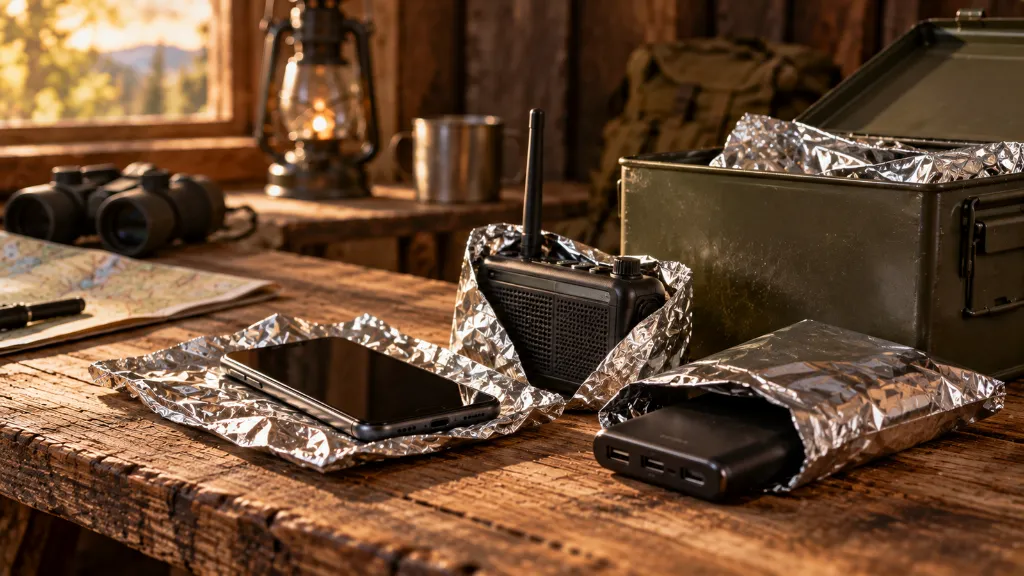
For a spare/backup phone and a backup handheld radio you’re not actively using: cheap insurance for the two devices you’d want working if something knocked out the grid or nearby electronics.
Larger Multi-Device Faraday Bag or Case
Sized to hold a backup radio, a spare phone, a power bank, and a couple of drives together: still not a whole-house solution, a bigger version of the same sensible hedge.
Free Updates
I send an email when something’s genuinely worth your time: a new guide, a real price drop on something I recommend, or an actual safety alert. No spam, no daily digest, unsubscribe anytime.
What’s worth protecting: a quick reality check
Before getting into the physics, here’s the practical checklist: the part most Faraday-bag marketing skips, because “you probably don’t need to protect most of what you own” doesn’t sell bags.
| Device Category | Realistic EMP Vulnerability | Faraday Protection Warranted? | Why |
|---|---|---|---|
| Smartphone in daily use, pocket or charger | Low-to-moderate, changes if actively charging | No, not for your primary daily-use phone | You use it constantly, so it can’t realistically live in a sealed bag. The protection you’d want here is a spare, not your main device |
| Backup/spare phone kept in a drawer, unused | Low intrinsic risk, but cheap to protect | Yes, worth it | Near-zero cost to bag a device you’re not using anyway |
| Laptop in daily use, unplugged and not connected to long cables | Low | No | Small electronics not connected to extended conductors are meaningfully more resistant than doomsday content implies |
| Handheld/backup radio, unused, in storage | Low intrinsic risk, but this is exactly the device you’d want working after a grid disruption | Yes, strongly worth it | Communication gear you’re counting on for an emergency is the highest-value candidate for this kind of cheap insurance |
| Car electronics, engine control modules | Low: modern vehicles are more hardened than prepper content suggests, and this isn’t something you can bag anyway | No, not practically applicable | Not a Faraday-bag use case at all |
| The power grid, transformers, long transmission lines | This is the genuinely vulnerable category | N/A, not a personal-electronics problem | A utility-infrastructure and national-policy issue, not something a bag in your closet addresses |
| External/backup drives with irreplaceable data, unused | Low intrinsic risk, high consequence if lost | Yes, cheap and easy | Reasonable to store protected regardless of cause |
The pattern here is the whole point of this article: the case for Faraday protection is strongest for backup devices you’re not using, kept specifically so they’d survive whatever knocked out other things. It’s weakest for anything you use daily, since you can’t keep your actual phone or laptop sealed in a bag and still use it.
What an EMP is, and what’s realistic versus rare
“EMP” gets used as a catch-all in prepping content, but there are genuinely different scenarios behind the term, and they don’t carry equal probability.
Geomagnetic solar storms. This is the most scientifically plausible large-scale event in this category. The sun periodically ejects charged particles toward Earth, and a severe geomagnetic storm can induce powerful currents in long conductors. The historical reference point people cite is a 19th-century event of the scale sometimes called a Carrington-level storm (NOAA’s Space Weather Prediction Center documents this risk and its history, including the 1989 geomagnetic storm that knocked out Quebec’s grid for nine hours). What a solar storm primarily threatens is large-scale, long-conductor infrastructure. The power grid, transformers, long transmission and pipeline runs, satellites. It is not primarily a threat to your phone sitting in a drawer, and that’s the piece prepping content consistently blurs: a grid-threatening event and a personal-electronics-threatening event are not the same thing.
A nuclear EMP. A high-altitude nuclear detonation generating a broad electromagnetic pulse is a real technical possibility that governments and researchers take seriously. It’s also, for an individual U.S. household, a very low-probability event to prioritize preparing against. It requires a state-level actor with both the capability and intent to use a nuclear weapon in a way that would trigger enormous, immediate geopolitical consequences. It belongs in the category of things worth a passing thought, not something that should drive your household’s preparedness budget or anxiety level.
Localized RF/EMI events. Smaller-scale electromagnetic interference from severe lightning or certain industrial equipment can occasionally damage nearby unprotected electronics: far more localized and far less discussed than the two scenarios above.
The honest ranking, most to least plausible for something that could affect you: a geomagnetic storm affecting grid infrastructure, then ordinary power-grid disruption from storms or equipment failure, then a nuclear EMP, then exotic non-nuclear personal-targeting scenarios. Most preparedness value comes from planning for a power outage in general (which can come from a hurricane, an ice storm, or a geomagnetic event alike) not from EMP specifically as a distinct category.
Pushing back on “an EMP will fry all your electronics instantly”
This claim shows up constantly in prepper content, and it’s an oversimplification that does real damage to people’s ability to prepare sensibly. It either scares people into buying far more Faraday protection than they need, or makes the whole topic sound absurd enough that they dismiss a real underlying risk (grid vulnerability) entirely.
Long conductors are the vulnerable part, not small devices. The physics of EMP coupling favor long, exposed conductive paths: power lines, long antenna runs, extended cabling, the grid itself. A phone in your pocket, not connected to anything, with a short internal circuit path, is a much smaller target for induced current than a mile of transmission line.
Whether a device is connected matters enormously. Electronics plugged into wall outlets, connected to long cables, or hooked up to external antennas are meaningfully more exposed than the same device unplugged and sitting on a shelf.
Modern small electronics are more resistant than prepper content implies. Consumer devices with short internal circuit paths, especially powered off and disconnected from external cabling, are not the low-hanging fruit that a nuclear E1 pulse or grid-scale geomagnetic event is best at damaging. That doesn’t mean zero risk. It means the risk to your phone is a different order of magnitude than the risk to the regional power grid. Testimony from the Congressional EMP Commission has made a similar point: small, self-contained, disconnected electronics are generally far less affected by these events than long-conductor infrastructure.
The grid going down is the actual disaster scenario, not your electronics dying. A severe geomagnetic storm damaging grid transformers and causing an extended regional power outage is the documented, plausible failure mode. A “no power for days or weeks” problem, which your existing emergency preparedness (water, food, light, communication, cash) already addresses. It’s not primarily a “my gadgets stopped working” problem.
Faraday bags vs. cages vs. doing nothing
| Option | What It Actually Protects | Realistic Use Case | Approx. Cost | Effort |
|---|---|---|---|---|
| Phone-sized Faraday bag | One small device: spare phone, small radio, USB drives | A single backup device you’re not actively using | Low: roughly $20–$55 (Faraday Defense’s own cell-phone-size bag runs about $33) | None, just seal it in |
| Larger multi-device Faraday bag or case | Several small-to-medium devices together | A small dedicated backup electronics kit stored together | Moderate: roughly $170–$230 for a single larger bag/case | Low, organize once and leave it |
| Home Faraday cage / whole-room shielding | Large-scale shielding of a space or major equipment | Niche: homelab server protection, ham radio base stations, or a specific documented occupational/regional risk | High: Faraday Defense’s largest product is a DIY box-shielding kit ($110–$200), not a true whole-room solution; genuine whole-room/professional shielding runs $5,000–$10,000+ | High, requires real technical setup and verification |
| Doing nothing | Zero dedicated EMP hedge, relies on devices being off/unplugged when an event occurs, if one ever does | Most households whose actual risk profile doesn’t justify the cost | $0 | None |
For the overwhelming majority of households, the first or second row is the right answer. The third is overkill unless you have a specific, nameable reason (a home radio station, expensive equipment you can’t easily replace). The fourth, doing nothing, is a legitimate, defensible choice too, especially if your emergency budget is better spent on water storage, backup power, or a NOAA weather radio that helps in scenarios far more likely than an EMP.
I’ve carried a Faraday bag myself for exactly this kind of low-effort protection: during my time as a volunteer humanitarian medic in Ukraine, it wasn’t EMPs I was thinking about, it was keeping a spare phone and storage drives secure when digital safety mattered. The same cheap bag doing that job for a U.S. household’s backup phone or drive is the same logic, just a different threat.
The decision framework: what’s worth protecting in your house
Run your own electronics through this filter, in order:
1. Is it something I’m not actively using? A spare phone, an old smartphone kept as backup, a battery-powered radio in a drawer. These cost nothing to bag because you weren’t unplugging and re-plugging them daily anyway.
2. Would I need it during an extended power/communications outage? A backup radio for emergency broadcasts, a spare phone once cell service is patched back together. These have a real “after” use case.
3. Does it have a long conductive path attached: antenna, power cord, external wiring? Higher realistic risk. A device sitting disconnected and self-contained has meaningfully lower realistic risk.
4. Am I about to talk myself into protecting my main devices? Stop here. Your primary phone, your daily laptop, your router are in active use and do you no good sealed in a bag in a closet. Faraday-bagging everyday electronics defeats their purpose.
What this rules out: wrapping your whole house, buying a large cage for a home office, or bagging every device you own “to be safe.” What it supports: a small, deliberate kit (a spare phone, a backup radio, maybe a power bank or a drive with backed-up data) in one or two Faraday bags, layered on top of the preparedness that matters for the far more likely scenario of an extended power outage.
Common misconceptions and oversold claims
“An EMP will instantly destroy every electronic device in range.” No: damage depends heavily on conductor length, connection state, and proximity/intensity. A blanket claim like this is marketing, not physics.
“You need to Faraday-cage your entire house to be safe.” For the vast majority of households, this isn’t a reasonable response to a realistic threat model. It’s expensive and difficult to do correctly, and likely leaves you under-prepared for the much more common cause of extended power loss: ordinary severe weather.
“Your car will die and be stuck on the highway.” Modern vehicle electronics are more resilient to this kind of event than a lot of prepping content suggests, and a car’s metal body also provides real (if partial) natural shielding: Congressional EMP Commission testimony found vehicles were generally not significantly affected in EMP testing, though some researchers note newer solid-state vehicle electronics haven’t been tested to the same degree.
“If you don’t Faraday-protect everything, you’ll have nothing that works afterward.” This conflates a personal-electronics problem with a grid problem. If the grid goes down for an extended period, the bigger issue is power generation and basic supplies, not whether your unused backup phone is shielded.
Bottom line
A geomagnetic solar storm is the most plausible large-scale event in this category, and it mainly threatens grid-scale infrastructure, not your phone. A nuclear EMP is technically real but not a rational top preparedness priority for an individual household. Most small personal electronics are meaningfully more resistant to this kind of event than prepping content suggests, particularly when disconnected from long cables or antennas. Where a Faraday bag genuinely earns its cost: shielding a handful of backup items you’re not actively using (a spare phone, a backup radio, maybe a drive with irreplaceable data) for a few dollars of insurance against a low-probability but real category of risk. Spend the marginal dollar on general power-outage readiness first; add the Faraday bag as the cheap, sensible extra step after that, not as the centerpiece of your plan.
Faraday Defense: Shop Faraday Bags & Cases
Free Updates
I send an email when something’s genuinely worth your time: a new guide, a real price drop on something I recommend, or an actual safety alert. No spam, no daily digest, unsubscribe anytime.
EMP protection is one piece of a broader threat-scenario plan: if CBRN exposure (chemical, biological, radiological, nuclear) is also on your radar, see my MIRA Safety gas mask and CBRN buying guide for what needs protection there too.
FAQ
Will an EMP instantly destroy my phone if it’s in my pocket?
Unlikely to be an instant, guaranteed failure. A phone not connected to a long antenna, cable, or the grid at the moment of the event is a smaller effective target than the “everything dies instantly” framing suggests. It’s not zero risk, but it’s a lower-probability scenario than prepping content often implies.
Is a nuclear EMP attack something I should prepare for?
It’s a real technical possibility, but a low-probability one for an individual household to treat as a top priority. It’s reasonable to have a small, cheap hedge (like a bagged backup radio) without reorganizing your preparedness plan around this specific scenario.
What’s the actual difference between a geomagnetic storm and a nuclear EMP?
A geomagnetic storm comes from solar activity and primarily threatens large-scale, long-conductor infrastructure like the power grid. A nuclear EMP comes from a high-altitude detonation and is a distinct, much lower-probability scenario for ordinary households. (Source: NOAA’s Space Weather Prediction Center and Congressional EMP Commission testimony, both of which draw this same distinction.)
Does my phone need to be in a Faraday bag right now?
No. Your primary, actively used devices don’t benefit from being sealed away, since you need them working day to day. Faraday protection makes sense for backup devices you’re not using anyway.
How do I know a Faraday bag works?
This comes down to build quality and proper sealing, and it’s genuinely hard to verify without real equipment. I’d rather tell you that plainly than make up a number.
The Prep Verdict is reader-supported. If you buy through a link on this page, I may earn a commission at no extra cost to you. See my full disclosure for details. I only recommend products I’d put in my own emergency supplies.