A winter car emergency kit should hold a wool blanket plus a reflective emergency blanket, a dry spare hat, gloves and socks, disposable hand warmers, a small shovel and snow brush, a charged power bank, a headlamp, reflective triangles or LED flares, a bright cloth for the antenna, sand or cat litter, jumper cables, a first aid kit with a tourniquet, a few days of essential medications, water and high-calorie snacks.
Stuck on a snowy highway overnight, hunger isn’t what hurts you. Cold and carbon monoxide are. So I’ve organized this kit by what keeps you alive: 1) stay warm, 2) keep the air safe, 3) call for help, 4) get seen, 5) get unstuck, 6) first aid and meds, 7) food and water. On a tight budget, buy from the top down.
I’m a medic and first aid instructor. This kit follows NHTSA, National Weather Service and CDC guidance. My product picks come from published specs and merchant information, not hands-on testing.
Reader-supported: I may earn a commission if you buy through links on this page, at no extra cost to you. Disclosure.
Quick Verdict: The Three Winter Car Kit Buys That Matter Most
Priority #1. Real insulation at 64 x 88 in, 80% wool, and the maker says it stays warm even when wet. Check Amazon for the price.
Priority #3. 19,200 mAh, 60W USB-C, IP67 waterproof, about 5 phone charges per Goal Zero. Phone power with the engine off. $119.95.
Priority #6. NHTSA’s kit list says “first aid kit, including tourniquet.” Buy the real one, not the blue trainer. $34.99.
Free Updates
I send an email when something’s genuinely worth your time: a new guide, a real price drop on something I recommend, or an actual safety alert. No spam, no daily digest, unsubscribe anytime.
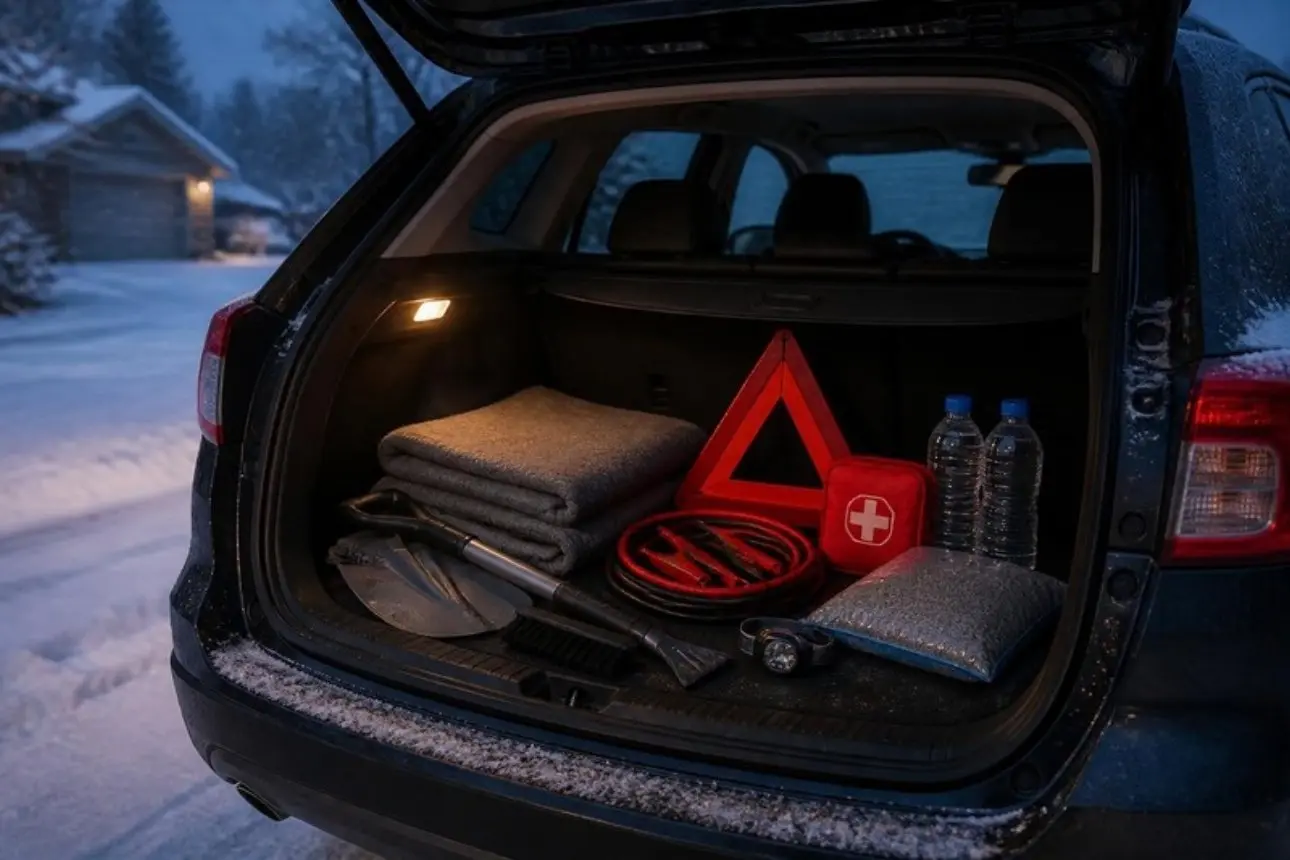
The Complete Winter Car Kit, in Priority Order
Most kit lists give 20 items equal weight. In first aid, you handle what kills fastest first, and a stranded car is no different. Warmth works whether or not the engine runs. Running the engine brings carbon monoxide risk. A phone gets help moving. Food and water matter over days, not hours, so they come last.
Linked items are my picks. The rest are basics from any hardware or auto parts store, with rough cost estimates.
| Item | Why it matters | What I’d buy / where | Approx. cost |
|---|---|---|---|
| 1. Warmth: wool blanket | Real insulation, warm even when damp | Arcturus Wool Blanket | Check Amazon |
| 1. Warmth: reflective layers | Block wind and hold heat over the wool | Arcturus All-Weather Survival Blanket; a North American Rescue Survival Wrap per passenger | Check Amazon; $8.99 each |
| 1. Warmth: spare hat, gloves, socks; hand warmers | Wet clothing pulls heat away fast | Your closet; disposable warmers from any store | A few dollars |
| 2. Air: folding shovel and snow brush | Keep the tailpipe clear of snow | Any hardware or auto parts store | About $30 to $50 with scraper and litter |
| 3. Help: power bank and phone cable | Phone power when the engine is off | Goal Zero Venture 75 | $119.95 |
| 3. Help: headlamp; paper map | Hands-free light; directions with no signal | Zippo HeatBank 6 + Headlamp Set, or any headlamp | $49.95 |
| 4. Seen: triangles or LED flares; bright red cloth | Warn traffic and signal for help | Any auto parts store | Roughly $20 to $40 |
| 5. Unstuck: sand or cat litter, ice scraper | Traction and clear windows | Any hardware or auto parts store | In the $30 to $50 above |
| 5. Unstuck: jumper cables or jump starter; tow strap | Cold drains batteries; a helper can pull you out | Any auto parts store | Cables roughly $20 to $40 |
| 6. Medical: first aid kit | Crash and fall injuries | Adventure Medical Kits Mountain Series Explorer, or a kit you own | $86.49 |
| 6. Medical: tourniquet | Severe bleeding; NHTSA lists it | C-A-T Tourniquet | $34.99 |
| 6. Medical: essential medications | A few days’ supply | Your pharmacy | Varies |
| 7. Food/water: water, high-calorie snacks | Hydration and fuel for body heat | Any store; keep in the cabin | About $10 to $15 |
Not sure how this differs from an evacuation bag? My car emergency kit vs. bug-out bag guide explains it.
1. Stay Warm: Blankets, Dry Layers and Hand Warmers
Warmth comes first because it works with the engine off. If you’re low on gas or worried about carbon monoxide, insulation carries you through the night.
The Arcturus Wool Blanket is the best warmth buy for a car. At 64 x 88 inches, it wraps an adult or covers two kids in the back seat. It is 80% wool and 20% synthetic, and the maker says it stays warm even when wet, which matters when snow melts off your coat in a cold car. It’s the first thing I’d buy.
Reflective blankets are layers on top of the wool, not substitutes for it.
- Arcturus All-Weather Survival Blanket: 60 x 82 inches (about 5 x 7 feet), a three-layer reflective blanket with grommets. A windbreak, ground cover or outer layer over the wool.
- North American Rescue Emergency Survival Wrap ($8.99): 96 x 60 inches and 3.7 oz, wind- and waterproof, reversible orange and silver so rescuers can spot it. One per passenger.
- SOL Emergency Bivvy with Rescue Whistle ($19.99): a reusable, body-length bag in rescuer-visible orange, for anyone who has to wait or walk outside.
My emergency blanket guide compares these in depth.
Dry layers are the cheapest item that works hardest. After digging around a car, your gloves and socks are probably soaked, and wet clothing pulls heat away fast. A spare hat, gloves and wool socks sealed in a zip bag cost almost nothing from your closet.
If you want to spend on one upgrade, make it a base layer. Woolpower, a Swedish maker, sells merino wool base layers in a lighter LITE weight for milder weather and a warmer Ullfrotté 200 weight for cold weather, and you can browse the Woolpower base layers (affiliate link) to compare. They’re premium pieces (200-weight tops were listed at roughly $127 to $182 on October 15, 2026), so treat them as an upgrade over the closet items above, not a requirement. I haven’t tested them, so this is a pointer, not a review.
Hand warmers: disposables for the car. They need no charging, run up to about 10 hours and keep until you check the printed date. My rechargeable vs. disposable hand warmers guide covers the trade-off.
2. Keep the Air Safe: Carbon Monoxide
When a car sits in deep snow, the tailpipe can get buried, and running the engine can push exhaust into the cabin. Carbon monoxide has no color or smell. Early signs are headache, dizziness, nausea and confusion, which are easy to blame on stress or cold.
The kit items here are a compact shovel and snow brush to clear the tailpipe. The rest is habit:
- Clear the tailpipe before starting the engine, and every time after. Blowing snow can rebury it.
- Run the engine in short bursts, about 10 minutes each hour, per the National Weather Service.
- Crack a window a little, ideally on the side away from the wind.
- Never run it for long with the windows up or in an enclosed space, as NHTSA warns.
If anyone gets a headache, dizziness, nausea or confusion with the engine running, shut it off, open a window and call emergency services. This is why warmth is #1: better insulation means less engine time.
3. Call for Help: Phone Power and Light
Your phone is your lifeline to emergency services, roadside assistance and road reports. A car charger only works while the engine runs, and you’ll run it in short bursts. The Goal Zero Venture 75 ($119.95) fills that gap: 19,200 mAh, up to 60W over USB-C and IP67 waterproof. Goal Zero says it gives about 5 smartphone charges.
One caution: lithium batteries lose capacity in deep cold. Keep it in the cabin, bring it inside during extreme cold snaps and top it up monthly.
A headlamp frees both hands for changing a tire at night. The Zippo HeatBank 6 + Rechargeable Headlamp Set ($49.95) pairs a 100-lumen headlamp with a HeatBank 6 hand warmer (up to 6 hours, up to 120°F) that doubles as a 4,400 mAh power bank. The catch: rechargeables must be kept charged. For cabin light, the LuminAID PackLite Nova ($33) is an optional solar inflatable lantern that recharges on the dash in daylight and never touches the car battery. Add a paper map; it works with no signal.
4. Get Seen
Visibility helps rescuers find you and keeps plows from hitting you.
- Reflective triangles or LED road flares. NHTSA lists warning devices like flares and emergency markers.
- A bright cloth, preferably red, tied to the antenna or a door, as the NWS recommends.
- The dome light at night. NHTSA and the NWS both suggest it; the NWS ties it to when the engine is running.
- The orange bivvy if someone has to be outside.
5. Get Unstuck
Plenty of winter emergencies end with you rocking the car loose and driving home.
- Folding shovel: clear snow around the tires.
- Snow brush and ice scraper: you need clear windows to drive out.
- Sand or non-clumping cat litter: spread it at the drive wheels for traction. A folding shovel, scraper and a bag of litter run about $30 to $50 together.
- Jumper cables or a portable jump starter: cold makes engines need more battery power to start. The NOCO Boost GB40 is rated for gas engines up to 6.0 liters and diesels up to 3.0 liters, so check your engine size against whatever unit you buy.
- Tow strap: lets a helper pull you out.
Shoveling heavy snow is hard work, and NHTSA’s own advice is not to overexert yourself. Work in short sets and rest often. If you have a heart condition, be especially careful. If it isn’t working, stop, get back in the car and call for help.
6. First Aid and Medications
A slide off the road or a fall on ice can mean real injuries. NHTSA’s kit list specifically says “first aid kit, including tourniquet.”
The Adventure Medical Kits Mountain Series Explorer ($86.49) covers everyday injuries for one to four people. But it does not include a tourniquet. If you already own a decent first aid kit, use it and put the money toward the tourniquet.
The C-A-T Tourniquet ($34.99, made by North American Rescue, sold by Mountain Man Medical) is CoTCCC-approved, the only kind I recommend. Mountain Man Medical also sells a blue trainer version. Buy the real one, not the blue trainer. A tourniquet works best when you’ve practiced with it, which is what I teach in Stop the Bleed. Near Vancouver, WA or Portland, OR? See my first aid classes. Want a ready-made kit instead? My Sweetwater vs. Yellowstone comparison covers which one to buy.
Check Price at Mountain Man Medical
Medications: NHTSA and the NWS both list medicines. Keep a few days of anything essential in the cabin and check the dates when you check the kit.
7. Food and Water in Freezing Temps
Food and water come last because cold and carbon monoxide act faster. Still, calories help your body make heat.
- Water in the cabin, not the trunk, where it freezes. Leave room in each bottle for expansion. An insulated bottle helps.
- High-calorie, no-cook snacks like the NWS’s examples: peanuts, hard candy and raisins.
- A tin can for melting snow into water, also on the NWS list. It’s a backup, not a plan.
What It Costs: Three Kit Tiers
Each tier follows the priority order. Linked prices were verified in October 2026; generic costs are rough.
| Tier | What’s in it | Approx. total |
|---|---|---|
| Starter | Arcturus wool blanket (check Amazon) + 2 survival wraps ($17.98) + shovel, scraper and cat litter (about $30 to $50) + closet layers, hand warmers, a red cloth, water and snacks | Linked gear $17.98 plus the blanket; roughly $48 to $68 plus the blanket, before warmers and snacks |
| Solid | Starter + Goal Zero Venture 75 ($119.95) + C-A-T ($34.99) + a first aid kit you already own | Linked gear $172.92 plus the blanket; roughly $203 to $223 plus the blanket |
| Complete | Solid + Mountain Series Explorer ($86.49) + Arcturus survival blanket (check Amazon) + HeatBank 6 + Headlamp Set ($49.95) + jumper cables and triangles or flares | Linked gear $309.36 plus the two blankets; roughly $380 to $440 plus the two blankets |
The Starter tier covers the first two priorities, the ones that keep people alive. Build up from there.
If You Get Stranded: Step by Step
This follows NHTSA and National Weather Service advice. Say you slide into a snowbank on a rural highway at 9 p.m.:
- Stay with your car. It’s shelter, and it’s easier to find than a person on foot.
- Call for help, give your location, then save your battery.
- Tie a bright cloth to the antenna or door. Set out triangles or flares if it’s safe.
- Clear the tailpipe before every engine run.
- Run the engine about 10 minutes each hour for heat, with a window cracked a little.
- Turn on the dome light at night while the engine runs.
- Bundle up: wool blanket, reflective layer over it, dry hat, gloves and socks. Huddle together.
- Move your arms, legs, fingers and toes vigorously from time to time, as the NWS advises, to keep blood moving.
- Don’t overexert yourself. Sweat soaks clothes, and wet clothes steal heat.
Sources: NHTSA’s winter driving tips and the NWS winter driving safety page.
Hypothermia and Frostbite: The Medic’s Section
The CDC lists these hypothermia warning signs in adults: shivering, exhaustion, confusion, fumbling hands, memory loss, slurred speech and drowsiness. In infants: bright red, cold skin and very low energy.
- Warm the center of the body first: chest, neck, head and groin.
- Below 95°F body temperature, get medical help now. Call emergency services.
- Confused, drowsy people rarely notice it in themselves. Check on each other.
For frostbite, the CDC’s advice is mostly don’ts:
- Don’t rub or massage it.
- Don’t use heating pads, heat lamps, fireplaces, radiators or stoves on numb skin. Numb skin can’t feel a burn, so don’t press a hand warmer onto it either.
- Get medical care.
More in the CDC’s hypothermia and frostbite guidance.
Before the First Snow: Car Prep Checklist
- Tire pressure: check monthly against the driver’s door-jamb label, not the tire sidewall.
- Tread depth: at least 2/32 inch, per NHTSA.
- Battery: cold makes engines need more battery power to start. Have the battery and charging system checked.
- Coolant: check the level.
- Gas: keep the tank near full. The NWS says it helps avoid fuel line icing, and it’s fuel for heat if you’re stranded.
- Wipers and washer fluid: fresh blades and fluid rated for freezing temperatures.
What to Skip
- Candles in a closed car. Some older lists include them. Use a headlamp or LED lantern instead.
- Cheap “all-in-one” roadside kits padded with filler. Many pad the piece count with small bandages and gadgets while skipping real insulation, phone power and a tourniquet. Build from the priority list.
- Water in the trunk. It freezes.
- Engine heat without clearing the tailpipe. That’s how carbon monoxide gets in.
- Foil blankets as your only warmth, or a blue trainer tourniquet in your real kit.
Where to Pack It and When to Check It
If the trunk is frozen shut or the back of the car is buried, anything you need to survive that night belongs in the cabin.
- Cabin (under or behind a seat): blankets, spare layers, hand warmers, power bank, headlamp, first aid kit and tourniquet, medications, water, snacks and the compact shovel if it fits.
- Trunk: cat litter, jumper cables, tow strap and triangles or flares.
Want this as a list you can check off and print? Use my free car emergency kit builder.
Check the kit twice a year; the daylight saving time changes make an easy reminder. Swap water and snacks, check medication and hand warmer dates and replace what you used. Top up the power bank monthly in winter.
For home, see my power outage emergency kit and how to stay warm without power. For evacuation, there’s the 72-hour go bag list.
Free Updates
I send an email when something’s genuinely worth your time: a new guide, a real price drop on something I recommend, or an actual safety alert. No spam, no daily digest, unsubscribe anytime.
FAQ
What should be in a car winter emergency kit?
Start with warmth: a wool blanket, a reflective blanket, spare hat, gloves and socks, and hand warmers. Then add a shovel, a power bank, a headlamp, triangles or flares, a bright cloth, cat litter, jumper cables, a first aid kit with a tourniquet, essential medications, water and snacks.
What to carry in your car for winter driving?
Carry that kit plus a charged phone and charger cable, a snow brush and ice scraper, and a near-full gas tank. Keep survival items in the cabin in case the trunk freezes shut.
How long can you run your car for heat if stranded?
The National Weather Service suggests about 10 minutes each hour. Clear snow from the tailpipe first and crack a window a little to reduce the risk of carbon monoxide poisoning.
Should you stay in your car if stranded in snow?
Yes. NHTSA and the National Weather Service both say to stay with your vehicle, which is shelter and easier for rescuers to find. Tie a bright cloth to the antenna and don’t overexert yourself.
Is it safe to keep water in your car in winter?
Yes, but keep it in the cabin, not the trunk, where it freezes. Leave room in each bottle for expansion.
Do I need a tourniquet in my car kit?
NHTSA’s winter kit list specifically includes a “first aid kit, including tourniquet.” Choose a CoTCCC-approved model like the C-A-T; many first aid kits don’t include one.
The Prep Verdict is reader-supported. If you buy through a link on this page, I may earn a commission at no extra cost to you. See my full disclosure for details. I haven’t hands-on tested every product named here; picks are based on published specs, merchant information and my medic training. I only recommend products I’d put in my own emergency supplies.