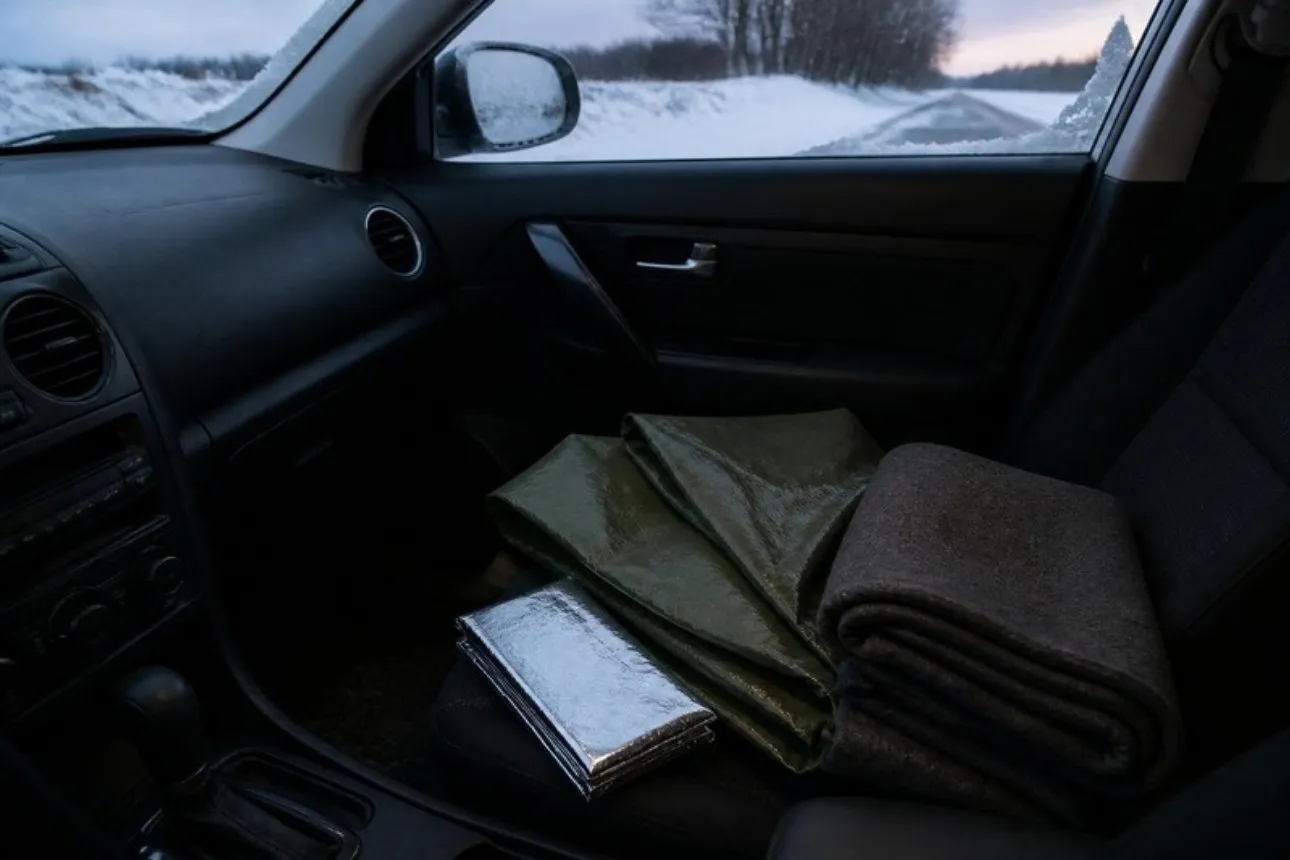
Picture an ordinary winter night. Your car has slid into a snowbank on a back road. Nobody’s hurt, and the tow truck is about 90 minutes out. In the glovebox is a little foil packet you bought years ago. Will it help?
Do emergency blankets work? Yes, with limits. A mylar “space blanket” reflects the heat your body radiates back toward you and stops wind and rain from stripping heat away. That’s real, and it can matter a lot when someone is cold, wet and stuck. What it doesn’t do is insulate. It won’t stop the cold ground from pulling heat out of you, and on its own it won’t rewarm someone who is already very cold.
So think of an emergency blanket as a barrier layer, not a heater. Paired with real insulation underneath and around the person, it’s one of the cheapest, most useful things you can pack.
The next question is which one to buy, and the honest answer depends on the job. Below: three quick questions to narrow it down, a head-to-head comparison of nine options, then how to use one the right way.
Reader-supported: I may earn a commission if you buy through links on this page, at no extra cost to you. Disclosure.
Quick Verdict: The Best Emergency Blanket for Most People
Reusable, waterproof and windproof, about 5 x 7 ft, with four grommets. Doubles as a ground cover or windbreak. The one I’d put in a car or home kit.
Eight mylar sheets for $19.99, about $2.50 each. Enough to put one in every kit, car and backpack. Need just one sturdier sheet? The North American Rescue Emergency Survival Wrap is $8.99.
A breathable sleeping-bag shape ($47.99) that lets moisture escape, so you wake up less damp than in a foil sheet. Also works as a sleeping bag liner.
Free Updates
I send an email when something’s genuinely worth your time: a new guide, a real price drop on something I recommend, or an actual safety alert. No spam, no daily digest, unsubscribe anytime.
Three Questions Before You Buy
- Will you be on the ground? Cold ground pulls heat out of you through direct contact, and a thin foil sheet does almost nothing to stop that. If the answer is yes, you need something underneath you as well as a blanket.
- For how long? For minutes to a few hours, a basic foil sheet is fine. Overnight or longer, condensation builds up inside non-breathable foil, and a breathable bivvy or real insulation starts to earn its price.
- Will you reuse it, or give it away? Thin mylar sheets are cheap and essentially single-use. If you’ll unfold it more than once, or hand it to someone at a crash scene, buy accordingly.
Emergency Blankets Head to Head: The Comparison Table
There are really four kinds of “emergency blanket”: thin mylar sheets, heavier reusable reflective blankets, bivvies (a reflective sleeping-bag shape), and plain insulating blankets. They do different jobs. Prices were checked in October 2026, and the heat-reflection figures are the makers’ own claims.
| Blanket | Type | Cost | Reusable? | Breathable? | Real insulation? | Best job |
|---|---|---|---|---|---|---|
| North American Rescue Emergency Survival Wrap | Laminated polyethylene and Mylar sheet | $8.99 | Not stated by the maker | No | No | First aid kit, glovebox, a single sturdier spare |
| P4X Mylar Emergency Blanket 8 Pack | Mylar sheet (thicker than most, per the maker) | $19.99 for 8 (about $2.50 each) | Treat as single-use | No | No | Stocking every kit and every family member |
| Arcturus Insulated Tarp | Heavy-duty reflective blanket | Check Amazon | Yes | No | No | Car kit, home outage kit, ground cover, windbreak |
| SOL Sport Utility Blanket | Heavy-duty reflective blanket with grommets | Check Amazon | Yes | No | No | Sidelines, camping, a rigged shelter or wearable cape |
| SOL Emergency Bivvy with Rescue Whistle | Reflective bivvy (sleeping-bag shape) | $19.99 | Yes (SOL says it resists tears and handles multiple uses) | No | No | Day hikes and go bags: wraps your whole body |
| SOL Escape Lite Bivvy | Breathable bivvy with hood | $47.99 | Yes (also a sleeping bag liner) | Yes | No | Sleeping in it for a night; less condensation |
| SOL Escape Bivvy with Hood | Breathable bivvy, quiet fabric | $82.49 | Yes (tear-resistant) | Yes | No | Repeated nights out; no crinkle noise |
| Stansport Wool Blend Camp Blanket | Wool-blend blanket | $38.99 | Yes | Yes | Yes | The car blanket: real warmth, even when damp |
| BattlBox “Bubbie” Poncho Liner Blanket | Synthetic quilt that zips into a sleeping bag | $39.99 | Yes | Yes (fabric quilt) | Yes | Packable insulation for a go bag or vehicle |
The pattern to notice: nothing reflective in this table is real insulation. The best setups pair something from the top with something from the bottom, like a wool blanket plus an Arcturus Insulated Tarp in the trunk.
Each Row Explained: Which Blanket for Which Job
Mylar sheets: North American Rescue Emergency Survival Wrap and P4X 8 Pack
This is the classic silver “space blanket.” The North American Rescue Emergency Survival Wrap is 96 x 60 inches and weighs 3.7 ounces. It’s laminated polyethylene and Mylar rather than a bare foil sheet, wind- and waterproof, and reversible: orange on one side for visibility, silver on the other. North American Rescue is the trauma-supply company that sells the C-A-T tourniquet, and at $8.99 this is the one I’d put in a first aid kit or glovebox.
The P4X 8 Pack gives you eight 82 x 50 inch sheets for $19.99. P4X describes them as waterproof, windproof and thicker than most, and says they reflect up to 90% of body heat. This is the value play if you’re stocking a household: one per car, one per backpack, a few in the outage bin.
The tradeoffs are the same for both: thin foil tears, crinkles loudly and doesn’t breathe. Once you’ve used one, replace it.
Check Price: P4X Mylar Emergency Blanket 8 Pack
Heavy-duty reusable: Arcturus Insulated Tarp
If you only buy one emergency blanket, I’d make it the Arcturus Insulated Tarp. It’s reusable, waterproof and windproof, roughly 5 x 7 feet (Arcturus lists 60 x 82 inches), and weighs about 1.4 pounds. Arcturus says it reflects up to 90% of body heat, and it has four grommets.
The bigger size matters. A standard mylar sheet barely wraps an adult; this one can go under a person as a ground cover, over them as a wind and rain shell, or up as a windbreak. Because it’s reusable, it’s the better fit for a car or home outage kit you might open more than once. The trade-off is weight: at about 1.4 pounds it is heavier than a foil sheet.
Check Price: Arcturus Insulated Tarp
Heavy-duty with grommets: SOL Sport Utility Blanket
The SOL Sport Utility Blanket is the one for people who’ll use a blanket outdoors often: cold bleachers, camping, sitting out a long wait. SOL says the metallized interior reflects up to 80% of radiant body heat. It’s waterproof, windproof, tear- and puncture-resistant and reusable.
You’re paying for the extras: metal grommets for a shelter, windbreak or ground tarp, a shoulder clasp to wear it as a cape, and a stuff sack with a whistle and tinder-cord drawstring. Without those needs, the Arcturus Insulated Tarp does the core job.
Bivvies: SOL Emergency Bivvy with Rescue Whistle
A bivvy is a reflective sheet sewn into a sleeping-bag shape. That solves the biggest practical problem with flat blankets: they come open. In wind, or once you fall asleep, a flat sheet slides off and leaves gaps. A bag doesn’t.
The SOL Emergency Bivvy ($19.99) is orange for visibility, 84 x 36 inches, 3.8 ounces, and packs smaller than a soda can. SOL says it reflects up to 90% of body heat and lists it as waterproof and windproof with sealed seams. The stuff sack has a whistle and a tinder-cord drawstring. It’s a strong pick for a day pack or a 72-hour go bag, where weight and space count. Like any non-breathable foil, expect condensation inside if you’re in it for hours.
Breathable bivvies: SOL Escape Lite and SOL Escape Bivvy
The Escape line exists to fix condensation. Instead of solid foil, SOL uses a fabric that lets moisture vapor escape, so sweat doesn’t collect on the inside. The trade is a little less reflection, by SOL’s own numbers.
- SOL Escape Lite Bivvy ($47.99): SOL says it reflects up to 70%. Water-resistant, integrated hood, 82 x 32 inches, 5.5 ounces. It can also serve as a sleeping bag liner, so it earns its space outside of emergencies.
- SOL Escape Bivvy with Hood ($82.49): SOL says it reflects 70% of radiated body heat. It uses SOL’s ThermaShell fabric, which is vapor-permeable, quiet (no crinkle), tear-resistant, water-resistant and windproof. 84 x 31 inches with an adjustable hood.
Worth the money if you can picture spending a night in it. For a just-in-case glovebox item, a foil bivvy or the Arcturus Insulated Tarp is enough.
Check Price: SOL Escape Lite Bivvy
Real insulation: Stansport Wool Blend and the BattlBox Bubbie
These aren’t reflective at all. They’re the insulation half of the system that the reflective blankets need.
The Stansport Wool Blend Camp Blanket ($38.99) is 60 x 80 inches, 55% wool and 45% synthetic, and water-repellent. Wool keeps some warmth even when it’s wet, which is exactly why it’s my answer to “what blanket should live in my car?”
The BattlBox “Bubbie” ($39.99) is a poncho-liner style quilt with an added zipper, so it converts into a sleeping bag or a liner. It has a ripstop polyester shell, polyester batting, corner ties and a carry bag. It packs smaller than a wool blanket, which makes it a better fit for a pack.
What you wear under the blanket matters too. Woolpower, a Swedish maker, sells merino wool base layers in a lighter LITE weight for milder weather and a warmer Ullfrotté 200 weight for cold weather, and you can browse the Woolpower base layers (affiliate link) to compare. They’re a splurge (200-weight tops were listed at roughly $127 to $149 when I checked), and I haven’t tested them, so consider this a pointer rather than a review.
Not sure which mix your kit needs? My find your kit quiz walks you through it.
How Emergency Blankets Work
Your body loses heat four main ways. Here’s what a reflective blanket does about each:
- Radiation: your body gives off infrared heat, like a warm stove you can feel from across the room. The metallized film reflects much of that back toward you. This is the “space” part of a space blanket.
- Convection: moving air carries heat away. Wind is the big one. A solid sheet blocks wind, and that’s often where most of the benefit comes from.
- Conduction: heat flows directly into anything colder you’re touching, like the ground, a wet rock or a car seat. A thin sheet barely slows this. Heat conducts right through it.
- Evaporation: wet skin and wet clothes lose heat fast. A waterproof sheet keeps rain and snow off, which helps, but it also traps your own sweat inside.
The open physics textbook Body Physics by Lawrence Davis has a “Space Blankets” chapter that works through a windy-day example. Its conclusion is the practical one: the blanket mostly helps by stopping wind-driven convection and reflecting radiation, while conduction losses remain.
The medical literature is more skeptical. A 1997 literature review by Chadwick and Gibson in Accident and Emergency Nursing concluded that space blankets on their own offer limited benefit for warming a cold patient, because most heat loss is by convection. Their main value is as a wind and moisture barrier. That tells you how to use it.
What Emergency Blankets Don’t Do
- They don’t insulate you from the ground. Lie on frozen dirt or snow with only a foil sheet under you and the ground will keep pulling heat out of you. You need something thick underneath: a foam pad, a backpack, a coat, cardboard, even a pile of dry leaves or branches.
- They don’t make heat. A blanket can only hold in heat the person is making. Someone who is already very cold and has stopped shivering isn’t making much, and a foil sheet alone won’t fix that.
- They trap moisture. A non-breathable foil sheet holds in sweat and vapor, so the inside gets damp over longer use. That’s the main reason SOL makes its breathable Escape line.
- Thin ones are fragile. Cheap mylar tears easily, especially at fold lines or once it snags. Plan on one use.
- They’re loud. Foil crinkles with every move, which makes sleep harder.
For a home power outage, these same limits apply. My guide to how to stay warm without power shows how to layer a reflective blanket between regular blankets, with padding under you, so you get the benefit without the downsides.
Which Side of an Emergency Blanket Faces In?
On a blanket that’s metallized on only one side, the shiny reflective side goes toward your body to keep heat in. That’s the side doing the work of reflecting your radiant heat back.
On a plain mylar sheet that’s silver on both sides, like most cheap foil blankets, it matters very little which way you wrap it.
Colored outer sides are about being seen, not warmth. Orange (like the SOL Emergency Bivvy) helps rescuers spot you. Green or tan blends in. Neither color changes how warm you’ll be.
How to Use an Emergency Blanket Properly: The Hypothermia Wrap
The Wilderness Medical Society’s hypothermia guidelines (2019 update) put it simply: “Insulation and vapor barrier from the ground and elements are key to all hypothermia treatment.” For mild hypothermia, they call for “insulation and a vapor barrier, especially for the head and neck and between the patient and the ground.”
That’s the idea behind what’s often called a hypothermia wrap, or “burrito.” Build it from the ground up:
- Get them off the ground first. Put the thickest insulation you have underneath: a foam pad, packs, coats, cardboard, a car seat cushion. It’s the step people most often skip, and it’s the one that matters most.
- Wrap real insulation around the person. A sleeping bag, a wool blanket, a quilt, dry coats. This is the layer that holds warmth.
- Add the barrier layer. Wrap the emergency blanket or bivvy around the insulation to stop wind, rain and snow. Tuck it in so the wind can’t get underneath.
- Cover the head and neck. Pull a hood, hat or a corner of the blanket over the head, leaving the face clear to breathe.
- Get them somewhere warm and get help if they show hypothermia signs (see below).
What about wet clothes? According to the WMS guideline as summarized by American Family Physician (2020), “Wet clothes should not be removed until the patient is in a warm environment.” Wrap them, get them sheltered, then change them.
First aid is easier to remember once you’ve practiced it with your hands. If you’re near Vancouver, WA or Portland, OR, I teach hands-on first aid and Stop the Bleed classes.
Where to Keep Emergency Blankets
The American Red Cross survival kit guidance says to “pack a first aid kit, emergency blankets, flashlights, and a battery-powered radio to stay safe, warm, and informed.” Here’s how I’d spread them out:
- Car: one Arcturus Insulated Tarp plus a wool blanket. If you’re stranded in winter, you’ll have both the insulation and the barrier. More on this in my car emergency kit vs. bug-out bag comparison.
- Go bag: a SOL Emergency Bivvy or an Escape Lite Bivvy. Small, light and it wraps your whole body. See my 72-hour go bag list.
- Home outage kit: a couple of reusable reflective blankets to layer under regular bedding, plus a few mylar sheets as spares.
- First aid kit: one individually wrapped mylar sheet. It’s light enough that there’s no reason to skip it.
- Kids and family: one per person in the family kit, and a mylar sheet in each older kid’s school or day pack if they carry one.
Safety Note for Babies and Toddlers
Like any thin plastic sheet, mylar and foil emergency blankets are a suffocation risk for babies and toddlers. Keep them out of reach, and never use one as crib bedding. For keeping little ones warm, see my family and kids preparedness guide.
Looking for an “Emergency Fire Blanket”? That’s a Different Product
If you searched “emergency blanket” and meant the kind you keep by the stove, that’s a fire blanket, and it’s not a warmth product at all. A fire blanket is made of fire-resistant material for smothering a small cooking fire. The SOL Emergency Fire Blanket, for example, is 100% flame-retardant fiberglass, 47 x 70 inches, and is meant for grease and cooking fires, not electrical fires.
Signs of Hypothermia and When to Get Medical Help
An emergency blanket buys time. It isn’t treatment for someone who is getting worse. Know the warning signs the CDC lists:
- Adults: shivering, exhaustion, confusion, fumbling hands, memory loss, slurred speech, drowsiness.
- Infants: bright red, cold skin and very low energy.
- If body temperature is below 95°F, get medical attention immediately.
Confusion and drowsiness are the ones people miss. A cold person who gets quiet, clumsy or “just tired” needs attention, not a nap.
Frostbite: the CDC says not to use a heating pad, electric blanket, fireplace, heat lamp, radiator or stove on numb skin. Numb skin can’t feel a burn. If someone has frostbite or hypothermia signs, call emergency services or get them to medical care.
Free Updates
I send an email when something’s genuinely worth your time: a new guide, a real price drop on something I recommend, or an actual safety alert. No spam, no daily digest, unsubscribe anytime.
FAQ
Do emergency thermal blankets really work?
Yes, as a barrier. They reflect radiant body heat and block wind and rain, which can make a real difference to someone cold and exposed. They don’t insulate, so they work best wrapped over real insulation with padding underneath. A 1997 review found that on their own they offer limited benefit for warming a cold patient.
How do emergency blankets work?
The metallized film reflects your body’s infrared heat back toward you, and the solid sheet stops wind and rain. Heat still conducts through it, so it does little against cold ground.
Which side of an emergency blanket faces in?
If only one side is shiny, the shiny side faces your body. If both sides are silver, it makes little difference. Orange or green outer sides are for visibility, not warmth.
What is better than a mylar blanket?
For durability, a reusable heavy-duty blanket like the Arcturus Insulated Tarp. For staying covered while you sleep, a bivvy. For less condensation, a breathable bivvy like the SOL Escape Lite. For actual warmth, real insulation such as a wool blanket, with a reflective layer over it.
What is the best blanket for extreme winter conditions?
No single foil sheet. In serious cold you want real insulation (a sleeping bag or a wool blanket), thick padding under you, and a windproof, waterproof barrier like a reflective blanket or bivvy over the top, with your head covered.
What blankets do EMTs use?
It varies by service and by situation. Whatever is in the rig, the principle is the one in this guide: get the person off the cold surface, add insulation, then a barrier against wind and wet, and cover the head.
What’s the best emergency blanket for a car?
Pair a reusable reflective blanket like the Arcturus Insulated Tarp with a real insulating blanket like the Stansport Wool Blend. Together they cover wind, wet and cold.
The Prep Verdict is reader-supported. If you buy through a link on this page, I may earn a commission at no extra cost to you. See my full disclosure for details. I haven’t hands-on tested every product named here; picks are based on published specs, merchant information and my medic training. I only recommend products I’d put in my own emergency supplies.