Hurricane Isaias made landfall near Destin, Florida, on the evening of Friday, October 9, and has weakened to a post-tropical cyclone over Alabama, but for a lot of people in its path the bigger risk comes after the wind. The National Hurricane Center expects 4 to 8 inches of rain across southern Alabama, the Florida Panhandle and Big Bend, and southwest Georgia, with isolated totals up to 15 inches. The coastal Carolinas could see 3 to 5 inches (locally 8), and much of the rest of the Southeast 1 to 3 inches. NHC says flash and urban flooding is likely across the region, and river flooding is expected, some of it significant.
If you’re in the path of this system, or you want a real plan in place before the next one shows up, here’s exactly what to do (before, during, and after a flash flood) and what’s worth having on hand. I’ve built this as a tiered checklist on purpose: you don’t need to buy everything at once, and you don’t need to already own a bunker’s worth of gear to meaningfully improve your odds this week.
Reader-supported: I may earn a commission if you buy through links on this page, at no extra cost to you. Disclosure.
Quick Verdict: If You Only Do Two Things Before This System Reaches You
Flash flooding is one of the fastest ways your tap water can end up under a boil-water advisory. A hand-pump filter that pulls out bacteria, protozoa, and sediment gives you a fallback that doesn’t depend on the grid staying up or the store shelf staying stocked.
Flash flood events routinely take out power alongside the water: downed lines, substation flooding, utility crews who can’t reach the area. A portable power station keeps your phone, a lantern, and a router or modem alive without running a generator in weather like this.
Free Updates
I send an email when something’s genuinely worth your time: a new guide, a real price drop on something I recommend, or an actual safety alert. No spam, no daily digest, unsubscribe anytime.
What’s Happening Right Now
As of the National Hurricane Center’s final advisory on Isaias, 4 a.m. CDT on Saturday, October 10 (the Weather Prediction Center now issues updates):
- Where the worst flooding is expected: 4 to 8 inches of rain through the weekend across southern Alabama, the Florida Panhandle and Big Bend, and southwest Georgia (locally up to 15), with considerable flooding impacts likely there. Much of the rest of the Southeast can expect 2 to 5 inches (locally up to 10), with considerable flash flooding and landslides possible in the Southern Appalachians.
- When: now through the weekend, as the storm moves across Alabama into the Tennessee Valley on Saturday and Sunday. Rivers can keep rising for days after the rain stops.
- Already flooded? My what to do after a flood checklist covers re-entry safety, private wells, and which food to throw out.
- On the coast? My hurricane preparedness checklist has a recap of Isaias and the final NHC update.
Why inland flooding catches people off guard
- Rivers crest after the rain stops. River flooding can peak a day or more after the storm has moved on, so a dry Sunday doesn’t mean the water is done rising. You can check the river gauge nearest you at water.noaa.gov.
- Most flood deaths happen in vehicles. The National Weather Service says more than half of flood drownings happen when someone drives into flood water. A road you drive every day can be washed out under water you can’t see through.
- Wet ground brings trees down. Saturated soil and gusty wind topple trees well inland, so power outages can reach far past the coast.
- “Not in a flood zone” doesn’t mean dry. Flash and urban flooding hits streets and neighborhoods that rarely flood, especially where storm drains back up.
If you live downstream of a dam or levee, or you’re told to leave, my evacuation checklist for flood and dam-failure scenarios walks through what to grab by how much time you have.
Readiness Isn’t All-or-Nothing
Whenever a flood watch shows up for your area, it’s easy to slide into one of two unhelpful reactions: ignore it because you didn’t do anything last time and it was fine, or feel like you suddenly need to buy a truckload of gear you can’t afford this week. Neither is the right response.
Real flash-flood readiness is a spectrum, and most of the highest-value steps cost nothing at all: they’re about knowledge, habits, and knowing your own risk. From there, you can build up a genuinely useful setup over a weekend, and only invest real money in the categories where it buys you something meaningful for your specific situation. I’ve broken this down across the four categories that matter most for flash flooding specifically: getting out fast if you need to, having water you can trust, keeping the lights and communication on, and knowing what’s happening in your area in real time.
The Tiered Flash-Flood Readiness Checklist
Use this as a working checklist, not a shopping list you need to clear in one sitting. Most people are further along than they think in the “$0” column already. The goal is to close the real gaps, not start from zero.
| Category | Tier 1: Already Have the Basics ($0) | Tier 2: Weekend Project | Tier 3: Building From Scratch / Bigger Investment |
|---|---|---|---|
| Evacuation & Go-Bag Readiness | Know two routes out of your neighborhood that avoid known low-water crossings and dry washes. Keep your gas tank above half when a watch is issued. | Assemble a real go-bag per person: change of clothes, medications, phone charger/cable, copies of ID and insurance docs, cash in small bills, a basic first aid kit. | Upgrade to a durable, purpose-built bag per family member and stage bags in the vehicle you’re most likely to evacuate in, so there’s zero packing time if a warning is issued at 2 a.m. |
| Water (Storage & Post-Flood Safety) | Fill bathtubs and available containers with tap water before the storm hits, in case service is interrupted or a boil-water advisory follows. | Use the emergency water calculator to figure out your household’s real storage target, then buy or fill enough sealed containers to hit it. | Add a hand-pump water filter like the Survivor Filter Pro, so you’re not dependent on stored water running out or bottled water selling out after the advisory hits. |
| Power | Fully charge phones, power banks, and any medical devices before the heaviest rain arrives. Know where your flashlight is. | Get a dedicated emergency lantern so you’re not burning phone battery for light during an outage. | Add a portable power station: the Goal Zero Yeti 300 for phones, a router and lights, or the Barebones Block Tower as a design-forward alternative. If someone in your home relies on a CPAP or other medical device, step up to the Jackery HomePower 1000 v2, which holds more than three times as much. |
| Communication & Info | Turn on Wireless Emergency Alerts on your phone (they’re on by default, but confirm) and know your county’s flood-watch-versus-warning status right now. | Set up a NOAA Weather Radio alert source (a crank model like the Midland ER310 works without power) or a dedicated weather app with push alerts for your exact ZIP code, since flash flooding is hyper-local. | Build a household communication plan: an out-of-area contact everyone texts if local lines are jammed, and a fixed meeting point if your street floods while people are scattered. |
If you’re not sure where you stand across these categories, the 5-question kit finder is a fast way to see which tier you’re really in per category, rather than guessing.
Turn Around, Don’t Drown
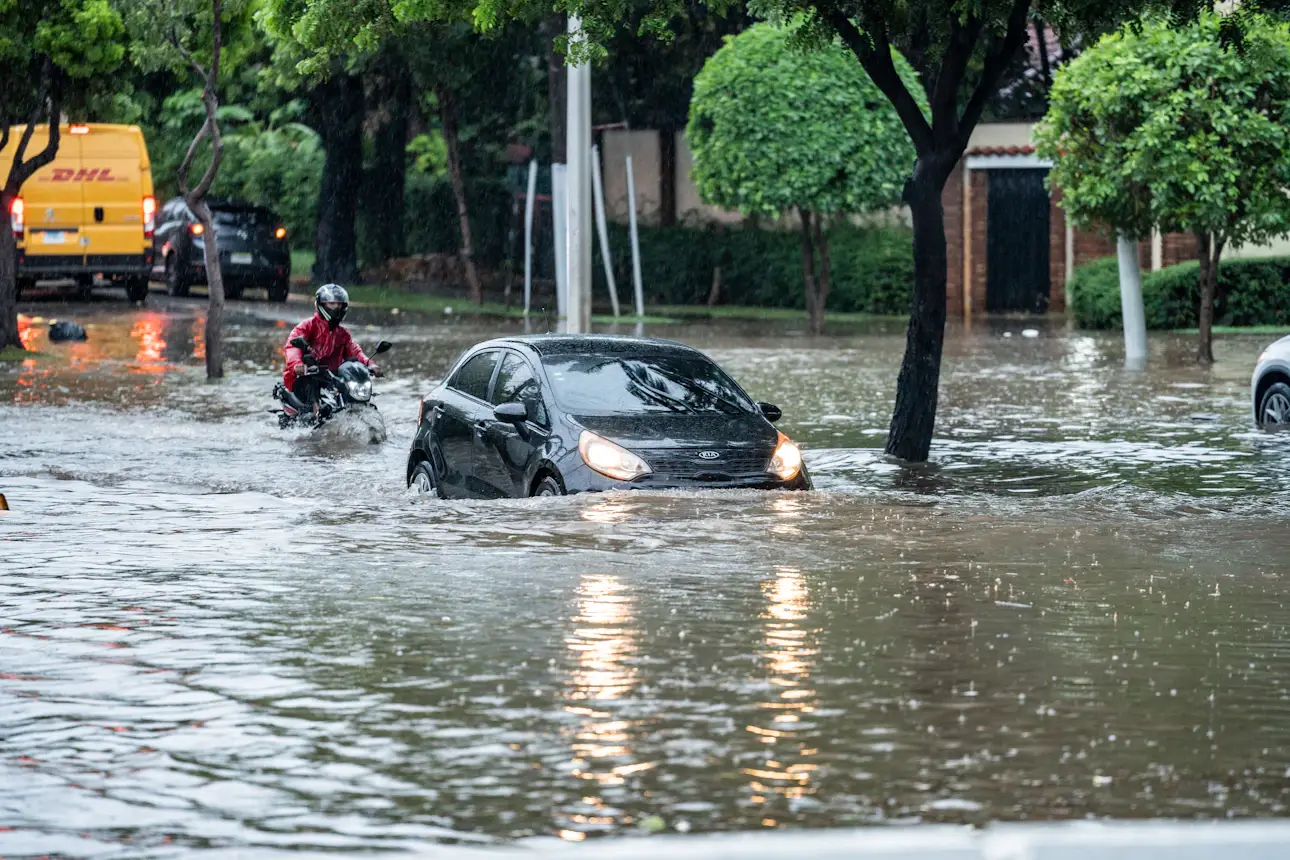
If you take one thing from this entire guide, make it this: never drive or walk into water covering a road, no matter how familiar that road is or how shallow the water looks. This is the National Weather Service’s own long-running safety campaign, and it exists because vehicles are involved in the majority of flash-flood deaths nationally, year after year. A few specific reasons it’s so consistently dangerous:
- You cannot judge depth from the driver’s seat. Floodwater is often opaque with sediment, hiding exactly how deep it is and what’s happened to the road surface underneath: including whether the road is even still there.
- Cars float sooner than most people expect. As little as 12 inches of moving water can float most passenger cars, and around 18–24 inches can carry off larger SUVs and trucks. Once a vehicle is floating, you’ve lost steering and braking control entirely.
- It doesn’t take much to knock a person over. Roughly six inches of fast-moving water is enough to sweep an adult off their feet: standing water can also be hiding a missing manhole cover, downed line, or washed-out ground underneath.
- Night and heavy rain hide the danger further. A large share of flood fatalities happen after dark, when depth and current are nearly impossible to judge by headlight.
If you come up on a flooded road, even one you drive every day, the only correct move is to turn around and find another route, or wait it out. It is never worth the ten minutes you’d save.
Before, During, and After: What to Do
Before: while the watch is up
Take a flash flood watch seriously the moment it’s issued for your county. A watch means conditions are favorable for flash flooding, not that it’s guaranteed, but it’s your window to act while you still have options. Move your car to higher ground if your street or garage has flooded before. Charge everything. Fill water containers. Check your go-bag. Identify your evacuation routes and pick ones that specifically avoid low-water crossings, underpasses, and any dry wash or arroyo near you. Those are exactly the spots that turn dangerous first and fastest.
During: when a warning is issued or water starts rising
A flash flood warning means flooding is imminent or already happening: this is no longer a “watch and see” situation. Move to higher ground immediately if you’re in a flood-prone area, stay out of basements and underground spaces (they fill first and fastest), and follow the “turn around, don’t drown” rule above without exception. If you’re in a vehicle and water is rising around you, get out and move to higher ground if you can do so safely. A car can be replaced; the decision to wait too long can’t be undone.
After: once the water recedes
Don’t assume tap water is safe just because the rain has stopped: flooding can contaminate water systems, and boil-water advisories are common in the days that follow, especially in areas with older infrastructure or wells. This is exactly the scenario a backup filtration option earns its keep. Stay off roads that were recently flooded until authorities confirm they’re structurally sound, since floodwater can erode the roadbed underneath in ways you can’t see from the surface. And check in with your out-of-area contact so people outside the affected area aren’t left wondering if you’re okay. For the full recovery checklist, including re-entry safety, private well testing, and what food to throw out, see my guide to what to do after a flood.
What’s Worth Having Ready
Rather than repeat the checklist above, here’s the honest reasoning behind the picks that matter most specifically for flash flooding, as opposed to general disaster prep.
Water filtration matters more here than in almost any other disaster scenario. A flash flood is one of the most direct paths to a compromised water supply: floodwater can get into wells, treatment plants can be overwhelmed, and boil-water advisories can last days. Stored water is your first line of defense, but it runs out. A hand-pump water filter built for home use, not a backpacking filter meant for a hiking trail, gives you a real fallback that doesn’t depend on the store shelf still having bottled water when everyone else in town had the same idea.
Power matters because floods and outages travel together. Downed lines, flooded substations, and utility crews who can’t safely reach an area all mean the power often goes out well before or after the water itself becomes the headline. A portable power station isn’t about running your whole house. It’s about keeping a phone charged, a router alive so you can get alerts, and a lantern running without burning through disposable batteries.
Evacuation readiness is what protects you when the warning comes at a bad time. The middle of the night, during a commute, while the kids are at practice. A packed go-bag means you’re not scrambling to find medications and chargers while water is already rising.
Information is the cheapest, highest-leverage category on this whole list. Knowing the difference between a watch and a warning, and getting alerts specific to your ZIP code rather than your whole metro area, costs nothing and is often the difference between having twenty minutes to act and having zero.
Free Updates
I send an email when something’s genuinely worth your time: a new guide, a real price drop on something I recommend, or an actual safety alert. No spam, no daily digest, unsubscribe anytime.
FAQ
What’s the difference between a flash flood watch and a flash flood warning?
A watch means conditions are favorable for flash flooding in your area: it’s a heads-up to prepare and stay alert, not a guarantee it will happen. A warning means flash flooding is imminent or already occurring, and it’s time to act immediately: move to higher ground and avoid flooded roads. Watches give you time to prepare; warnings mean that time is up.
How much rain causes a flash flood?
There’s no single number: it depends heavily on ground saturation, terrain, and drainage. Already-saturated ground is the big multiplier: after days of rain, even moderate additional rainfall can produce flash flooding faster than it would on dry ground. Urban areas with lots of pavement can also flash flood from relatively modest rainfall because there’s nowhere for the water to soak in.
Is it really that dangerous to drive through standing water?
Yes. It takes far less water than most people assume to float a vehicle or sweep it off a road: moving water is especially dangerous, but even standing water of unknown depth can hide a washed-out road surface underneath. You cannot reliably judge depth or road condition from inside a car. “Turn around, don’t drown” exists because this is one of the most common and most preventable causes of flood-related harm every year.
What should I do if my car stalls in floodwater?
Get out of the vehicle and move to higher ground immediately if it’s safe to do so. Don’t stay with a stalled car in rising water: vehicles can be swept away with surprisingly little water movement, and a car is not a safe place to wait it out. If you can’t safely exit and water is entering the vehicle, get to the highest point inside and call for help.
How do I know if my area is at risk?
Check your county’s current watches and warnings through the National Weather Service, and set up alerts specific to your ZIP code rather than relying on general news coverage of your metro area: flash flooding is highly localized, and conditions can be very different a few miles away. Low-lying areas, anywhere near a creek, wash, or arroyo, and areas with a history of drainage problems carry meaningfully higher risk than the same rainfall would pose elsewhere.
Do I need to evacuate every time there’s a flash flood watch?
Not necessarily: a watch means you should prepare and stay alert, not that you need to leave immediately. But you should already know your evacuation routes and have a go-bag ready before a watch turns into a warning, since flash flooding can develop far faster than other disaster types. If local officials issue an evacuation order, or water is already rising near you, don’t wait to see how it plays out.
The Prep Verdict is reader-supported. If you buy through a link on this page, I may earn a commission at no extra cost to you. See my full disclosure for details. I only recommend products I’d put in my own emergency supplies.