A first aid kit for your car should cover two layers. Everyday first aid: adhesive bandages, gauze pads, tape, antiseptic wipes, antibiotic ointment, a cold pack, tweezers, nonlatex gloves, an emergency blanket and a few basic meds. Serious-bleeding control: a CoTCCC-approved tourniquet, a pressure bandage, gauze for packing and trauma shears. Then add what no store kit can: a few days of your essential medications, any prescribed epinephrine auto-injector and an emergency contact card.
Most ready-made car kits stop at the first layer. For most cars, I’d buy the Adventure Medical Kits Mountain Series Hiker and add a C-A-T tourniquet, $69.48 together. Already own a decent kit? Add the second layer for $79.99 with the Mountain Man Medical Sweetwater Trauma Kit.
I’m a medic and certified first aid instructor, and I teach Stop the Bleed near Vancouver, WA and Portland, OR. The checklist below comes from the American Red Cross kit list, NHTSA’s car-kit advice and what I teach in class. My product picks come from published specs, merchant information and my medic training, not hands-on testing.
Reader-supported: I may earn a commission if you buy through links on this page, at no extra cost to you. Disclosure.
Quick Verdict: The Car First Aid Kits I’d Buy
Both layers in a compact kit. The Hiker has no tourniquet, so the C-A-T completes it. $69.48 total.
Already own a basic kit? This adds tourniquet, pressure bandage, gauze and shears. Choose the C-A-T option. $79.99.
More supplies, plus hemostatic gauze and a chest seal for when help is far away. Choose the C-A-T option. $235.48 total.
Free Updates
I send an email when something’s genuinely worth your time: a new guide, a real price drop on something I recommend, or an actual safety alert. No spam, no daily digest, unsubscribe anytime.
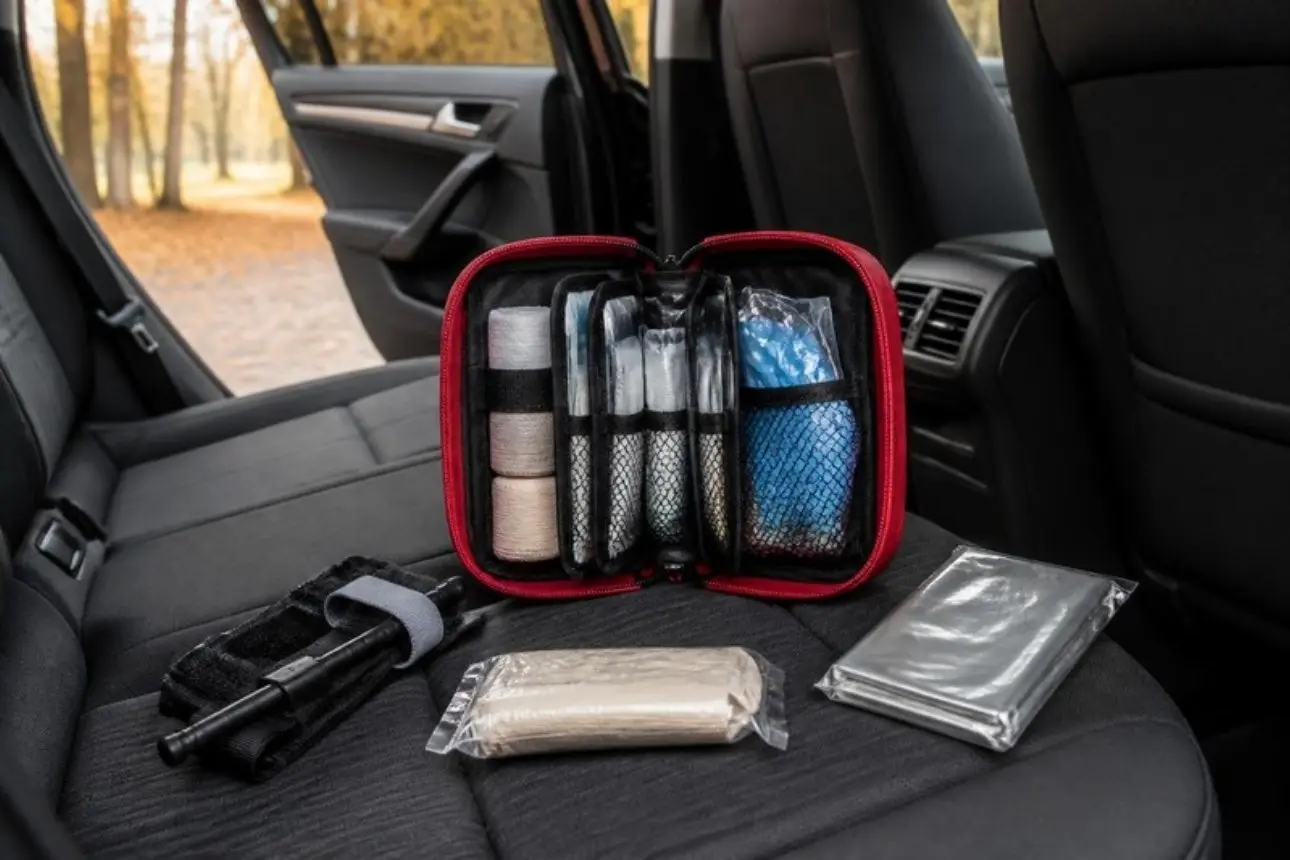
What Should Be in a Car First Aid Kit: The Full Checklist
This starts from the Red Cross kit list for a family of four. I added a pain reliever and an antihistamine, then the bleeding-control layer and the personal items only you can add. Each row is marked by layer: Everyday, Bleeding control or Personal. Check any kit you buy, or the one you own, against it.
| Item | Why it matters in a car | Quantity |
|---|---|---|
| Everyday: adhesive bandages, assorted sizes | Cuts and scrapes from car doors, tools or a fall at a rest stop | 25 |
| Everyday: sterile gauze pads (3 x 3 in and 4 x 4 in) | Wounds too big for an adhesive bandage | 5 of each |
| Everyday: absorbent compress dressings (5 x 9 in) | Larger wounds that need a thick cover | 2 |
| Everyday: adhesive cloth tape (10 yd x 1 in) | Holds gauze in place | 1 roll |
| Everyday: roller bandages (3 in and 4 in wide) | Wraps a dressing or supports a sprain | 1 of each |
| Everyday: triangular bandages | A sling for an injured arm | 2 |
| Everyday: antiseptic wipes | Cleans minor wounds with no sink nearby | 5 packets |
| Everyday: antibiotic ointment | Covers minor cuts after cleaning | 5 packets |
| Everyday: hydrocortisone ointment | Bug bites and itchy rashes | 2 packets |
| Everyday: instant cold compress | Sprains and bumps; no freezer needed | 1 (2 is better) |
| Everyday: tweezers | Splinters, glass slivers and ticks | 1 |
| Everyday: nonlatex gloves, size large | Protects you both; avoids latex allergies | 2 pairs (more is better) |
| Everyday: breathing barrier with one-way valve | For rescue breaths during CPR | 1 |
| Everyday: oral thermometer (non-mercury, nonglass) | Fevers on a trip; glass can break in a car | 1 |
| Everyday: aspirin, 81 mg | Only for a suspected heart attack in a non-allergic adult, as an emergency dispatcher directs. Never for children or teens. | 2 packets |
| Everyday: pain reliever and antihistamine | Headaches and mild allergies on the road | A few single-dose packets |
| Everyday: emergency blanket | Keeps an injured person warm; a North American Rescue Emergency Survival Wrap is $8.99 | 1 (I’d add 1 per seat) |
| Everyday: first aid instructions | A reminder when your hands are shaking | 1 card or booklet |
| Bleeding control: CoTCCC-approved tourniquet (C-A-T) | Stops life-threatening limb bleeding from a crash, broken glass or a tool accident | 1 |
| Bleeding control: pressure (compression) bandage | Holds pressure so your hands are free | 1 |
| Bleeding control: gauze for packing (compressed or Z-fold) | Packs deep wounds where a tourniquet can’t go | 1 to 2 |
| Bleeding control: trauma shears | Cuts clothing and seat belts to reach a wound | 1 |
| Bleeding control: permanent marker | Records the time a tourniquet went on | 1 |
| Personal: essential medications | A few days’ supply if you’re stuck | As prescribed |
| Personal: epinephrine auto-injector (if prescribed) | Severe allergic reactions can’t wait | As prescribed (keep it on you) |
| Personal: emergency contacts and medical info | Allergies, conditions and who to call | 1 card per regular rider |
For everything else your car should carry, see my winter car emergency kit. This is the first aid piece of it.
Why Most Car Kits Miss the Second Layer
Say you’re the first car to stop at a crash on a two-lane highway. One driver has a scraped hand from broken glass. Her passenger has a deep cut on his lower leg that keeps bleeding through his jeans, even with pressure. A box of small bandages handles the first person. Only real bleeding-control gear handles the second.
Many store car kits brag about piece counts, and most of those pieces are small adhesive bandages. Fine for scrapes, and no help for the injury that matters most in a crash.
Severe bleeding is the crash injury that can kill before an ambulance arrives. That’s why NHTSA’s own car-kit list says “first aid kit, including tourniquet.” Here’s how ready-made options compare to the checklist:
| Kit | Covers | Missing |
|---|---|---|
| Typical drugstore or auto-aisle kit | Usually the small stuff: adhesive bandages, wipes, some gauze | Usually no tourniquet or pressure bandage; your personal items |
| Adventure Medical Kits Mountain Series Hiker | Everyday first aid for one to two people: bandages, gauze, tape, moleskin and basic medications | Tourniquet, burn gel, cold pack; your personal items |
| Adventure Medical Kits Mountain Series Explorer | Everyday first aid for one to four people, with more supplies than the Hiker and a CPR face shield | Tourniquet, burn gel, cold pack; your personal items |
| Mountain Man Medical Sweetwater (C-A-T option) | The bleeding-control layer: tourniquet, pressure bandage, packing gauze, shears, gloves, marker | The everyday layer (bandages, wipes, ointments, cold pack) |
| Mountain Man Medical Yellowstone (C-A-T option) | Everything in the Sweetwater, plus hemostatic gauze and a chest seal | The everyday layer |
No single kit covers all three layers. That’s why each pick below is a pairing or an add-on.
The Kits I’d Buy, in Detail
Not sure which fits? Stop at the first question that matches you:
- Long road trips, rural roads, spotty cell service or a long wait for an ambulance? Get the Mountain Series Explorer + Yellowstone Trauma Kit.
- Already own a decent first aid kit? Keep it and add the Sweetwater Trauma Kit (C-A-T option).
- Tight budget or a second car? Restock the kit you own and add a C-A-T.
- Everyone else: the Mountain Series Hiker + C-A-T. Both layers, small enough for under a seat.
Prices checked October 2026. For the two trauma kits head to head, see my Sweetwater vs. Yellowstone comparison.
Best for Most Cars: Adventure Medical Kits Mountain Series Hiker + C-A-T
What you get: the Mountain Series Hiker ($34.49) is a compact trail kit built for one to two people for up to two days. It weighs about 7 ounces and measures about 6.5 x 5.5 x 3 inches. Inside: 10 fabric bandages, butterfly closures, gauze, tape, an elastic bandage, a 5 x 9 inch trauma pad, moleskin, shears, forceps, gloves, basic pain and allergy medications, antibiotic ointment and a first aid manual.
Who it’s for: commuters, parents and anyone who wants one organized under-seat kit.
The tourniquet: the Hiker has none. Add the C-A-T Tourniquet ($34.99, made by North American Rescue, sold by Mountain Man Medical). It’s CoTCCC-approved, the only kind I recommend. Mountain Man Medical also sells a blue trainer version; buy the real one. My best tourniquet guide explains why I stick to approved models.
What to add: the Hiker has only 10 adhesive bandages, no burn gel and no cold pack. Add a box of ordinary bandages, a tube of burn gel and an instant cold pack to match the checklist above.
Honest trade-offs: it’s a trail kit sized for two people, so a family will run through the bandages quickly. Restock it after every use.
Check Hiker Price at Adventure Medical Kits
Check C-A-T Price at Mountain Man Medical
Best Bleeding-Control Add-On: Mountain Man Medical Sweetwater Trauma Kit
What you get: the Sweetwater Trauma Kit ($79.99 with the C-A-T option) is the whole second layer in a 7 x 5 x 4 inch pouch that weighs about 12 to 13 ounces. Inside: the tourniquet, a Bridger compression (pressure) bandage, 2 pairs of large nitrile gloves, trauma shears, a mini permanent marker for writing the tourniquet time, compressed Z-fold gauze (4.5 in x 4.1 yd), Krinkle gauze and a 2 in x 5 yd hook-and-loop elastic wrap.
Who it’s for: anyone with a basic kit already in the car who needs the bleeding-control layer.
Choose the C-A-T option on the product page; other tourniquets are offered.
Honest trade-offs: no adhesive bandages, wipes or ointments, so it won’t help with a scraped knee. It rides alongside a basic kit, not instead of one.
Check Price at Mountain Man Medical
Best for Long or Remote Drives: Adventure Medical Kits Mountain Series Explorer + Yellowstone Trauma Kit
What you get: the Mountain Series Explorer ($86.49) is the bigger kit in the same series. It is built for one to four people for up to seven days, with more supplies, a CPR face shield, a wound irrigation tool and a wilderness medicine book. It has no tourniquet. The Mountain Man Medical Yellowstone Trauma Kit ($148.99 with the C-A-T option, about 15 ounces, 7 x 5 x 4 inches) fills that gap. It holds everything in the Sweetwater, plus ChitoGauze OTC hemostatic gauze (3 x 48 in), a HyFin Vent compact twin chest seal pack and extra gauze.
Who it’s for: rural drivers and road-trippers on roads where an ambulance could be far off. Hemostatic gauze helps control bleeding in packed wounds. A chest seal covers an open chest wound, such as from a sharp object in a crash.
Honest trade-offs: it’s the priciest setup, and two bags take more room. Choose the C-A-T option on the Yellowstone page, and take a class so you can use what’s inside.
Check Explorer Price at Adventure Medical Kits
Check Yellowstone Price at Mountain Man Medical
Budget: The Kit You Already Own + C-A-T
Lay the kit you own (or a basic drugstore kit) next to the checklist and restock what’s missing. Then add a C-A-T for $34.99. If you can, add a pressure bandage and packing gauze too.
Honest trade-offs: drugstore kits vary and restocking takes time, but it gets a tourniquet into your car for under $40.
Check Price at Mountain Man Medical
Price and Fit: The Four Setups Compared
| Setup | What you get | Approx. total | Best for |
|---|---|---|---|
| Mountain Series Hiker + C-A-T | Both layers; compact 7-ounce kit plus tourniquet | $69.48 | Most cars, commuters, families |
| Sweetwater (C-A-T option) | Bleeding-control layer only, 7 x 5 x 4 in | $79.99 | Adding layer two to a kit you own |
| Mountain Series Explorer + Yellowstone (C-A-T option) | Larger everyday kit plus bleeding control, hemostatic gauze and chest seal | $235.48 | Rural roads, long trips, remote areas |
| Kit you own + C-A-T | Restocked basics plus tourniquet | $34.99 plus restock | Tight budgets, second cars |
Add an $8.99 North American Rescue survival wrap per seat to any of these.
Medic Notes for Keeping a Kit in a Car
Building the rest of your car kit? My free car emergency kit builder walks through warmth, getting seen and getting unstuck, and lets you print the list.
A closed car in summer sun gets much hotter than the air outside, and in winter it freezes. That’s hard on medical supplies.
- Heat and cold wear supplies out. Heat weakens adhesive, dries out ointments and wipes, and degrades medications (most labels say store at room temperature). Cold freezes liquids and makes some items brittle.
- Store it in the cabin, not the trunk. The trunk may jam in a crash. Under a seat or on a seat back works well.
- Secure it. A loose kit can become a projectile. Use straps or a cargo net.
- Keep the tourniquet reachable. On top of the kit or outside it, not buried.
- Tell everyone where it is. The injured person may be you.
- Keep critical personal meds on you, or rotate the car supply. An epinephrine auto-injector belongs in your bag or pocket.
- Check it twice a year. The daylight saving time changes are an easy reminder. Check it after every use, too. The Red Cross says: “Check expiration dates and replace any used or out-of-date contents.”
The Red Cross also says: “Keep a first aid kit in your home and in your car.” If you keep a go bag at home, my car emergency kit vs. bug-out bag guide explains how the two differ.
What to Do First After a Crash
Here’s the general order, and it is no substitute for training:
- Make the scene safe. Pull well off the road, turn on your hazard lights and watch for traffic, fire and leaking fuel.
- Call emergency services, or have someone else call.
- Check breathing and bleeding. Is each person breathing? Is anyone bleeding badly?
- Don’t move someone with a possible neck or back injury unless they’re in danger where they are, such as from fire or traffic.
- Control serious bleeding. Life-threatening bleeding is spurting, pooling, soaking through clothing or bandages, or a limb wound that won’t stop with pressure. Press firmly and directly on the wound. Pack a deep wound with gauze and keep pressing. For life-threatening arm or leg bleeding, apply a tourniquet high and tight, about 2 to 3 inches above the wound, and tighten it until the bleeding stops. Write down the time.
- Keep them warm. Injured people lose heat fast. Cover them with an emergency blanket and stay until help arrives.
What to Skip
- Cheap kits padded with tiny bandages. Judge a kit by the checklist, not the piece count.
- Blue trainer tourniquets and uncertified knockoffs. Trainers are for practice; knockoffs aren’t approved.
- Expired meds. Swap them at your twice-a-year check.
- Glass thermometers. Get a non-mercury, nonglass one.
- Trunk storage. If the trunk jams after a crash, the kit is useless.
Get Trained
Gear works best when you’ve practiced. A tourniquet you’ve never handled is hard to apply under stress.
A Stop the Bleed class is short, hands-on and often free or low-cost. You practice pressure, packing and tourniquets on training gear. If you’re near Vancouver, WA or Portland, OR, see my first aid classes.
For the evacuation side, see my 72-hour go bag list.
Free Updates
I send an email when something’s genuinely worth your time: a new guide, a real price drop on something I recommend, or an actual safety alert. No spam, no daily digest, unsubscribe anytime.
FAQ
What should be in a first aid kit in a car?
Everyday supplies (adhesive bandages, gauze pads, tape, antiseptic wipes, antibiotic ointment, a cold pack, tweezers, gloves and an emergency blanket) plus bleeding control (a CoTCCC-approved tourniquet, a pressure bandage, packing gauze and shears). Add a few days of your essential medications and an emergency contact card.
What is the best first aid kit for a car?
For most cars, I recommend the Adventure Medical Kits Mountain Series Hiker plus a C-A-T tourniquet, $69.48 total. The C-A-T adds the tourniquet the Hiker lacks.
Do I need a tourniquet in my car first aid kit?
Yes. NHTSA’s car-kit list says “first aid kit, including tourniquet,” because severe bleeding from a crash can kill before help arrives. Choose a CoTCCC-approved model like the C-A-T.
Where should I keep a first aid kit in my car?
In the cabin, secured under a seat or on a seat back, not in the trunk, which can jam after a crash. Keep the tourniquet on top, and tell everyone where the kit is.
Is it OK to leave a first aid kit in a hot car?
Yes, the cabin is still the best place for it, but heat weakens bandage adhesive, dries out ointments and wipes, and degrades medications. Keep critical personal meds on you, and check and replace the kit’s contents twice a year.
How often should I check my car first aid kit?
Check it twice a year (the daylight saving time changes are an easy reminder) and after every use. Replace anything used, expired or damaged by heat or cold.
Is a basic drugstore first aid kit good enough for a car?
It covers the everyday layer if you restock it to match the Red Cross list. Most don’t include a tourniquet or pressure bandage, so add a C-A-T at minimum.
The Prep Verdict is reader-supported. If you buy through a link on this page, I may earn a commission at no extra cost to you. See my full disclosure for details. I haven’t hands-on tested every product named here; picks are based on published specs, merchant information and my medic training. I only recommend products I’d put in my own emergency supplies.