If you saw the headline about a possible plague death at a Russian research lab and felt a jolt of worry, here’s what I’d tell you as a medic: that reaction is normal, and you’re right to want real information instead of rumors. A 28-year-old lab technician lost her life, and that deserves to be said plainly before anything else.
Here’s the short version. As of October 12, 2026, plague has not been officially confirmed in this case, the risk to people in the U.S. right now is very low, and plague is a bacterial infection that’s curable with prompt antibiotics. Still, stories like this are a good, calm moment to fix a gap I see in almost every household emergency kit: most people stock water, food and a first aid kit, but almost nobody has thought about protecting their lungs.
Below is what’s actually known, how pneumonic plague spreads, the symptoms worth knowing, and a sensible, tiered respiratory protection plan for the whole family. If you only have a minute, jump to the bottom line.
Quick Verdict
Reader-supported: I may earn a commission if you buy through links on this page, at no extra cost to you. Disclosure.
Quick Verdict: The Russia Plague Scare and Your Household
Plague isn’t confirmed in the Russian case, and there’s no reported spread outside the Irkutsk region. Plague is curable with prompt antibiotics.
NIOSH-approved, affordable, and useful for wildfire smoke and flu season long before anything rarer.
A reusable, sealed full-face setup with eye coverage and filters that store for up to 20 years, for biological and particulate threats.
Free Updates
I send an email when something’s genuinely worth your time: a new guide, a real price drop on something I recommend, or an actual safety alert. No spam, no daily digest, unsubscribe anytime.
The short answers
Is it confirmed that she died of plague?
No. As of October 12, 2026, plague has not been officially confirmed. Russia’s public health agency, Rospotrebnadzor, lists the cause of death as “pneumonia of unknown etiology” and says testing found no microorganisms linked to her lab work. Regional officials say nearly 5,000 lab tests found no dangerous pathogens, and they lifted the local quarantine on October 8. In its first full update on October 10, the World Health Organization said the cause is still unexplained, that more than 5,500 tests found no dangerous pathogens, and that it has found no evidence of ongoing transmission.
Is plague contagious?
Only one form is. Pneumonic plague, which infects the lungs, can spread from person to person through respiratory droplets during close, sustained contact. The more common bubonic form spreads through flea bites, not from person to person.
Is the U.S. at risk from this?
Not in any meaningful way right now. There’s no reported spread outside Russia’s Irkutsk region and no confirmed outbreak. The CDC calls the risk to the U.S. “extremely low” and is monitoring travelers arriving from the region, and the WHO rates the risk beyond Russia’s borders as very low. The WHO doesn’t advise any travel or trade restrictions related to this event.
Is plague treatable?
Yes. Plague is caused by a bacterium, not a virus, and it’s curable with antibiotics when treated promptly. Timing is what matters, which is why fast medical care makes all the difference.
What happened in Russia (and what’s still unconfirmed)
This is a developing story, and details may change. Here’s what has been reported by outlets including NBC News, Forbes, Meduza, the Associated Press and Al Jazeera.
What’s reported and official:
- A 28-year-old laboratory technician at the Irkutsk Anti-Plague Research Institute in Shelekhov, in Siberia’s Irkutsk region, was hospitalized on September 29 with severe pneumonia and died a few days later, in early October.
- Nearly 200 people who had contact with her were placed under medical observation. Several Irkutsk hospitals imposed quarantines that were expected to last about three weeks. On October 8, the regional governor said medical monitoring of all her contacts was complete and that the quarantine measures had been lifted.
- Rospotrebnadzor calls the situation “stable” and says it sees no epidemic risk. Among her contacts, tests found two COVID-19 cases and two rhinovirus cases, and no other infectious agents. Russia told the World Health Organization that no plague case has been registered in the Irkutsk region. Regional officials say nearly 5,000 laboratory tests found no dangerous pathogens.
- In its first full update on the case, published October 10, the World Health Organization said it still hasn’t been told what caused her illness. It reports that monitoring of all her contacts, including seven days of daily lab testing, is complete, that all of them stayed symptom-free, and that more than 5,500 tests found no dangerous pathogens. The WHO says it has found no evidence of ongoing transmission and doesn’t advise any travel or trade restrictions. It also notes that until a diagnosis is confirmed, a lab-related exposure can’t be completely ruled out. Earlier, it rated the risk beyond Russia’s borders as very low.
- The CDC says the risk to the U.S. is “extremely low” and that there’s “no indication of a broader threat to the United States.” It’s monitoring travelers arriving from the region, including through a health station at New York’s JFK airport. The State Department has formally asked Russia for more information, and the EU says it’s monitoring closely.
- The U.S. Embassy in Moscow issued a health alert on October 6. It repeats the State Department’s Level 4 “Do Not Travel” advisory for Russia, which was already in place before this incident, and advises anyone who travels to an affected area to watch their health for 14 days afterward.
- There’s no reported spread outside the Irkutsk region.
What’s claimed but not confirmed:
- The regional governor called it a “suspected case of a particularly dangerous infection.”
- The head of a neighboring region said she “may have died of the plague.”
- A local outlet reported that she broke a test tube containing plague bacteria.
- Media reports describe a second institute employee with pneumonia of undetermined cause. The WHO has asked Russia about these reports. The Kremlin says most media reporting on the situation is false, and Russian health officials say no infections were detected among institute staff, and Rospotrebnadzor calls the reports of a second case untrue. Russia told the WHO there have been no further cases of severe pneumonia linked to hers.
None of those claims has been officially confirmed. Officials are sending mixed messages, which is exactly when rumors fill the gap, so I’d treat them as possibilities, not facts. The detail I find most reassuring is the contact testing: nearly 200 people under observation, all of them now finished with monitoring and none of them sick, and what’s turned up is common respiratory viruses, not plague. I’ll update this page if the facts change.
What pneumonic plague is, and how it spreads
Plague is caused by the bacterium Yersinia pestis. Because it’s a bacterium, antibiotics work against it. According to the CDC, plague takes three forms:
- Bubonic plague comes from infected flea bites. It causes fever, headache, chills, weakness, and one or more swollen, painful lymph nodes, usually 2 to 8 days after exposure.
- Septicemic plague comes from flea bites or handling an infected animal. It causes fever, chills, extreme weakness, abdominal pain and shock, and can cause bleeding into the skin and organs.
- Pneumonic plague comes from breathing in infectious droplets. It causes fever, headache, weakness, and a rapidly developing pneumonia with shortness of breath, chest pain, cough, and sometimes bloody or watery mucus. Symptoms can start as soon as 1 day after exposure.
Pneumonic plague is the only form that spreads from person to person, through respiratory droplets during close contact. An easy way to remember the difference: bubonic plague comes from fleas and shows up in the lymph nodes. Pneumonic plague is in the lungs and can spread by coughing during close contact.
The medical response is well established. People who are sick get antibiotics such as gentamicin or a fluoroquinolone for 10 to 14 days. Close contacts, meaning sustained contact within about 6 feet, get a 7-day preventive course of antibiotics, called post-exposure prophylaxis (CDC clinical guidance). Untreated pneumonic plague is almost always fatal, so prompt treatment is what matters.
How worried should you be in the U.S.? (Straight answer)
Not very, about this story specifically. Here’s why:
- Plague hasn’t been confirmed in the Russian case.
- There’s no reported spread beyond the Irkutsk region, and close contacts are under observation.
- Pneumonic plague needs close, sustained contact to spread, and it’s treatable with antibiotics.
What surprises many people is that plague already exists in the U.S. at a low level. The CDC reports an average of about 7 human cases a year (ranging from 0 to 17), mostly in northern New Mexico, northern Arizona, southern Colorado, California, southern Oregon and far western Nevada. More than 80% are bubonic. People usually get it from flea bites or from handling infected animals such as rodents, prairie dogs, squirrels or pets.
So the realistic plague risk for most Americans has nothing to do with a lab in Siberia. If you live in or visit those areas, the practical takeaway is simple: don’t handle sick or dead wild animals, and take fleas on you or your pets seriously.
Symptoms to know and when to get care
Get medical care right away if you develop these symptoms after a possible exposure, such as flea bites, handling wild rodents or a sick pet, or close contact with someone known to have pneumonic plague:
- Sudden fever, chills, headache and weakness
- Swollen, painful lymph nodes
- Shortness of breath, chest pain or cough, especially if it’s getting worse quickly
- Coughing up bloody or watery mucus
When you call or arrive, tell the clinician about the possible exposure up front. One sentence, like “I cleaned out a shed full of dead mice last week,” can change how quickly the right testing and antibiotics happen.
If you want to be the calm, useful person when someone gets sick or hurt, a hands-on class teaches more than any article can. I teach CPR, first aid and Stop the Bleed classes in Vancouver, WA and Portland, OR.
Why respiratory protection is the overlooked part of most preparedness kits
When I look at the average household emergency kit, I usually see water, food, flashlights and a first aid kit (if you’re upgrading yours, here’s my comparison of two Mountain Man Medical trauma kits). What I rarely see is anything to protect the lungs, or at most a single loose mask in a drawer.
That gap isn’t really about plague. You’re far more likely to need respiratory protection for wildfire smoke, flu season, or caring for a sick family member. My public safety power shutoff checklist covers smoke season, and a few respirators belong in your go-bag too; see my evacuation checklist.
Here’s the part I most want people to take away. The CDC says responders and health care workers don’t need preventive antibiotics before plague exposure “as long as standard and droplet precautions can be maintained.” In other words, the professional standard for working around pneumonic plague is droplet-level protection worn correctly, not a gas mask.
From my training, what decides whether protection works is rarely the brand name on the box. It’s three things:
- Fit. A respirator that leaks around the edges only filters the air that doesn’t go around it.
- Seal. Facial hair, the wrong size, or glasses under a full-face mask all break the seal.
- Practice. Gear you’ve never put on is gear you’ll put on wrong when you’re stressed.
Choosing protection that matches the threat
The rule I teach is simple: match the filter to the threat. Bacteria and viruses are particles, so you need particulate filtration. Chemical gases and vapors need a different kind of filter entirely, which I cover in my MIRA Safety gas mask and CBRN buying guide.
In the U.S., the regulatory standard for respirators is NIOSH approval. Look for it on any N95 or P100 you buy. Here’s the three-level framework I’d use. Most households need Level 1, some will want Level 2, and Level 3 is a deliberate upgrade.
Level 1: Fitted N95 respirators (the baseline for every household)
An N95 filters 95% of particles. A properly fitted N95 is the realistic, affordable baseline for airborne particles, including bacteria and viruses. Keep a few per person at home, in your go-bag and in the car. You don’t need a special brand, just NIOSH approval and a size that fits each person. Try them on before you need them.
Level 2: P100 respirators (higher filtration)
A P100 filters 99.97% of particles, is oil-proof, and is the highest NIOSH particulate class. It’s a sensible step up for heavier smoke or longer exposure.
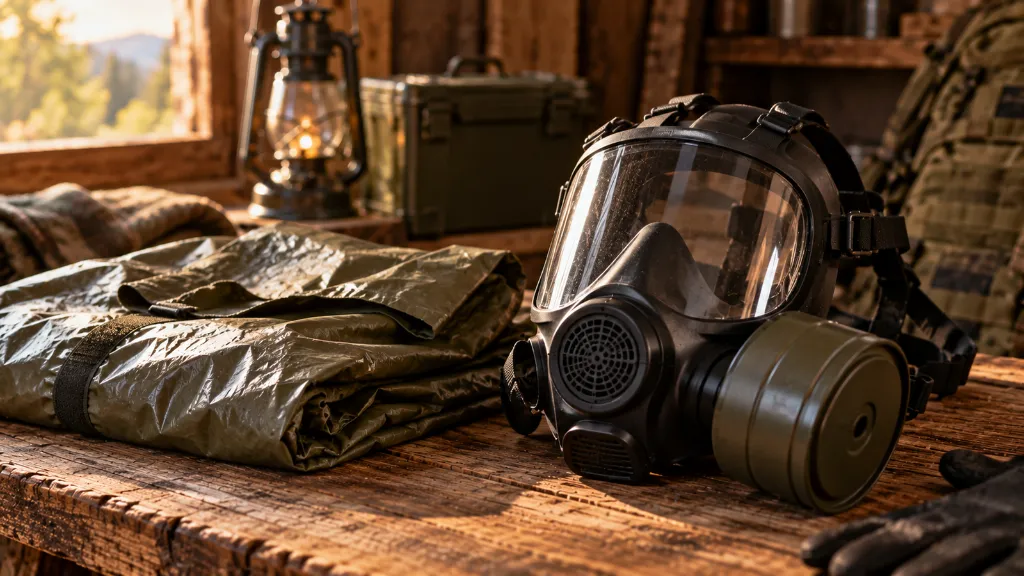
Level 3: A sealed, reusable full-face setup (MIRA CM-I01 + ParticleMax P3)
If you want something longer-lasting and fully sealed that also covers your eyes, the step up is a reusable full-face respirator with a particulate filter. This is the setup MIRA Safety recommends for airborne biological threats, and it’s the pairing I’d point you to. To be clear, I haven’t personally tested these MIRA products. What follows is based on MIRA’s published specifications and my medical training on fit and seals.
MIRA ParticleMax P3 filter
- P3 rating under the European standard EN 143. MIRA says it “filters out 99.9999+% of biothreats” and removes particles down to 0.2 microns.
- Standard 40mm NATO thread, about 100 g per filter, and a 20-year shelf life.
- About $160 for a 6-pack at the time of writing.
- Know the limits: it’s for particulate and biological threats only. It has no activated carbon, so it does not filter gases or chemical vapors. It’s European-certified, not NIOSH-approved.
Check Price: MIRA ParticleMax P3 Filters
MIRA CM-I01 full-face respirator
- $159.99 at the time of writing. Filters are sold separately.
- EN 136 Class 3 (European standard), two 40mm filter ports, one universal medium size, and a 10-year shelf life.
- Know the limits: there’s no drinking system, and prescription glasses can’t be worn inside because they break the seal, so plan on contacts. MIRA notes it isn’t a full CBRN gas mask because its face seal isn’t resistant to blister agents. For a biological and particulate setup, that’s not a drawback.
Check Price: MIRA CM-I01 Full-Face Respirator
Why choose this over more N95s? It’s reusable, seals across the whole face, covers your eyes, and the filters store for decades, so it can sit in a closet kit for years and still be ready. Why not? It costs more, comes in one size, doesn’t work with glasses, and isn’t NIOSH-approved. It’s a long-term preparedness choice, not something this news story requires you to buy this week.
N95 vs. P100 vs. full-face with a P3 filter
| Level 1: N95 | Level 2: P100 | Level 3: MIRA CM-I01 + ParticleMax P3 | |
|---|---|---|---|
| Standard | NIOSH (U.S.) | NIOSH (U.S.) | European: EN 136 Class 3 mask, EN 143 P3 filter (not NIOSH-approved) |
| Particle filtration | 95% | 99.97%, oil-proof | MIRA states 99.9999+% of biothreats, down to 0.2 microns |
| Covers eyes | No | No (disposable and half-mask styles) | Yes |
| Filters gases or chemical vapors | No | No | No (no activated carbon) |
| Seal watch-outs | Beards break the seal | Beards break the seal | Beards and eyeglasses break the seal; one size |
| Best for | Every household: smoke, flu season, home care | Heavier smoke, longer exposure | A sealed, reusable, long-storage setup for biological and particulate threats |
Is a P3 filter better than an N95?
On paper, the P3 filter’s stated filtration is higher, and a full-face mask adds eye coverage and reusability. But a fitted N95 worn correctly beats a high-end respirator that leaks around a beard or sits unopened in a closet. Pick the level you’ll fit, practice with and keep where you can reach it.
A biological preparedness setup for the whole family
A plan that only protects one adult isn’t a household plan. Here’s how I’d build it. Start at the top and stop wherever it makes sense for your family.
- Adults: A supply of fitted, NIOSH-approved N95s or P100s for everyone, plus spares. If you add a full-face respirator, check that it seals on each person (a universal medium won’t fit every face), and practice putting it on before you ever need it.
- Children (ages 4 and up): Kids aren’t small adults, and their gear has to fit. MIRA makes two children’s options: the MD-1 children’s gas mask ($231.95 at the time of writing) and the MD-2, which adds a battery-powered blower ($599.95 at the time of writing).
- Infants: Infants can’t use a standard mask. Ask your pediatrician how to plan for a baby.
As a medic and instructor, here’s what I’d want every parent to know before buying anything for a child:
- Size matters. Children need properly sized gear.
- Supervision matters. A child should never wear a respirator without an adult watching.
- Practice matters. Short, calm practice sessions make the gear familiar instead of frightening.
- Talk to your pediatrician first, especially if your child has asthma or any breathing condition.
Store everyone’s respiratory gear where you’d grab it in a hurry, ideally alongside your go-bags.
What a mask can’t do
- A mask can’t create oxygen. No filter helps in oxygen-deficient air.
- Particulate filters don’t stop gases or chemical vapors, and that includes the ParticleMax P3.
- A mask doesn’t replace medical care. If you have symptoms after a possible exposure, get care. For plague, prompt antibiotics are what save lives.
- A poor seal undoes the filter. Facial hair, the wrong size, or glasses under a full-face mask all leave gaps.
- Tight-fitting respirators aren’t right for everyone. Anyone with asthma, COPD or a heart condition should ask a doctor before relying on one.
Bottom line
A young woman died, and the official cause is still “pneumonia of unknown etiology.” Plague hasn’t been confirmed, contact testing has turned up only common respiratory viruses, monitoring of her contacts has ended, the WHO has found no evidence of ongoing transmission, and there’s no reported spread outside the Irkutsk region. For people in the U.S., the risk from this event is very low; the CDC calls it “extremely low.” Plague is curable with prompt antibiotics, and only the pneumonic form spreads between people, through close, sustained contact.
What the headline is good for is a reminder that most preparedness plans skip respiratory protection. Make sure everyone in your household has a few fitted, NIOSH-approved N95 or P100 respirators. If you want a sealed, reusable, long-storage upgrade for biological and particulate threats, the MIRA CM-I01 with ParticleMax P3 filters is the pairing I’d look at, limits and all. For kids, size gear properly, practice, and talk to your pediatrician first.
Calm, informed and prepared beats scared every time.
Check Price: MIRA ParticleMax P3 Filters
Free Updates
I send an email when something’s genuinely worth your time: a new guide, a real price drop on something I recommend, or an actual safety alert. No spam, no daily digest, unsubscribe anytime.
FAQ
Will an N95 protect against pneumonic plague?
A properly fitted, NIOSH-approved N95 filters 95% of particles, including bacteria, and is a realistic baseline. The CDC says responders and health care workers don’t need preventive antibiotics as long as standard and droplet precautions can be maintained. Fit is critical, and beards break the seal.
Do I need a gas mask for plague?
No. The professional standard is droplet-level protection, not a gas mask. A full-face respirator with a particulate filter is an optional long-term upgrade that adds a full-face seal and eye coverage.
What’s the difference between bubonic and pneumonic plague?
Bubonic plague comes from flea bites and causes fever, chills, weakness and swollen, painful lymph nodes, usually 2 to 8 days after exposure. Pneumonic plague infects the lungs, can start within 1 day, causes a fast-developing pneumonia, and is the only form that spreads between people.
Is there a plague outbreak in Russia?
No outbreak has been confirmed. As of October 12, 2026, plague hasn’t been officially confirmed in the lab technician’s death, Russian health officials say they see no epidemic risk, and there’s no reported spread outside the Irkutsk region. Regional officials lifted the local quarantine on October 8 after monitoring of her contacts ended. The World Health Organization says it has found no evidence of ongoing transmission and doesn’t advise travel restrictions, though it’s still waiting on a confirmed cause of death. Unconfirmed media reports of a second sick employee are denied by Russian health officials.
Where does plague occur in the U.S.?
The U.S. averages about 7 human cases a year, mostly in northern New Mexico, northern Arizona, southern Colorado, California, southern Oregon and far western Nevada. Most are bubonic and come from flea bites or handling infected animals.
Is a P3 filter better than an N95?
MIRA’s ParticleMax P3 has a higher stated filtration rate and, in a full-face mask, adds eye coverage. But it’s certified to European standards rather than NIOSH, and a well-fitted N95 you wear beats a better filter that leaks. Choose based on fit, practice and what you’ll really use.
Sources
- CDC: Signs and Symptoms of Plague
- CDC: Clinical Care of Plague
- CDC: Plague Maps and Statistics
- NBC News: Russian lab worker dies of suspected plague as 200 enter medical observation
- Forbes: Russian plague lab researcher dies as nearly 200 monitored
- Contagion Live: Russian lab worker dies in suspected pneumonic plague case
- Meduza: Hospitals in Irkutsk impose quarantines after an anti-plague institute employee dies
- Euronews: Russia denies lab worker died of plague as quarantine stays in place
- Associated Press (via ABC News): UN health agency wants more details from Russia on suspected pneumonic plague case
- Forbes: CDC monitors travelers as Russia says plague scare is under control
- Euronews: Russia dismisses transparency calls amid reports of second Siberia plague case
- Al Jazeera: Russia dismisses reports of second plague case, WHO urges formal response
- U.S. Embassy Moscow: Health Alert, October 6, 2026
- Kyiv Independent: Russia lifts quarantine in Irkutsk region (October 8, 2026)
- Bloomberg: Russia finds no plague or other pathogens in Siberia lab death (October 9, 2026)
- World Health Organization: Pneumonia of undetermined etiology, Russian Federation (Disease Outbreak News, October 10, 2026)
Affiliate Disclosure
The Prep Verdict is reader-supported. If you buy through a link on this page, I may earn a commission at no extra cost to you. See my full disclosure for details. I haven’t hands-on tested the MIRA Safety products mentioned here; the recommendations are based on the manufacturer’s published specifications and my medical training.