·
Medic & certified first aid instructor
Updated September 2026
The question I want you to ask isn’t “should I buy a gas mask.” It’s narrower and less exciting than that: does my household face a realistic scenario where this specific piece of gear would matter, and if so, what level of protection fits that scenario. Not the scariest version of it, the real one. I’m going to answer that as honestly as I can, which means telling you upfront that for most people reading this, the answer involves a lot less gas mask and a lot more N95.
This is respiratory and CBRN protective equipment for civilian household and workplace safety. It is not tactical gear, it has no connection to combat or self-defense use, and I’m not going to frame it that way anywhere in this piece.
Reader-supported: I may earn a commission if you buy through links on this page, at no extra cost to you. Disclosure.
Quick Verdict: MIRA Safety Gas Mask & CBRN Buying Guide
N95/P100 Respirator
Properly fitted, kept on hand for wildfire smoke, dust, and general air-quality emergencies. Cheap, simple, no fit-testing rabbit hole, and it covers the scenario you’re likely to face.
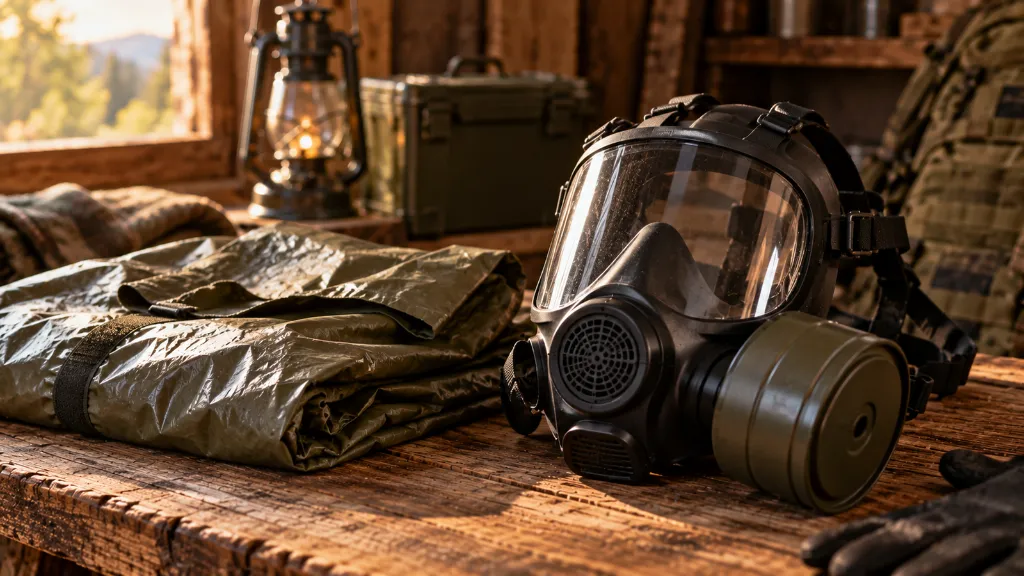
MIRA Safety Full-Face Gas Mask + CBRN Filter
For households near industrial/chemical infrastructure or with another specific, identifiable risk who’ve done the math and still want the added margin.
Free Updates
I send an email when something’s genuinely worth your time: a new guide, a real price drop on something I recommend, or an actual safety alert. No spam, no daily digest, unsubscribe anytime.
The honest risk assessment: what’s likely to threaten your air
I want to separate two categories that prepping content constantly blurs together: things reasonably likely to affect your household’s air quality at some point, and things that are almost certainly never going to happen to you. Both are real. They are not equally probable, and gear decisions should track probability as well as consequence.
Genuinely realistic, moderate-to-high likelihood depending on where you live:
- Wildfire smoke. Across large parts of the western U.S. and increasingly the Midwest and Northeast during bad fire seasons, smoke events that push air quality into “unhealthy” or “hazardous” territory for days at a time are now a recurring, multi-week part of the calendar, not a freak occurrence, and smoke can travel hundreds of miles from the fire itself.
- Industrial or transportation chemical incidents. Train derailments, chemical plant releases, tanker spills. These happen in the U.S. with some regularity. If you live near rail lines, refineries, ports, or industrial parks, a shelter-in-place order tied to one is a plausible event over a multi-decade homeownership horizon.
- General air-quality emergencies. Dust storms, agricultural burning, regional ozone/pollution spikes, or smoke from a structure fire nearby.
Real, but genuinely rare for an ordinary household:
- CBRN events in the strict sense: a deliberate chemical, biological, or radiological/nuclear attack on a civilian population. These aren’t zero-probability, but for the overwhelming majority of U.S. households they’re extremely low-probability on any given year’s timescale, and lower still for anyone not near a specific high-value target or notable industrial hazard.
For a current, real-world example of how to think about a biological headline, see my breakdown of the Russia pneumonic plague scare: what’s confirmed, the real U.S. risk, and which respiratory protection fits a biological threat.
I’m not saying that risk is fake. I’m saying prepping content routinely markets full gas masks by leaning on the scariest 2% of the scenario space while glossing over the fact that the same piece of gear, at a much lower cost of entry, also handles the boring 80%, which is where most of you live.
Do you need this, and at what level? A real self-assessment
Work through this before looking at products:
- Do you live somewhere with recurring wildfire smoke seasons, even if you’re not near the fire itself? If yes, some respiratory protection is a reasonable, low-cost addition. The strongest, most common case for at least an N95/P100 supply.
- Do you live within a few miles of a chemical plant, refinery, rail line, or industrial corridor? If yes, a shelter-in-place-capable setup is more defensible than for a household in a low-industrial-risk area.
- Have you ever had to shelter in place or evacuate for an air-quality or chemical event before? Past local incidents are a reasonable signal. Check your county or state emergency-management site for a hazard history if you’re unsure.
- Does anyone in your household have a respiratory condition: asthma, COPD, or anything else affecting breathing? If so, this is worth a real conversation with a doctor before relying on any mask, full stop. A tight-sealing mask changes breathing resistance, and that’s a genuine physiological consideration for some people. No article can substitute for guidance specific to that person.
- Are you drawn to this gear because of a specific, describable local risk, or general anxiety fed by prepping content? If you can’t name a real, local reason, that’s a sign you might be responding to marketing rather than an actual gap.
If your honest answers point to “I deal with smoke most years” or “I live near a rail corridor or industrial site,” you have a legitimate case for owning respiratory protection. The next question is which tier.
Three tiers, not two: N95/P100 vs. escape hood vs. full gas mask
| Equipment Type | Protection Level | Realistic Use Case | Complexity |
|---|---|---|---|
| N95/P100 respirator | Filters particulates only, ~99.97% for P100; no gas/vapor or oxygen-deficiency protection | Wildfire smoke, dust, ash cleanup, general poor air quality | Very low: put it on and check the seal |
| Escape hood / smoke mask | Short-duration protection from smoke and some particulates: built to get you OUT of a hazard, not to work or live in one | Getting clear of a house fire or a short-duration release during evacuation | Low: designed for fast one-handed deployment under stress |
| Full-face gas mask + CBRN-rated filter | Broadest protection when properly fitted with the correct filter; zero protection against oxygen deficiency | A genuine industrial chemical spill, prolonged heavy smoke exposure, or a specific identified regional/occupational risk | Highest: requires a real fit test and correct donning procedure |
Rough current pricing, for context: a reusable P100 half-mask respirator with filters runs about $60–$65 (e.g., a 3M 6391/2091 kit); dedicated escape hoods run roughly $275–$545 depending on grade; and a full-face gas mask paired with one CBRN filter cartridge (MIRA’s CM-7M plus an NBC-77 SOF filter, for example) runs about $370 combined, with replacement filters priced separately. MIRA does not sell a standalone N95/P100 respirator; for that tier, look to a general reputable brand like 3M.
The honest read of that table: for most realistic household scenarios, the first row is the answer. The other two are for specific, identifiable situations, not a general-purpose “just in case” purchase.What a mask can protect against, and what it can’t
This is the section most prepping content skips, and it matters more than which product you buy.
Fit is everything. A respirator or gas mask that doesn’t seal against your face isn’t filtering the air you breathe. It’s filtering the air that happens to pass through while unfiltered air leaks in around the edges. Facial hair, an ill-fitting size, or a mask that’s never been checked against your face shape can turn a rated filter into something close to no protection at all. MIRA Safety, for example, sizes its full-face masks Small/Medium/Large by facial measurements (their Medium size is stated to fit roughly 95% of wearers) and recommends a negative-pressure seal check: block the filter port, inhale, and confirm the mask holds a seal with no air leaking in.
Filter type and rating matter, and they’re not interchangeable. An N95 handles particulates (smoke, dust, ash) not gases or vapors. A CBRN-rated filter cartridge is built and certified for a much broader threat profile, but “CBRN-rated” doesn’t mean “protects against everything, indefinitely”. No single filter is a universal shield, and it has to be matched to the actual hazard present. MIRA Safety’s current full-face lineup spans the CM-6M, CM-7M, CM-8M, and C21 military/CBRN-rated masks plus the industrial-grade CM-I01, all using standard 40mm NATO-threaded filters; their flagship CBRN cartridge is the NBC-77 SOF, rated for a broad chemical/biological/radiological/nuclear threat profile.
Expired or already-used filters don’t work. Sealed shelf life is finite, and once a cartridge is exposed to contaminated air, its working life is measured in hours, not years. A filter that’s expired, or already spent from a prior use, looks the same as a fresh one but won’t perform the same. One of the more overlooked failure points in home CBRN kits. MIRA Safety states a 20-year sealed shelf life for its NBC-77 SOF cartridge (10 years for the lower-tier NBC-17 SOF). Check the specific filter’s printed date rather than assuming that figure applies across their whole lineup.
No mask solves oxygen deprivation. A gas mask filters what’s in the air. It doesn’t add oxygen. In an oxygen-deficient environment (a sealed basement fire, certain confined-space situations), a filtering mask can’t help you and can give a dangerous false sense of safety. That situation calls for a supplied-air system, or more realistically for a household, simply leaving that environment.
Who genuinely benefits from owning a full gas mask vs. who’s buying into fear
Some households have a real, defensible case for a full CBRN setup: those near industrial, chemical, or rail-transport infrastructure with a documented local hazard history; people whose occupation puts them near a genuine chemical or particulate risk; households in severe, recurring wildfire-smoke regions who’ve already covered the higher-probability basics and are deliberately adding a lower-probability layer with eyes open; and anyone genuinely willing to maintain it: checking filter dates, verifying fit, storing it properly.
Some households are buying into fear rather than addressing a real gap: buying a full CBRN setup because of doomsday-attack content, without a specific, local, describable risk driving the decision; skipping the cheap, high-value basics (a fitted N95/P100 supply, a room-sealing plan, a battery-powered radio) in favor of an expensive full-face setup that then sits unused because it’s uncomfortable or never practiced with; and buying the gear once and never checking the filter’s condition or expiration, which makes the “protection” theoretical rather than real by the time it’s ever needed.
If you’re in the first group, a full gas mask with the right filter is a legitimate, well-considered purchase. If you’re closer to the second, your money and attention are better spent on a properly fitted respirator supply and a real shelter-in-place plan.
Common misconceptions
“A gas mask protects against everything.” It protects against what its specific filter is rated for, for a limited working life, with a proper seal: nothing more.
“Buying the mask is the hard part.” The mask is the easy part. Fit-checking it, learning to don it quickly, tracking filter expiration, and storing it somewhere accessible is where most home CBRN kits quietly fail.
“This is basically the same category as tactical gear.” It isn’t. Respiratory protective equipment is a civilian safety category: used by industrial workers, hazmat responders, and households managing smoke or chemical exposure. It has no legitimate tie to combat or self-defense use.
“If I have a mask, I don’t need a real shelter-in-place plan.” A mask is one part of a response, not a substitute for the basics: knowing how to seal a room, following official guidance for your specific area, and having a way to receive that guidance.
Bottom line
Most households will never face a real CBRN event, and I’d rather say that plainly than sell you gear on the strength of a scenario that isn’t realistic for your life. What most households will face, at some point, is a bad air-quality week from wildfire smoke, or, less often but not negligibly, a shelter-in-place order from an industrial or rail incident nearby. A properly fitted N95 or P100 respirator, checked for fit, covers the first case well and is the right starting point for nearly everyone reading this. An escape hood is worth adding if getting clear of smoke during a fire is a specific concern for your home. A full-face gas mask with a CBRN-rated filter is a real step up for a smaller, more specific group (generally households near industrial or rail infrastructure, or with a documented local incident history) who want a genuine short-duration escape and shelter-in-place tool. It is not a doomsday talisman, it doesn’t protect against oxygen deprivation, and it’s only as good as its fit and its filter’s current condition. Buy it because it answers a specific risk you can name, not because it looks like the serious choice.
MIRA Safety: Shop Respiratory & CBRN Protection
Free Updates
I send an email when something’s genuinely worth your time: a new guide, a real price drop on something I recommend, or an actual safety alert. No spam, no daily digest, unsubscribe anytime.
A gas mask is one piece of a broader threat-scenario plan: if you’re also thinking about electromagnetic pulse events, see my EMP and Faraday protection buying guide for what needs protection there.
FAQ
Do I need a gas mask for wildfire smoke, or is an N95 enough?
For wildfire smoke specifically, a properly fitted N95 or P100 respirator is the right tool. It covers the realistic threat, fine particulate matter. A full gas mask adds cost and complexity without meaningfully improving smoke protection over a good-quality, well-sealed particulate respirator.
How long do CBRN filter cartridges last?
Sealed and unused, a cartridge has a manufacturer-stated shelf life, typically measured in years. Once exposed to contaminated air, its working life is much shorter and depends on what it’s filtering. Check expiration periodically rather than assuming a filter bought years ago is still good. MIRA Safety’s own flagship NBC-77 SOF filter, for reference, carries a manufacturer-stated 20-year shelf life sealed and unused.
Is it legal to own a gas mask or CBRN protective gear in the U.S.?
Yes: civilian ownership of gas masks and filtering respirators is legal in the U.S. and these are sold openly as safety equipment. This isn’t legal advice, and local rules can vary at the margins, but there’s nothing unusual or restricted about owning respiratory protective gear as a private individual.
Does a gas mask protect against everything: chemical, biological, radiological, and nuclear threats, all at once?
No single filter is a universal shield. Different threats require different filter media and ratings, and a mask is only as protective as the specific cartridge installed and its match to the actual hazard present. It also does nothing for oxygen-deficient environments, which require entirely different, supplied-air equipment.
I have asthma: is a respirator safe for me to use?
This is a genuine question for a doctor, not something to decide from an article. Masks and respirators change breathing resistance, and that can matter significantly for someone with an existing respiratory condition. Get personalized guidance before assuming any mask is the right fit for your situation.
The Prep Verdict is reader-supported. If you buy through a link on this page, I may earn a commission at no extra cost to you. See my full disclosure for details. I only recommend products I’d put in my own emergency supplies.