·
Independently tested & researched
Updated September 2026
Quick Verdict: Tablets, filter, or both?
Survivor Filter Pro
Handles volume and anything that isn’t perfectly clear water.
Aquatabs
Zero-maintenance tablets for when the filter is busy, broken, or overkill.
Pair both with a HydraPak Seeker+ Gravity Filter Kit — a hands-free backup filter that also stores the water it makes. See the full breakdown below.
Search “water purification tablets vs. filter” and most of what comes back is written for someone standing next to a stream with one water bottle — a hiker deciding what to clip to a backpack. That’s a real comparison, but it isn’t your comparison. If the power’s out for a week or two, you’re not filtering a liter at a time on a trail. You’re a household — maybe one person, maybe five — trying to make sure everyone has safe water to drink, cook with, and brush their teeth with, for as long as this lasts, using whatever’s already in your stored reserve plus whatever you can pull from a tap, a rain barrel, or a pool if it comes to that.
That changes the question. It’s not “which one is better.” It’s “which one handles my situation” — and for most households facing a real multi-day-to-two-week outage, the honest answer is some of both, in different roles. This guide walks through the actual decision: when a tablet is the right tool, when you need a filter, when you need both, and how to think about storing and moving the water once it’s safe to drink.
If you’ve already decided you need a filter and want the deep dive on a specific model, our Best Emergency Water Filter for a Home Power Outage (Not a Backpacking Trip) article covers the Survivor Filter Pro, Aquatabs, and the HydraPak Seeker+ Gravity Filter Kit in full detail — this guide is the shorter, decision-first companion to that one.
The real question isn’t “tablets or filter” — it’s “what does my water need, and how much time do I have?”
Tablets and filters aren’t competing products. They solve overlapping but different problems, and a two-week outage usually throws multiple problems at you over the course of those two weeks — which is exactly why most households end up wanting both rather than picking one and hoping it covers everything.
Here’s the quick logic:
Reach for tablets when:
- The water is already clear (a stored jug, a municipal tap under a boil-water advisory, a questionable-but-clean-looking source) — tablets don’t remove sediment or particles, so they work best on water that’s already visually clean.
- You have 30 minutes to spare before you need to drink it. Tablets aren’t instant.
- You want a zero-effort, zero-moving-parts backup that can sit in a drawer for years without maintenance.
- You’re outfitting more than one kit (car, go-bag, home supply) cheaply — tablets are the least expensive way to cover all of them.
Reach for a filter when:
- The water is cloudy, turbid, or has visible particles — pool water, a rain barrel with debris, a creek if you’re that far into an emergency. Tablets alone won’t clear that up and may work less reliably in murky water; a filter physically removes what’s making it cloudy.
- You need water now and can’t wait out a treatment time.
- You’re processing volume — several gallons a day for a household, not a single bottle.
- You want something reusable that doesn’t run out the way a finite box of tablets does.
Use both when:
- This is the realistic default for most households in a multi-day-to-two-week scenario. Filter first for volume and speed; keep tablets as the backup for when the filter’s tied up, breaks, or you’re dealing with a batch of water while the filter is busy with another. Redundancy matters more the longer an outage runs — day 3 is forgiving if something breaks, day 10 is not.
Scenario walkthrough: match the tool to the situation
| Scenario | What we’d reach for | Why |
|---|---|---|
| Boil-water advisory, tap still runs, water looks clear | Tablets | Clear water, no urgency for volume, cheapest option |
| Rolling outage, stored jugs running low, need several gallons fast for cooking + drinking for a family | Filter | Volume and speed matter more than cost per gallon here |
| Rain barrel or pool water as a last-resort source, visibly cloudy | Filter first, tablets optional afterward as extra insurance | Filter removes particulate a tablet can’t touch |
| Car emergency kit, go-bag, or a supply you’re unlikely to ever open | Tablets | No maintenance, no risk of a pump seizing up unused for years |
| Two-week outage, single household, planning realistically | Both | Redundancy — one covers the other’s failure mode |
Tablets vs. filter: the practical comparison
This isn’t a spec-sheet shootout of one filter against one tablet brand — it’s the categories that actually decide which one fits your situation.
| Purification tablets (e.g. Aquatabs) | Portable filter (e.g. Survivor Filter Pro) | |
|---|---|---|
| Speed | Slow — typically ~30 minutes wait time before the water is safe to drink | Fast — filtered as you pump, ready immediately |
| Effort | Minimal — drop in, wait | Low to moderate — the linked model is battery-powered, so it’s mostly setup rather than physical effort (a fully manual hand-pump version is also available if you’d rather not depend on batteries) |
| Cost per treated gallon | Low — a box of tablets treats many gallons for a modest upfront cost | Higher upfront cost, but drops toward near-zero per gallon over the filter’s rated lifespan |
| What it removes | Bacteria, viruses, and cysts (chemically) — does not remove sediment, turbidity, heavy metals, or improve taste/odor | Bacteria, protozoa, and (depending on model) viruses, plus sediment, some heavy metals and chemicals, and generally improves taste via a carbon stage |
| Failure modes | Water must be visually clear first; wait time can’t be rushed; won’t fix murky or foul-tasting water | Pre-filter can clog in visibly dirty water; it’s a mechanical device with moving parts that can wear out or need cleaning |
| Shelf life / lifespan | Long shelf life (commonly cited around 3 years unopened) sitting in a drawer with no maintenance | Long usable lifespan measured in total gallons filtered rather than calendar time, but needs periodic care (rinsing, replacement stages) to keep performing |
Where tablets do the job on their own
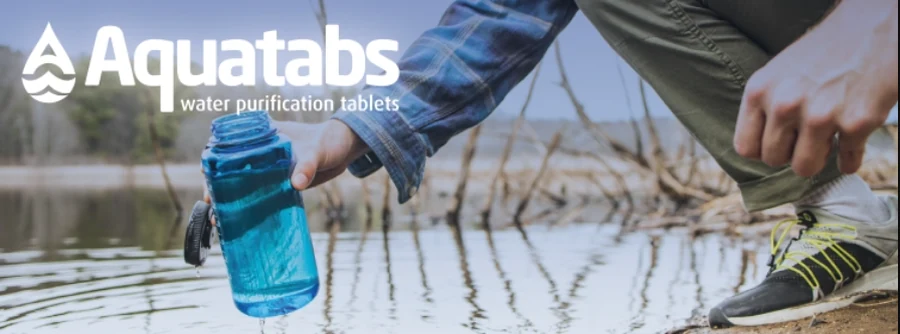
Aquatabs are the tablet product tied to this site, and the case for them is simple: they’re the cheapest, lowest-effort way to make already-clear water safer to drink, they take up almost no space, and they don’t have anything that can break sitting in a drawer for years. For a boil-water advisory, a car kit, or a backup you hope to never use, they’re close to the ideal tool — the tradeoff is the wait time and the fact that they do nothing for water that’s cloudy or full of sediment.
We go deep on Aquatabs’ specifics — treatment ratio, wait time, what pathogens they address — in the sibling filter article linked above. The short version for this piece: keep a container in every kit (home, car, go-bag) because the cost of doing so is trivial next to the value of a backup treatment method that can’t jam or wear out.
Where a filter earns its keep
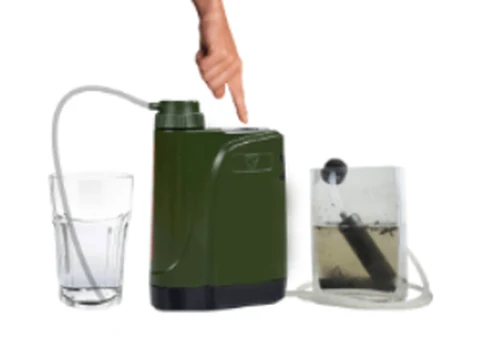
A filter — specifically the Survivor Filter Pro, the model we’ve tested and reviewed in depth on this site — is the right call whenever volume or turbidity is the problem tablets can’t solve: cloudy water, a household’s worth of gallons needed in a hurry, or a situation where waiting 30 minutes per batch just doesn’t scale. It’s also reusable in a way a box of tablets isn’t, which matters if an outage runs long enough that you’d otherwise be watching a tablet count tick down.
The tradeoff versus tablets is upfront cost and depending on a power source — this is the electric-pump version, so it runs on batteries rather than muscle, and the pre-filter stage needs attention if you’re running visibly dirty water through it repeatedly. If you’d rather not rely on batteries at all, Survivor Filter Pro also comes in a fully manual hand-pump version with the same core filtration — a solid no-power backup-to-the-backup option, linked below alongside the electric model.
We link the electric-pump version below since it’s the one we’d default to for a home kit, but a fully manual hand-pump model is available too if you’d rather not depend on batteries.
Check Price: Survivor Filter Pro (Electric) See the Manual Version
The piece most guides skip: a hands-free filter that doubles as storage
Treating water is usually framed as one job: pump it or drop a tablet in, done. But once you are filtering for a household over multiple days, hands-free capacity starts to matter — you do not want to stand at a pump for twenty minutes every time someone needs a refill. The HydraPak Seeker+ 6L Gravity Filter Kit solves that with a dual-bag gravity system: fill the “dirty” bag from a tap, rain barrel, or any questionable source, hang it, and gravity pushes the water through a 63mm filter cap into a “clean” bag you can pour or dispense straight from — no pumping required.
The filter itself removes 99.99% of bacteria and parasitic cysts, is rated for roughly 1,500 liters before it needs replacing, and flows at over a liter per minute. That makes it a genuine second filtration method rather than just somewhere to put water after the Survivor Filter Pro has already treated it — and the clean bag doubles as your storage vessel, so there is no separate reservoir to buy on top of it.
The Survivor Filter Pro is faster for a quick refill, but it needs someone actively pumping. The Seeker+ Gravity Filter Kit is slower but hands-free — hang it before bed or before tackling other chores, and come back to clean water waiting in the attached bag. It is also real redundancy: if one filter clogs or breaks, you are not down to tablets alone.
Building your kit: the bottom line
For most households planning realistically for a multi-day-to-two-week outage, the answer isn’t “tablets or a filter” — it’s a small system where each piece covers the other’s weak point:
- A filter (Survivor Filter Pro) as your primary method for volume and for handling anything that isn’t perfectly clear.
- Tablets (Aquatabs) as the zero-maintenance backup for when the filter’s busy, broken, or you just don’t want to pump water for a quick single batch.
- A gravity filter that doubles as storage (HydraPak Seeker+ Gravity Filter Kit) as a hands-free backup filtration method for bulk volume, with the clean water it produces held in the same bag rather than a separate container.
That’s a complete system, not a single purchase decision — and building it out costs far less than most people assume relative to the actual risk of a multi-day outage. See the sibling article linked above for the specific product breakdown, pricing, and our full take on each piece.
FAQ
Do I really need both tablets and a filter, or is that just upselling?
For a short outage (a day or two) with clean stored water, either one alone can cover you. The case for both strengthens the longer an outage runs and the more sources you might end up relying on — redundancy matters more on day 10 than day 2, and the two methods fail in different ways, so having both means one covers the other’s blind spot.
Can I use purification tablets on cloudy or muddy water?
Not reliably. Tablets are a chemical treatment for pathogens — they don’t remove sediment, turbidity, or improve taste, and cloudy water can also make the chemical treatment less effective. If a source looks dirty, filter it first (or find a clearer source) before treating it with tablets.
Which one is cheaper in the long run, tablets or a filter?
Tablets have a lower upfront cost but a real per-use cost that adds up over time and eventually run out. A filter costs more upfront but the cost per gallon drops sharply over its rated lifespan since it’s reusable rather than consumable. For most households, the practical answer is to own both rather than optimize purely for cost — they’re not interchangeable enough to treat as a straight cost comparison.
How fast does each one actually work?
A filter produces drinkable water as you pump it — there’s no wait. Tablets need time to work, commonly around 30 minutes, before the water is safe to drink. If you need water in a hurry, that difference alone often decides which one you reach for.
What about boiling — do I even need tablets or a filter if I can just boil water?
Boiling is effective against biological contaminants and is a legitimate backup method if you have a reliable heat source and enough time and fuel. It doesn’t remove sediment or chemical contaminants the way a filter can, and it requires fuel and time that may be scarce during an extended outage — which is why it’s a good backup to know, not a full substitute for having tablets or a filter on hand.
Do I need a separate container to store treated water?
Not if you use a gravity filter kit like the HydraPak Seeker+ — its “clean” bag holds the water it produces, so filtration and storage happen in the same product. If you are filtering or treating water some other way, any clean, food-safe, sealed container works for short-term storage.
The Prep Verdict is reader-supported. If you buy through a link on this page, we may earn a commission at no extra cost to you. See our full disclosure for details. We only recommend products we’d actually put in our own emergency supplies.
Leave a Reply