Picture two households, same night, same street, packing the same closet shelf of gear. One is watching a hurricane track shift toward them on the news, with a mandatory evacuation order maybe twelve hours out. The other is watching a livestream of a crowd a few blocks from their neighborhood, with a decision to leave that might need to happen in the next twelve minutes. Same shelf. Same bag, ideally. Completely different problem.
That’s the comparison this guide is built around, and it’s the one Ready.gov’s “Build A Kit” checklist, FEMA’s own federal baseline for a disaster supply kit, doesn’t make for you. It gives you a solid, official list of the essentials. It doesn’t tell you that a hurricane evacuation and a civil-unrest evacuation put different pressure on that same list: different time budgets, different destinations, different odds you’re walking instead of driving. Search “bug out bag checklist” past that and you’ll find the same forty-item list on forty different sites, reshuffled with different product names. None of them run the two scenarios side by side and show you where the answer splits.
So here’s the head-to-head, laid out plainly before I get to a single item:
| Natural disaster (hurricane, wildfire, flood) | Civil unrest | |
|---|---|---|
| Warning time | Hours to days, often with an official order | Minutes, sometimes none |
| Destination | Usually known: a shelter, a hotel inland, family out of the area | Often just “away from here,” decided en route |
| Infrastructure | Roads, cell towers, and card networks are usually still functioning, at least for a while | Roads, cell service, and payment systems can be unreliable or overloaded fast |
| Likely mode of travel | Mostly driving | Real chance the fastest way out is on foot |
| What that does to the bag | Rewards more supply margin: extra water, extra food, more redundancy | Punishes extra weight: speed, low profile, and grab-and-go readiness matter more |
Lay it out like that and the design problem becomes obvious: a bag built only for the hurricane column is heavier and slower than a fast, on-foot evacuation needs. A bag built only for the civil-unrest column is too thin on food, water, and shelter margin for a multi-day disaster evacuation. The right bag isn’t a compromise between the two. It’s a kit built to satisfy the harder constraint in each category, so it holds up no matter which column you end up in.
Here’s the question that distills all of that into one gut-check: how much warning do you get, and how much do you know about where you’re going? Answer that, and most of the rest of the packing decision follows from it.
That’s what follows: not another item list, but the bag I’d build on top of the federal baseline. What a pack has to physically do, what goes in it and why, what I deliberately leave out, and, at every turn, what the natural-disaster and civil-unrest columns above pull in different directions and what they don’t touch at all.
Reader-supported: I may earn a commission if you buy through links on this page, at no extra cost to you. Disclosure.
Quick Verdict: Building a Bug-Out Bag for Evacuation Scenarios
Load-bearing, mil-spec-grade construction built to be carried for miles, not just worn to the car.
Most of the capacity and durability of the premium tier for meaningfully less money.
- Why “checklist” is the wrong frame
- Choosing the pack itself
- Water: what fits in a bug-out bag
- Food: enough calories to move, not a pantry
- First aid, medications & medical needs
- Shelter, warmth & clothing
- Tools, light & timekeeping
- Hygiene & sanitation
- Communication, documents & cash
- Non-weapon safety & situational awareness
- Pack comparison at a glance
- Building your kit: three budgets
- Bottom line
- FAQ
Free Updates
I send an email when something’s genuinely worth your time: a new guide, a real price drop on something I recommend, or an actual safety alert. No spam, no daily digest, unsubscribe anytime.
Why “checklist” is the wrong way to think about this
The table above is the shorthand. Here’s the fuller version of why those two columns diverge as much as they do.
A natural disaster evacuation (hurricane, wildfire, flood, earthquake aftermath) usually gives you some structure even when it gives you little warning. There’s often an official evacuation route, a known category of destination, and a real if imperfect expectation that roads, cell towers, and card networks are still mostly working, at least for a while. The bag’s job is self-sufficiency for an uncertain number of days away from home, plus enough redundancy that a broken filter or a dead phone battery doesn’t turn into a real problem.
Civil unrest flips more of that than people expect. The decision to leave often has to happen faster and with less certainty about where you’re going beyond “away from here.” Infrastructure that a natural-disaster evacuation usually still has (cell service, card payments, clear roads) can be unreliable or actively overloaded. And the walk out may genuinely be a walk, through crowded or unpredictable conditions, which makes weight, speed, and not standing out matter more than they do when you’re mostly driving.
Worth saying plainly: FEMA, Ready.gov, and the Red Cross build their guidance around natural and technological hazards (hurricane, wildfire, flood, earthquake, extended power outage) and none of them publish a civil-unrest-specific protocol. The natural-disaster column tracks their official kit lists closely. The civil-unrest column is this site’s own reasoning, applied consistently from the same underlying emergency-management principles (have a plan, know your routes, have an out-of-area contact), not a citation of an agency source that doesn’t exist. I think that reasoning holds up, but it’s a different kind of claim than “FEMA recommends this,” and I’d rather say so than let the two blur together.
Run that table through the rest of this guide and the design problem sharpens: build for the harder constraint in every category (the natural-disaster column’s supply math, the civil-unrest column’s weight and speed math) and the result is one bag that clears both bars, not two separate kits.
One more reality check before the gear list: for most households, “bugging out” doesn’t mean disappearing into the wilderness. It means getting to a hotel, a relative’s house, a shelter, or simply a safer part of town, and being self-sufficient for the day or two it takes to get fully settled somewhere. That’s a very different packing list than the one built for someone planning to live off-grid in the woods, and it’s the one this guide is built around. If what you need is a kit that lives in the trunk for a stranded-on-the-highway scenario rather than a full evacuation, that’s a related but distinct kit. I’ll cover that difference in a future car-emergency-kit-vs.-bug-out-bag guide.
Some bug-out-bag guides also cover self-defense tools. I don’t, and that’s a deliberate choice, not an oversight. This guide sticks to evacuation readiness, situational awareness, communication, and non-lethal safety measures. The parts of a bag that make sense regardless of where you live, what your state’s laws allow, or your personal comfort with the topic. If you choose to carry a self-defense tool, that’s a personal decision best made with proper training and legal guidance for your specific state and situation. It’s genuinely outside what a gear guide can responsibly tell you to do.
Choosing the pack itself
Everything below has to physically fit in something, and the pack is where the two-scenario comparison gets decided before you’ve even opened the main compartment. Get the pack wrong for the civil-unrest column (too heavy, too tactical-looking, too hard to move fast in) and it undermines the bag no matter how well you’ve stocked the rest of it. Get it wrong for the natural-disaster column (too flimsy, too small) and it can’t carry the supply margin a multi-day evacuation needs. The pack has to answer to both columns at once, which is exactly why it’s the one piece of the kit worth spending real money on.
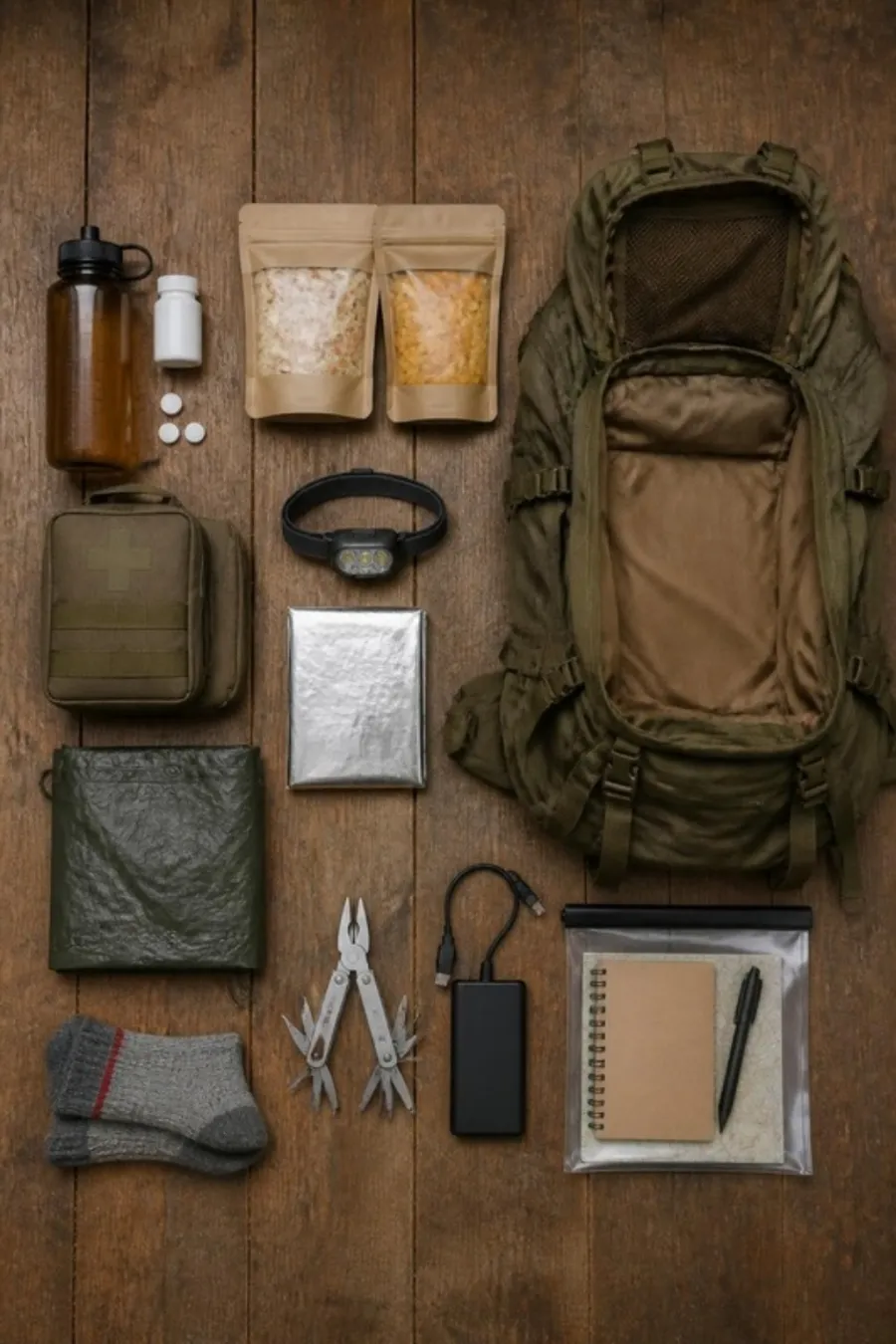
What matters for a bug-out pack, in rough order:
- Load-bearing comfort over capacity. A padded hip belt that transfers weight off your shoulders matters more than a few extra liters of space once the bag has real weight in it. Most people underestimate how heavy a fully packed bug-out bag gets until they’ve carried one for more than a few blocks, which is precisely the civil-unrest scenario where “a few blocks” might turn into a few miles.
- Durable, weather-resistant material. This bag may sit untouched in a closet for years and then get used hard, wet, and without gentle handling on the one day it matters. Ripstop or similarly abrasion-resistant fabric and reinforced stress points (straps, zippers, the bottom seam) matter more here than they would on a bag used daily.
- A sane capacity range. Big enough to hold a real 24–72-hour kit for the natural-disaster column, not so big that you’re tempted to overpack it past what you can carry for miles if the civil-unrest column is the one you’re living through. The three packs below range from roughly 20L to 40L, which covers that range comfortably without tipping into “expedition pack” territory.
- External attachment points, for a sleeping bag, a jacket, or a water bottle you want quick access to without opening the main compartment.
- A low-key color and silhouette. For the civil-unrest column specifically, a bag that doesn’t visually scream “I am prepared for the apocalypse” is doing real work: drawing less attention is itself a safety feature, and it costs nothing on the natural-disaster side of the comparison.
Mystery Ranch: the premium pick
Mystery Ranch built its reputation on load-bearing systems originally developed for demanding professional use, and that heritage shows up directly in how their packs carry weight. The frame and hip belt are built to move real load comfortably over real distance, which is exactly the stress test both columns of this comparison put on a pack. It’s the more expensive option here, and for most households it’s worth it specifically because this is the one piece of gear you’re betting on performing when everything else is going wrong.
The Blitz 35 is the specific model worth pointing at: 35.8L, built from CORDURA fabric with YKK AquaGuard zippers, a framed harness system with a padded, removable waist belt, and MOLLE/PALS webbing for external attachment. It runs around $329, the most expensive pack in this roundup, but that framed harness is the difference between “carryable for a mile” and “carryable for as long as an evacuation takes.”
Check the Mystery Ranch Blitz 35
Breakwater Supply: the value pick
Breakwater Supply takes a different build approach than Mystery Ranch (fully waterproof, IP68-rated construction rather than tactical MOLLE webbing) at a lower price point than the premium tier. That’s arguably a better fit for a household kit anyway: it keeps everything inside genuinely dry through a real downpour or water crossing, without leaning into a tactical look, which does double duty for the low-profile half of the comparison above. For a household outfitting several bags at once (one per family member, plus car kits), the price difference across multiple packs adds up fast, and Breakwater gets you most of the way to the premium-tier experience without the premium-tier cost.
The Waterproof Preparedness Pack bundle is the specific pick: a Fogland backpack (15L, 20L, or 25L, your choice) plus a 100-piece marine first aid kit in its own 2L dry bag, all IP68-rated for full submersion. Bundle pricing runs from around $173. It’s a genuinely different build philosophy than Mystery Ranch, fully sealed rather than load-framed, which is exactly why it works as the budget pick without feeling like a downgrade in the ways that matter for this comparison.
Check the Breakwater Supply Preparedness Pack
3V Gear: the middle ground
3V Gear sits between the two above on both price and build quality: a reasonable pick if Mystery Ranch feels like more pack (and more money) than your household needs, but Breakwater’s entry tier feels like it’s cutting corners you’re not comfortable with. Their packs lean modular, with MOLLE-style attachment webbing for external gear.
The Paratus 3-Day Operator’s Backpack is the model to look at: 40L (the biggest capacity of the three, useful if you’re packing for more than one person’s contingency supplies), heavy-duty 600D polyester with reinforced stress points, a detachable Rapid Deployment Pack for grab-and-go essentials, and hydration-bladder compatibility. It runs around $140: meaningfully less than Mystery Ranch, more capacity than Breakwater’s bundle.
Check the 3V Gear Paratus 3-Day Pack
Water: what fits in a bug-out bag
This is the section where a bug-out bag and a home emergency kit genuinely diverge, and it’s worth being honest that the two-scenario comparison above matters less here than the disaster-vs.-home comparison does. Whether you’re evacuating a hurricane or evacuating on foot from something faster-moving, you’re carrying the water, not driving it. My home emergency water guide recommends a 6L or 10L HydraPak Seeker for a stationary household supply. That’s the right call when the reservoir sits on a counter or in a closet and never has to be carried. A bug-out bag is a different problem: everything in it has to be carried, on foot if it comes to that, for an unknown distance, so bulk and weight both count against you in a way they don’t at home.
Building the stationary home half of your water plan too? Use my free household water calculator to get the right number for your house before you size the go-bag.
The American Red Cross’s benchmark for an evacuation supply is specific: one gallon of water per person, per day, with a minimum 3-day supply for a go-bag (their home kit standard is higher still. A 2-week supply for sheltering in place). For a family of four, the full 3-day evacuation figure works out to 12 gallons: roughly 100 pounds of water, before anything else goes in the bag. That’s the honest math, and it’s exactly why a bug-out bag can’t just be a smaller cooler: nobody is carrying 12 gallons of water on foot, whether the reason they’re on foot is a flooded road or a crowded one. The bag’s job instead is to get you through the first stretch of the evacuation and then let you refill and treat water along the way rather than hauling the full 3-day gallon count on your back.
That’s why the bag’s hydration setup should be built around the HydraPak Seeker 2L instead: collapsible, packs flat when empty, and light enough that filling it doesn’t turn your bag into something you can’t carry. It’s not a smaller version of the “right” home answer; it’s the correctly-sized answer for a different problem, paired with a refill-and-treat strategy rather than an attempt to carry the full Red Cross gallon count in bottled water.
Beyond the reservoir itself, keep two things in the bag:
- A day or two of bottled or pouched drinking water as your starting supply: enough to comfortably cover the Red Cross’s 1-gallon-per-person-per-day figure for the first day or so, so you’re not relying on finding and treating water in the first hours of an evacuation.
- Aquatabs as your zero-weight, zero-moving-parts backup treatment method for everything after that starting supply runs out. A dozen tablets weigh almost nothing and take up almost no space, and they cover you if the water you find along the way isn’t safe to drink straight. No pump and no wait for a filter to clear. Drop one in and wait.
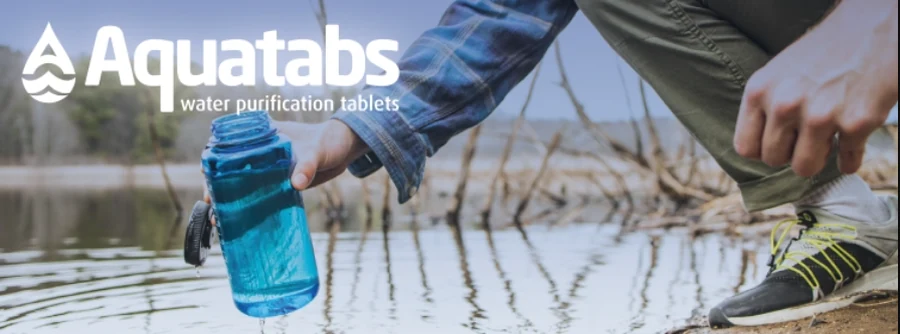
If you’re weighing tablets against a squeeze or pump filter for the bag itself (rather than the stationary setup above), my tablets vs. filters comparison breaks down when each one makes sense for a bug-out scenario.
Food: enough calories to move, not a pantry
A bug-out bag’s food plan answers a narrower question than a home food-storage plan does: enough calories, in the lightest and most shelf-stable form possible, to get through the actual evacuation window without needing to cook a real meal or find a grocery store. That’s a 24–72-hour problem, not a “how do I eat for two weeks” problem. My freeze-dried vs. dehydrated vs. MRE guide covers the longer-term storage decision in depth; this is the condensed, bug-out-specific version of that same logic.
Freeze-dried pouch meals are the right format for a bag specifically because they’re light, compact, calorie-dense, and only need hot or cold water to prepare. No separate cookware required if you’re eating cold, and just a small amount of fuel if you want a hot meal. Nutrient Survival’s higher-protein formulation is a reasonable fit here for the same reason it’s a reasonable fit for a home base layer: when you’re already stressed and moving, a meal that delivers real nutrition does more for you than a bucket of empty carbs.
Round the pouches out with a handful of no-prep items (protein bars, nut butter packets, anything shelf-stable that needs zero water and zero time) for the first few hours when stopping to rehydrate a pouch meal isn’t realistic. That first-few-hours window is exactly where the two-scenario comparison bites hardest: a hurricane evacuation usually gives you a minute to grab a pouch and heat water at a rest stop, a civil-unrest evacuation usually doesn’t.
If a hot meal is the plan even occasionally, pack the means to make one: waterproof or storm-proof matches and a small lighter, kept together in a waterproof container (a simple zip-top bag works, or a dedicated waterproof match case). It’s a near-zero-weight, near-zero-cost addition, and it’s the piece that’s easy to forget when “fuel for a hot meal” gets mentioned without ever naming an ignition source. This is that ignition source, and it earns a permanent spot next to the pouch meals rather than getting left out. Carry more than one way to start a fire: if one method gets wet or runs out of fuel, you still have another.
Check Price: Nutrient Survival Protein Breakfast Sampler
First aid, medications & medical needs
A bug-out first aid kit needs a different emphasis than a home first aid kit. At home, you’re mostly managing everyday injuries and illness over a longer outage. In an evacuation, either column, the realistic injury profile skews toward what happens to people moving fast, sometimes over rough terrain, sometimes in a crowd: cuts, sprains, blisters, and, worst case, a bleeding injury that needs to be controlled quickly before you can get to real medical care.
A bug-out bag needs two kinds of medical gear: everyday first aid and bleeding control. For everyday first aid, the Adventure Medical Kits Mountain Series Explorer ($86.49) covers cuts, blisters and sprains for one to four people for up to seven days. It has no tourniquet, so pair it with a CoTCCC-approved one like the C-A-T tourniquet. Mountain Man Medical’s Basecamp kit (around $325) goes further into pure trauma response: two C-A-T tourniquets, a SWAT-T tourniquet, hemostatic dressing, chest seals, a nasopharyngeal airway, and a moldable splint, all in a molle pouch built for vehicle or base-camp storage. The Explorer plus a C-A-T is the better all-purpose pick for most households; the Basecamp kit is the one to add if you want dedicated hemorrhage-control gear beyond the basics.
Whichever kit you choose, know how to use it before you need it: a stop-the-bleed style basics course (widely offered free or low-cost through local fire departments and Red Cross chapters) is worth more than any single item in the kit itself.
Prescription medications & other medical needs
A trauma kit covers injuries. It doesn’t cover the person in your household who takes a daily prescription, and this is a real blind spot in most bug-out-bag advice, not a minor add-on, and it’s a blind spot that doesn’t care which column of the comparison you’re in. Is there a week of insulin in the bag, or is that the thing everyone assumes someone else grabbed? The Red Cross explicitly recommends a minimum 7-day supply of prescription medications in an evacuation kit, separate from whatever’s already in your first aid kit. Build this layer deliberately:
- At least a 7-day supply of every regularly taken prescription medication, stored in its original labeled container where possible and rotated periodically so it doesn’t expire quietly in the bag.
- A written, up-to-date medication list (drug name, dosage, and prescribing doctor) for every household member who takes one. If a pharmacy or ER has to step in, this list does more for you than trying to remember it under stress.
- Doctor and pharmacy contact information, including a secondary pharmacy if your regular one is a local chain that could be closed or inaccessible during the same event you’re evacuating from.
- Backup glasses, hearing aid batteries, or mobility aids for anyone in the household who depends on them daily. An easy category to forget precisely because it’s so routine at home.
If anyone in your household has a medical condition that isn’t obvious at a glance (diabetes, a severe allergy, a cognitive or mobility condition), consider a simple medical ID card or bracelet in the bag as well. It’s a small addition that can matter a great deal if you’re separated from your group or unable to explain your own needs in the moment.
This is also the right place to think about who else the bag needs to work for. A single-adult packing list doesn’t automatically cover an infant (formula, diapers, a bottle), a pet (food, a leash, any pet medications), or an elderly or medically dependent household member (mobility aids, larger medication needs, dietary restrictions). None of this changes the bag’s core structure. It’s the same categories above, sized and stocked for the actual people (and animals) in your household rather than a generic single adult.
Shelter, warmth & clothing
Shelter in a bug-out bag isn’t about camping gear: it’s about surviving an unplanned night outside your home or your car if the evacuation takes longer than expected, or the destination you were counting on isn’t available when you get there, which is a real risk in both columns of the comparison, for different reasons. Keep this layer light and multi-purpose rather than building out a full camping kit:
- An emergency mylar/space blanket: compact, nearly weightless, and genuinely effective at retaining body heat for an unplanned cold night.
- A compact rain poncho or emergency poncho: keeps you dry and functions as improvised shelter in a pinch.
- An extra warm layer appropriate to your climate: a packable insulated layer if you’re anywhere that gets cold at night, even somewhere that’s warm during the day.
- A full change of clothes, including sturdy, closed-toe shoes you can walk miles in. This one’s easy to underrate until you remember where this guide started: a civil-unrest evacuation, and plenty of natural-disaster ones, may genuinely mean walking, not driving. Whatever you’re wearing when an evacuation starts is what you’re stuck with unless a change is already in the bag, and that includes footwear.
- Work gloves: for anything from clearing debris to handling a hot vehicle part, and they take up almost no room.
- An N95 or equivalent dust mask, a few per household member. It’s a doubly useful item for this specific guide: on the natural-disaster side it’s standard wildfire-smoke and debris-cloud protection, and on the civil-unrest side it’s genuinely relevant for smoke and crowd conditions (including tear gas exposure) during an evacuation through an unstable area. It’s cheap, weighs almost nothing, and covers both columns of the comparison with one item.
Tools, light & timekeeping
A reliable EDC knife earns its place in a bug-out bag as a utility tool (cutting cordage, opening packaging, food prep, gear repair) not as a weapon. Buck Knives and SOG both make fixed and folding blades built for exactly this kind of daily-carry utility use: sturdy, easy to maintain, and sized to carry rather than display. (For the full head-to-head, including CRKT and Schrade, see my EDC knife comparison.) A folding knife, a fixed blade, or both is a good idea, and in some scenarios a hatchet can also be very useful (splitting wood, clearing debris) if you can spare the weight.
The Buck 112 Slim Select is a compact, pocket-clip EDC knife based on Buck’s classic 112 Ranger: made in the USA, easy to carry daily, and priced affordably enough to drop in every household member’s bag without a second thought. The SOG Escape leans more rescue-oriented: a 3.4″ serrated blade paired with a built-in strap cutter and glass breaker, useful if the evacuation scenario involves a vehicle. Either is a solid utility pick; the SOG’s rescue features make it the better choice specifically for the “still might be in the car” half of this comparison.
Check the Buck 112 Slim Select Check the SOG Escape
A headlamp or compact flashlight matters more than people expect: hands-free light while you’re carrying a pack, setting up shelter, or checking a map in the dark is worth more than a single bulky flashlight. Pack spare batteries or a small power bank dedicated to it.
A rugged watch solves a problem most people don’t think about until their phone is dead: knowing what time it is. Look for a durable, water-resistant watch with a long-life battery or solar charging, a backlight, and a strap that is easy to adjust with gloves on. It is a genuinely useful backup once you’re rationing phone battery for communication instead of checking the time, which is exactly the tradeoff the civil-unrest column tends to force earlier than the natural-disaster column does.
A small dry-bag or set of packing cubes keeps the bag organized enough that you can find things under stress: fumbling through a jumbled main compartment for a headlamp in the dark defeats the point of packing ahead of time. Any packing-cube set or small dry bag sized to your pack’s main compartment does the job here. This is one spot where the specific brand matters far less than simply having a system and sticking to it.
Hygiene & sanitation
This is a category most bug-out-bag content skips entirely, and it shouldn’t. It’s on every official go-bag list for a reason. Staying reasonably clean during a multi-day evacuation isn’t a comfort item, it’s a real illness-prevention measure when you may not have reliable access to a working bathroom or shower, regardless of which scenario put you on the road. Keep it simple and compact:
- Travel-size hand sanitizer and a pack of wet wipes: for hands, basic cleanup, and situations where running water isn’t available.
- A small roll of toilet paper, compressed or in a zip-top bag to keep it dry.
- A few small trash bags: for waste, for keeping wet or dirty items separated from the rest of the bag, and as an improvised extra layer against rain if it comes to that.
- Feminine hygiene items, sized for the number of days you’re planning around, for anyone in the household who needs them.
- A travel toothbrush and small toothpaste, plus any daily personal-care item someone in the household genuinely can’t skip for several days.
None of this needs to be elaborate or brand-specific: a simple zip-top pouch with these items is enough. The point is that it exists in the bag at all, not that it’s a curated kit.
Communication, documents & cash
This is the category that separates a genuinely well-built bug-out bag from a gear pile, and it’s also where the two-scenario comparison from the top of this guide matters most in practice: both columns can knock out the infrastructure you’d normally lean on, at different speeds.
Communication:
- A battery or hand-crank emergency radio: cell towers and data networks can get overloaded or go down entirely in both a natural disaster and a civil-unrest event, and a radio doesn’t depend on either.
- A portable power bank, charged and stored in the bag, dedicated to your phone. Not the one you also use daily and might grab half-charged.
- A written family communication plan, built along the lines of Ready.gov’s own Family Emergency Communication Plan: an out-of-area contact everyone calls if local lines are jammed (it works because long-distance calls often route around local network congestion that blocks local calls), plus a physical rally point if separated and phones aren’t working at all. Ready.gov’s site has a free fillable version of this plan if you want a ready-made template rather than building one from scratch.
Documents:
- Copies of ID, insurance policies, and critical medical information, in a waterproof pouch: digital copies (photographed and stored somewhere accessible offline, like a password-protected drive on the power bank) are a smart backup, but paper copies don’t depend on a charged device.
- A physical, printed map of your area and likely evacuation routes. Your phone’s map app is great until it isn’t: dead battery, no signal, or a network too congested to load anything.
- A recent printed photo of each household member. It sounds minor next to insurance paperwork, but it earns its place for a specific, concrete reason: if your group gets separated during a chaotic evacuation, the exact civil-unrest scenario this guide keeps coming back to, a current physical photo is one of the fastest ways to help someone else identify and help reunite you, especially if phones are dead or service is down and a digital photo isn’t reachable.
Cash:
- A modest reserve of small-bill cash kept in the bag. Card networks and ATMs can be unreliable or entirely unavailable during both a natural-disaster outage and a civil-unrest event, and a functioning gas station or corner store that can’t process cards still takes cash.
Non-weapon safety & situational awareness
This is the section civil-unrest framing usually skips or overcorrects on: either ignoring the scenario entirely or leaning hard into tactical gear. Neither is useful. What helps, without touching self-defense weapons:
- A loud personal alarm or whistle. Three short blasts is a universally recognized distress signal, it draws attention and help without confrontation, and it takes up essentially zero space in the bag.
- A portable travel door lock or door wedge alarm. If you end up in a hotel room or unfamiliar temporary lodging, a small device that reinforces a door or alerts you if it’s opened adds real peace of mind for almost no weight.
- High-visibility or reflective elements for when you want to be seen (signaling for help, staying visible to your group at night) and the judgment to know when you’d rather not stand out (moving through an unstable area, where a low-key bag color and unremarkable clothing serve you better). The same tradeoff that shaped the pack-color advice earlier in this guide.
- A plan to go with the gear. Know your routes out of your immediate area before you need them, identify a few possible destinations in advance, and agree on rally points with your household ahead of time. The printed family photo and written communication plan above are both part of this same plan, not separate afterthoughts. The single biggest safety upgrade in a civil-unrest scenario is usually leaving earlier and with a plan, not any item in the bag.
- Situational awareness basics: staying with your group, avoiding obvious choke points and large unpredictable crowds when you have a choice, and trusting your read of a situation enough to change course early rather than pushing through somewhere that feels wrong.
None of this requires, or benefits from, a weapon. A whistle, a door lock, a flashlight, and a plan you’ve talked through with your household do more for realistic personal safety than most of what gets marketed as “civil unrest gear,” and they come with zero legal complexity and zero training requirement.
Pack comparison at a glance
| Mystery Ranch | Breakwater Supply | 3V Gear | |
|---|---|---|---|
| Best for | Households who want the most durable, comfortable-to-carry option and are willing to pay for it | Budget-conscious households, or outfitting multiple bags at once | A middle ground between premium build and lower price |
| Price | ~$329 (Blitz 35, 35.8L) | From ~$173 (Fogland bundle, 15–25L) | ~$140 (Paratus, 40L) |
| Build/carry comfort | Load-bearing frame and hip belt built for real-distance carrying | Fully waterproof, IP68-rated construction; solid for the price, not built to the same load-bearing standard as the premium tier | Comparable to Breakwater; MOLLE-style exterior webbing for modular attachment |
| Best fit | The one bag in the house, or the bag for whoever’s carrying the most weight | A second, third, or fourth bag for other household members | Anyone who wants more modularity without the premium price |
Building your kit: three budgets
Every tier below assumes the same non-negotiable basics regardless of budget: each household member’s 7-day medication supply and written medication list, a hygiene kit, an N95 mask, sturdy shoes and a change of clothes, and a fire-starting kit with more than one method (for example a lighter plus waterproofed matches). None of those add meaningful cost, so they’re not really a “tier” decision. They belong in every version of this bag, in both columns of the comparison. What scales with budget is the pack itself and the depth of the food/water/first-aid layers.
Budget tier: Breakwater Supply pack, HydraPak Seeker 2L, Aquatabs, a couple days of no-prep food plus a few Nutrient Survival pouches, a basic first aid kit (the Adventure Medical Kits Mountain Series Hiker, $34.49), one EDC knife (Buck or SOG), a mylar blanket and poncho, a battery radio, printed documents and a family photo in a zip-top bag, and cash. This covers the real essentials without stretching the budget on the pack itself.
Mid-tier: 3V Gear or Breakwater pack, the same water/food/first-aid core scaled up slightly (more Nutrient Survival pouches, a more complete first aid kit), a rugged watch, a dedicated organizer pouch to keep everything findable, and a dedicated power bank rather than sharing one with daily use.
Premium tier: Mystery Ranch pack, the fullest version of the food and first aid layers, a hand-crank radio in addition to battery, a proper waterproof document case, and, genuinely worth the small cost at this tier, a second, smaller version of the kit for a car or a second household member.
One more thing worth mentioning: gear doesn’t stay current forever. Batteries drain, food pouches near their best-by date, and new products come along. If you’d rather have new supplies rotated in for you than manage the checklist yourself, BattlBox’s curated survival-gear subscription is a reasonable way to keep a kit fresh over time without doing the research from scratch every six months.
Bottom line
Run any bug-out bag against the two scenarios that put people in this situation (a natural disaster giving you hours and a known destination, civil unrest giving you minutes and none) and most generic checklists fall short on one side or the other: too heavy for the fast exit, too thin for the multi-day one. Build around the pack’s real carrying comfort first, size the water layer against the Red Cross’s actual 1-gallon-per-person-per-day evacuation figure rather than a vague guess, and put real thought into the medications, hygiene, and communication/documents/cash layers that most lists skip entirely. Skip the weapons question altogether. It’s not what this kit needs to solve, and it’s not a decision a gear guide should be making for you.
Free Updates
I send an email when something’s genuinely worth your time: a new guide, a real price drop on something I recommend, or an actual safety alert. No spam, no daily digest, unsubscribe anytime.
FAQ
How much should a bug-out bag weigh? There’s no single right number (it depends on your fitness, how far you might realistically need to carry it, and what climate/season you’re packing for) but a commonly cited target for an adult is roughly 10–20% of body weight. The practical test matters more than the number: if you can’t comfortably carry your packed bag for a mile or more, it’s too heavy. A test that matters a lot more if a civil-unrest evacuation is the one you face.
Do I need a bug-out bag if I already have a home emergency kit? Yes. They solve different problems. A home kit assumes you’re sheltering in place; a bug-out bag assumes you’re leaving. The water and food amounts in particular should be sized differently for each: a home kit can lean on bulkier, cheaper storage (see my home water storage guide), while a bug-out bag needs to prioritize weight and packability.
What’s the real difference between a bug-out bag and a 72-hour kit? In practice, very little: “72-hour kit” is often just another name for the same concept. The framing in this guide (natural disaster vs. civil unrest, side by side) is meant to sharpen the decision-making behind what goes in that 72-hour window, not to describe a fundamentally different product.
Should I keep my bug-out bag at home or in the car? Ideally both, in some form. A full bag at home for a home evacuation, and a lighter, car-specific kit for being stranded away from home. They’re not the same kit; I’ll cover how to think about that difference in a future car-emergency-kit-vs.-bug-out-bag comparison.
Is it useful to carry cash for a disaster or civil unrest event? Yes: card networks, point-of-sale systems, and ATMs can all be unreliable or unavailable during both types of events, even when a store or gas station is otherwise open and willing to sell you something. A modest reserve of small bills is inexpensive insurance against that specific failure mode.
Why doesn’t this guide cover self-defense weapons? It’s a deliberate editorial choice, not an oversight: see the callout above. This site focuses on evacuation readiness, situational awareness, and non-lethal safety measures that apply regardless of where you live or what your state’s laws allow. Any decision about carrying a self-defense weapon is a personal one that depends on training, local law, and your own judgment. Not something a gear guide should be recommending.
How often should I check or rotate my bug-out bag? At least twice a year. Check expiration dates on food and any medical supplies (medications in particular, given the 7-day supply above), confirm batteries and power banks are charged, make sure clothing and shoes still fit everyone it’s packed for, and update documents and the medication list if anything’s changed. Tying it to a recurring date (daylight saving time changes are a common trick) makes it easier to remember.
The Prep Verdict is reader-supported. If you buy through a link on this page, I may earn a commission at no extra cost to you. See my full disclosure for details. I only recommend products I’d put in my own emergency supplies.