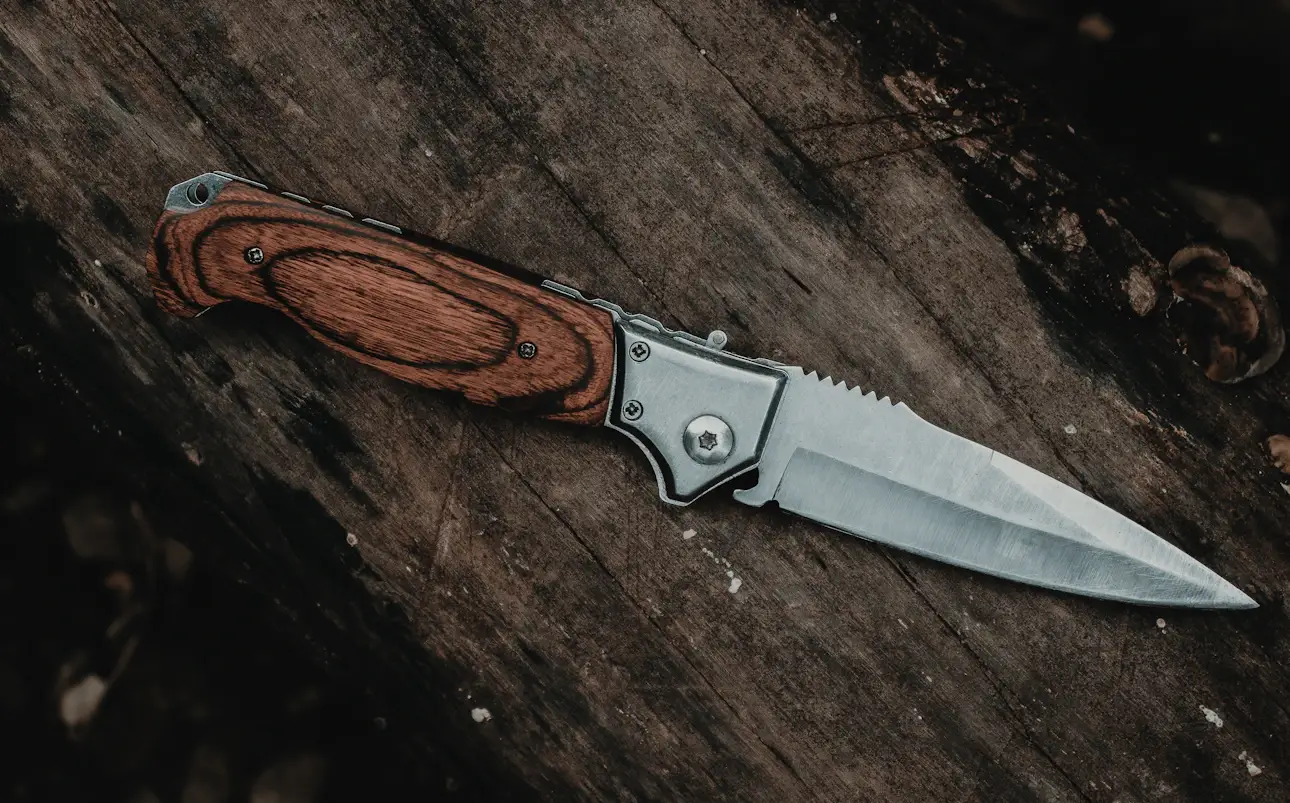
Buck vs. SOG vs. CRKT vs. Schrade. If you’ve narrowed your EDC knife search to these four names, you’re already asking the right question. Not “which knife is best” in the abstract, but which of these four fits the way you’ll use it. I compared all four head-to-head, brand against brand, the same way I’d size up multitools or headlamps: on how well the tool does its job, not on how sharp the marketing sounds.
Picture the last time a delivery box beat you. Not the cardboard itself. The tape. Whoever packed it ran the tape around every seam twice, and now you’re standing in the doorway digging through a kitchen drawer for scissors that have wandered off somewhere. Or picture the version that happens outdoors: a bungee cord’s knot has swollen tight in the rain and your fingers can’t pick it loose, or a paracord bracelet needs trimming to length before it’ll sit right on your wrist. None of that is dramatic. It’s just Tuesday. And it’s exactly the moment a decent knife in your pocket turns a small annoyance into a five-second non-event.
And to be clear about the job: this is a utility-tool comparison, full stop. An EDC knife earns its place in a preparedness kit the same way a multitool or a headlamp does. You reach for it all the time, emergency or not. Slicing open a delivery box, cutting cordage or webbing, breaking down cardboard, prepping food at camp, notching kindling for a fire, trimming a bandage, freeing a stuck zipper. That’s the whole list. Nothing in this comparison touches self-defense or combat use: see my bug-out bag guide for why this site doesn’t cover self-defense gear at all.
Here’s why these four specifically make for a genuinely useful head-to-head: they’re not fighting for the same customer. Buck, SOG, CRKT, and Schrade sit at four distinct points on the price-and-positioning map, which means this comparison isn’t about crowning one overall winner. It’s about matching each brand’s real strengths to your specific use case and budget, then telling you plainly which one that is.
Reader-supported: I may earn a commission if you buy through links on this page, at no extra cost to you. Disclosure.
Quick Verdict: Buck vs. SOG vs. CRKT vs. Schrade
Built to last, mostly made in the USA, and backed by the strongest warranty in this comparison. The pick that’s hardest to get wrong.
The lowest price of the four: makes sense when you’re stocking more than one kit at a time.
One-handed assisted-opening folders and tough fixed blades built for fast deployment and real work.
Designer-built locks and opening mechanisms, including a tool-free-cleaning design, priced better than the engineering suggests.
Free Updates
I send an email when something’s genuinely worth your time: a new guide, a real price drop on something I recommend, or an actual safety alert. No spam, no daily digest, unsubscribe anytime.
What makes a good EDC/utility knife for a prep kit
Before getting into steel types and lock mechanisms, run your own answer through this: how often will this knife leave your pocket, how hard will you use it, and how many do you need to buy? Answer those three honestly and the “best” brand for your kit mostly picks itself. The sections below are what makes each answer land on a specific brand.
Before pitting the four brands against each other, it’s worth knowing what you’re judging. Four things separate a good EDC knife from a disappointing one: the steel, the lock type, whether it folds or stays fixed, and whether the price buys you more durability.
Blade steel, in plain language. Every knife steel trades off the same three things: how long it holds an edge, how well it resists rust, and how easy it is to sharpen once it dulls. No single steel wins on all three at once.
- Budget stainless steels (commonly cited examples across the industry include grades like 8Cr13MoV or 7Cr17MoV) sharpen easily with basic tools and shrug off rust, but lose their edge faster under heavy use. Most lower-priced knives, including entry-level lines from several brands below, land here.
- Mid-tier stainless steels (Buck’s long-standing 420HC is the clearest example) hold an edge noticeably longer than budget stainless while staying easy to sharpen and rust-resistant. The sweet spot for a knife that sees regular use and needs to stay serviceable without fuss.
- Premium stainless steels (CPM S30V and S35VN are common examples, including in some higher-end Buck runs) push edge retention well past either category above, at the cost of being harder to sharpen and a real step up in price.
- High-carbon steels (1095 is the standard example, used in some Schrade fixed blades) take an exceptionally sharp edge and resharpen easily in the field, but demand more attention to drying and oiling the blade to keep rust away.
None of these wins outright: a 420HC or budget-stainless folder that gets wiped down and put away after every use will outlast a premium-steel knife that gets neglected. For most preparedness use (occasional, general-purpose cutting rather than daily heavy trade work) edge retention matters less than the marketing implies; corrosion resistance and easy upkeep matter more.
Lock type. A folding knife’s lock is what keeps the blade from folding shut on your hand mid-task. Not a minor detail. Here’s what you’ll run into across these four brands:
- Lockback: a spine-mounted lever holds the blade open; simple, proven, and the mechanism Buck’s iconic Model 110 made famous decades ago.
- Liner lock / frame lock: a spring-tensioned liner, or the handle’s own frame, shifts in behind the open blade to hold it; common on modern folders from all four brands.
- Assisted opening: a spring finishes the opening motion once the blade is pushed partway, so you can deploy the knife one-handed in a hurry; SOG and CRKT both build heavily around this.
- Proprietary mechanisms: CRKT stands out here with several patented locks (its Deadbolt lock and its Field Strip system, which lets a knife come fully apart by hand for cleaning without tools, are two examples) built to fix specific real-world annoyances rather than just add a new way to open a blade.
Fixed vs. folding. A fixed-blade knife has no moving parts to fail, holds up better to hard use like batoning kindling, and draws faster, but it needs a sheath and won’t tuck into a pocket. A folding knife carries discreetly and comfortably for daily use, but its lock is one more part that can eventually wear or fail. Most preparedness kits do best with one of each: a folder for daily pocket carry and light tasks, a fixed blade in a bug-out bag or car kit for the heavier cutting and food-prep jobs.
Price-to-durability. Spending more doesn’t automatically buy a knife that outlasts a cheaper one for your actual use case. A $25 Schrade fixed blade used occasionally for camp chores can genuinely last years, while a premium folder nobody ever maintains can rust or loosen just as fast. The real question isn’t “which is the toughest knife money can buy”. It’s “which knife’s price, steel, and lock type match how often and how hard you’ll use it.” That’s the lens the brand-by-brand breakdown below runs on.
Buck Knives
Positioning: A classic American cutlery maker, founded in 1947 and still family-owned five generations later. Buck is best known for essentially inventing, then popularizing, the modern folding hunting knife category. Its Model 110 Folding Hunter, introduced in 1964, has sold an estimated 15 million units and is the direct reason “buck knife” became American shorthand for any folding lockback knife.
Manufacturing: Buck moved from San Diego to Post Falls, Idaho in 2005, and most of its knives are still made there: roughly 87% of the current lineup, by independent estimate. The remaining ~13% is imported, mostly on lower-tier lines like certain fillet knives and camp axes, and clearly labeled per-product.
Strengths: Steel quality and consistency (typically 420HC on mainline models, with select premium runs in steels like CPM S30V/S35VN), a genuinely strong warranty (see below), and a design pedigree most competitors are still chasing. Buck’s lockback mechanism on classic models is about as field-proven as folding-knife locks get.
Warranty: Buck’s “Forever Warranty” covers defects in material and workmanship for the life of the knife, with repair or replacement at Buck’s discretion. It excludes normal wear, misuse (using the knife as a pry bar, chisel, or screwdriver), rust from neglect, and dishwasher damage; sheaths are covered for one year only, and a $10 fee applies if the knife needs reassembly after repair. Turnaround runs 10-12 weeks. It’s a real, well-documented warranty, and the strongest of the four brands here on paper.
Who it’s for: Anyone who wants a knife they can reasonably expect to hand down rather than replace, and who’s comfortable paying a bit more up front for that. Buck is the safest default recommendation in this head-to-head. Not the cheapest, not the flashiest mechanism, but the hardest to get wrong.
SOG
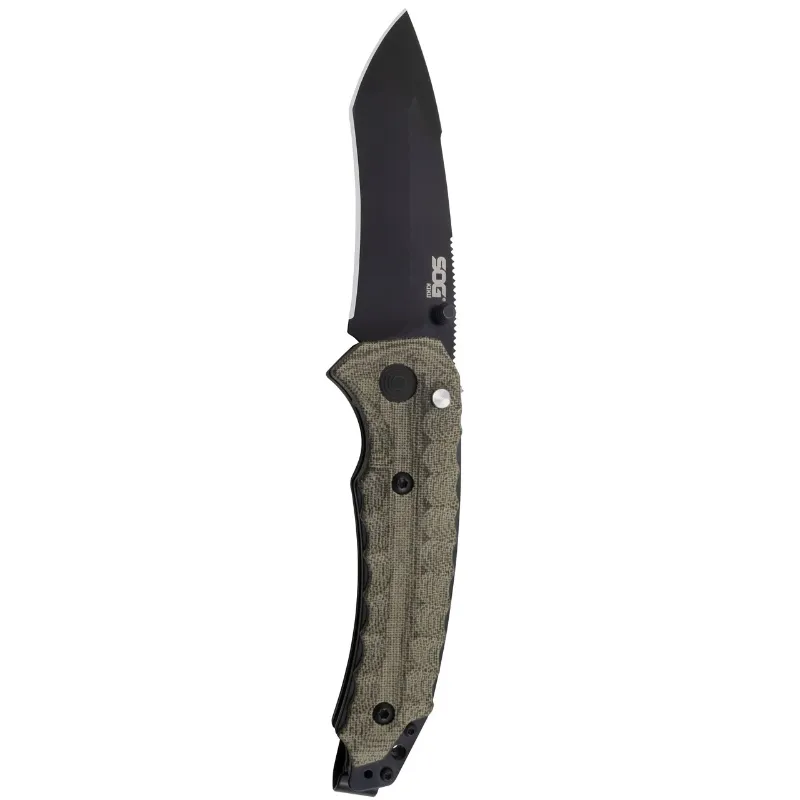
Positioning: Founded in 1986 in Santa Monica, California, SOG’s name is a historical reference to a Vietnam-era joint special operations unit. A naming choice from the company’s earliest branding, worth noting briefly for accuracy, though it has no bearing on how this site evaluates or recommends the brand’s knives, which I cover strictly as utility tools. SOG is now headquartered in Irving, Texas and has been owned by GSM Outdoors since December 2021.
Manufacturing: SOG’s lineup spans a wider manufacturing range than the other three brands here. Premium folding models have historically been made by G. Sakai in Seki City, Japan, a city with a long cutlery-manufacturing reputation, while fixed-blade production has shifted from Japan to Taiwan over time, and more budget-oriented lines are made in Taiwan or China. A smaller USA-made line also exists within the current catalog.
Strengths: SOG’s folders are where the brand’s assisted-opening mechanisms show up most, letting you deploy a blade one-handed in a hurry: genuinely useful when you need the blade out fast while your other hand is busy holding a box, a rope, or a flashlight. The brand also spans a wide price range, from accessible entry lines up through more premium Japan-made folders, so there’s real room to move within a single brand.
Warranty: SOG backs its knives with a Limited Lifetime Warranty against defects in materials and workmanship. The exclusions have real teeth: normal wear and tear, resharpening, misuse, lack of maintenance, disassembly, rust or staining from neglect, bent tips, and damage from prying, throwing, or chopping are all excluded, as are purchases from unauthorized sellers. Claims go through SOG customer service for an RA (return authorization) number before anything is sent in. It’s genuine coverage, but closer in spirit to CRKT’s exclusion-heavy structure than to Buck’s more generous terms.
Who it’s for: Someone who wants a knife that snaps open fast and one-handed for frequent, quick utility tasks, cutting cordage or packaging without needing a free second hand, and who’s willing to shop within SOG’s range to land on the price-to-build-quality combination that fits their budget.
CRKT
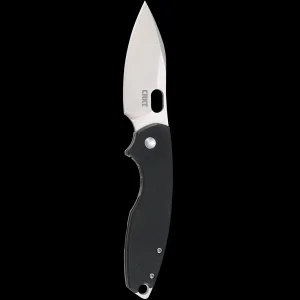
Positioning: Columbia River Knife & Tool was founded in 1994 in Tualatin, Oregon (still its headquarters) by two former Kershaw Knives employees. CRKT built its identity around collaborating with independent knife designers: Ken Onion, Kit Carson, and Ed Halligan (whose K.I.S.S. design became an early breakout hit at the 1997 SHOT Show) are among the names behind CRKT’s catalog: rather than relying solely on in-house design.
Manufacturing: The large majority of CRKT knives are made in China, with some production in Taiwan and small amounts elsewhere. CRKT does sell a small line of USA-made knives (around half a dozen models) alongside the broader overseas-made catalog, worth knowing if domestic manufacturing matters to you specifically.
Strengths: This is the brand where mechanism innovation isn’t a marketing line, it’s the actual pitch. CRKT’s Field Strip design lets a knife be taken fully apart by hand, with no tools, for real cleaning: genuinely useful for a knife that handles food prep or gets dirty and needs to come apart rather than just get wiped down. Its Deadbolt lock and Outburst assisted-opening mechanism are two more examples of CRKT engineering around a specific practical annoyance (accidental lock disengagement, slow one-handed deployment) instead of just shipping another folder. Across the lineup, CRKT consistently outperforms its price point on design thoughtfulness.
Warranty: CRKT backs its knives with a Limited Lifetime Warranty covering defects in materials and workmanship for the life of the original owner, on products bought from CRKT or an authorized retailer. It excludes normal wear and tear, damage from misuse or poor maintenance, and modified or resold products; accessories like sheaths get a one-year limited warranty, and LED components get 90 days. It’s a real warranty with sensible exclusions, similar in structure to Buck’s.
Who it’s for: Someone who wants a genuinely clever, easy-to-maintain design at a strong price, and doesn’t need the knife to be American-made to earn its spot in the kit. CRKT is a particularly good fit if the knife will regularly see food prep or dirty, greasy tasks, given how much easier the Field Strip-style designs are to clean.
Schrade
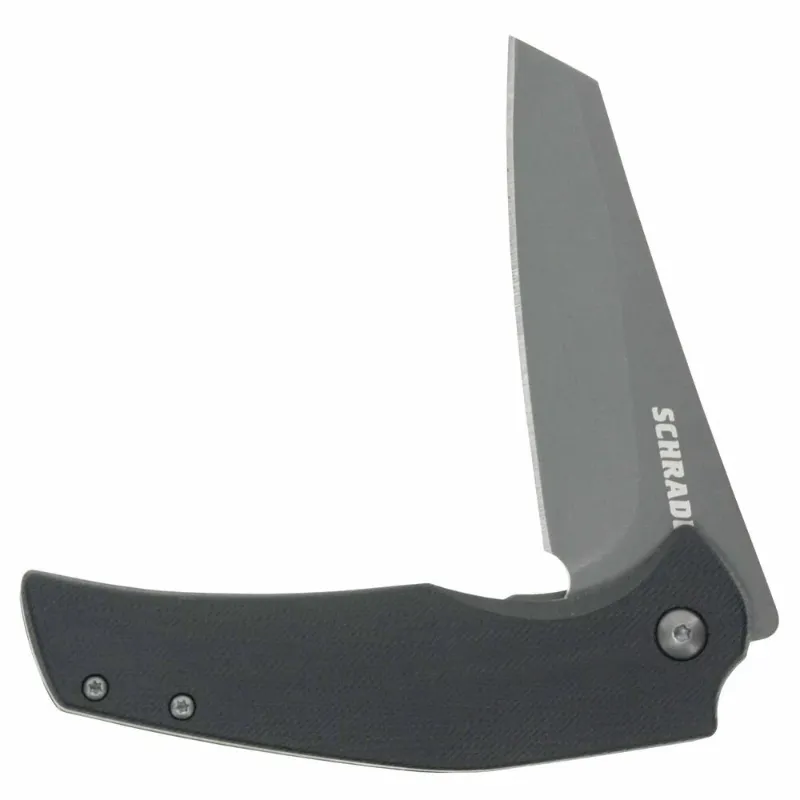
Positioning: The Schrade name goes back to 1892, and for most of the 20th century it was a genuinely significant American cutlery brand (as Imperial Schrade Corp. after a 1946 merger). That original company went bankrupt in 2004, and its equipment and intellectual property were sold off. Taylor Brands LLC subsequently acquired the Schrade name and brand rights; Taylor Brands was later acquired by Battenfeld Technologies. It’s worth being direct about this history: today’s Schrade is a licensed revival of a historic name, not a continuation of the original American manufacturer, and manufacturing moved to China after the original Ellenville, New York factory closed.
Manufacturing: Current Schrade-branded knives are made in China: well-documented and consistent across current sourcing.
Strengths: Price. Schrade is consistently the least expensive of the four brands in this comparison, built on workhorse budget steels, commonly cited examples include 8Cr13MoV or 7Cr17MoV stainless on folders and 1095 high-carbon steel on fixed blades, rather than premium alloys. Reviewers who’ve handled the current lineup generally describe the fixed blades as noticeably better built than the folders, and the overall value proposition as honest rather than impressive: a knife you can use hard, scratch up, and not feel bad about, without expecting the fit-and-finish of a pricier brand.
Warranty: Schrade (Taylor Brands) backs its knives with a Limited Lifetime Warranty for the original owner only. It’s non-transferable, and a claim requires proof of purchase from an authorized retailer. It excludes normal wear, lost or stolen knives, commercial use, corrosion, misuse or neglect, and unauthorized disassembly or repair; liability is capped at the retail price paid, with no consequential damages covered. Fair coverage for the price point, but it doesn’t stretch as far as Buck’s more generous terms.
Who it’s for: Budget-conscious buyers, and specifically households outfitting multiple kits at once (a car kit, a bug-out bag for each family member, a spare in a junk drawer) where paying premium-brand prices four or five times over doesn’t make sense. It’s also a reasonable “beater knife” choice for genuinely rough utility work you don’t want to put a nicer blade through.
Comparison at a glance
| Buck Knives | SOG | CRKT | Schrade | |
|---|---|---|---|---|
| Price tier | $$-$$$ | $$-$$$$ | $-$$ | $ |
| Best for | Overall pick: durability, warranty, reputation | Fast one-handed deployment for frequent utility tasks | Value and clever, easy-to-maintain mechanisms | Lowest cost per knife, outfitting multiple kits |
| Lock/opening type | Primarily lockback and liner lock (manual) | Assisted opening on many folders; manual on fixed blades | Manual and assisted opening (Outburst); proprietary locks (Deadbolt, Field Strip) | Primarily manual lockback |
| Typical construction | ~87% USA-made (Post Falls, ID); ~13% imported lower-tier lines | Ranges from Japan-made premium folders to Taiwan/China budget lines, plus a small USA line | Mostly made overseas (China/Taiwan), with a small USA-made line | Made in China |
| Warranty | Forever Warranty: lifetime against defects, documented exclusions, 10-12 week turnaround | Limited Lifetime Warranty: real exclusions (wear, misuse, prying/throwing damage), RA-number claims process | Limited Lifetime Warranty: original owner, documented exclusions | Limited Lifetime Warranty: original owner only, non-transferable, retail-price-capped liability |
Bottom line: buying by use case and budget
If you only want to buy one knife and never think about it again: Buck is the pick. The Forever Warranty alone makes it close to a no-lose decision, and the build quality holds up to years of the kind of occasional-but-real use a preparedness knife sees.
If you’re equipping multiple kits: car, bag, junk drawer, one per family member: go with Schrade. Paying premium-brand prices four or five times over doesn’t make sense for knives that will mostly sit in a kit until needed; Schrade’s fixed blades in particular are a reasonable, honest choice for that job.
If you want a knife that deploys fast, one-handed, for frequent quick tasks: SOG makes the most sense. The assisted-opening mechanism genuinely earns its keep when you’re cutting cordage or packaging with one hand full.
If you want the most thoughtfully engineered knife for the money, especially one that’s easy to clean after food prep or dirty work: CRKT is worth a look. The Field Strip and Deadbolt designs solve real annoyances other budget-friendly knives don’t bother addressing.
None of these four is a wrong choice: they’re each solving a slightly different problem at a different price point, which is exactly why the head-to-head framing matters more than a single “winner.” A reasonable two-knife kit for many households: a Buck or CRKT folder for daily pocket carry, and a Schrade fixed blade in the bug-out bag or car kit where hard use and replaceability matter more than pocket-friendliness. See my bug-out bag guide for how an EDC knife fits into the broader kit, and my best emergency water filter guide and freeze-dried vs. dehydrated vs. MRE guide for the other pieces of a complete home and bug-out setup.
Free Updates
I send an email when something’s genuinely worth your time: a new guide, a real price drop on something I recommend, or an actual safety alert. No spam, no daily digest, unsubscribe anytime.
FAQ
Do I need a fixed blade or a folding knife for a preparedness kit?
Ideally both, for different jobs. A folder is what you carry daily in a pocket for quick, light tasks. A fixed blade is stronger for harder use (batoning kindling, heavier food prep, anything that puts real stress on the blade) and belongs in a bug-out bag or car kit rather than a pocket.
Is a more expensive steel worth it for a preparedness knife?
Usually not as much as marketing suggests. Premium steels hold an edge longer between sharpenings, but for occasional, general-purpose use, the way most people use a preparedness knife, a well-maintained mid-tier steel like 420HC will serve just as reliably as a premium steel that gets neglected. Corrosion resistance and consistent maintenance matter more day to day than maximum edge retention.
Are assisted-opening knives legal to carry everywhere?
Assisted-opening and automatic knife laws vary significantly by state, and even by county or city, in the U.S.. This isn’t a case of exaggerating for caution: the American Knife & Tool Institute (AKTI), the industry’s standard legal reference, says the same thing and maintains an up-to-date state-by-state law finder. Check AKTI’s current guidance for your specific state before carrying an assisted-opening or automatic knife, rather than relying on general advice like this one.
Which of these four brands is the most durable?
On paper and by reputation, Buck: long-standing steel and construction quality, backed by the strongest documented warranty of the four. That said, “durable” also depends on maintenance: any of these four knives, used within its intended purpose and dried/oiled appropriately, should hold up for years of preparedness-kit use.
Why doesn’t this guide cover self-defense use?
Same editorial stance as the rest of this site: I cover knives strictly as utility tools (cutting, food prep, gear repair, general camp and household tasks) not as self-defense items. See the callout in my bug-out bag guide for the fuller explanation of why self-defense gear isn’t part of this site’s scope.
How do I maintain an EDC knife so it lasts?
Wipe the blade dry after use (especially with carbon steel, which is more rust-prone than stainless), keep the pivot or hinge lightly oiled on folders, avoid using the knife for tasks it’s not built for (prying, screwing, chopping with a folder), and touch up the edge periodically with a basic sharpening stone or rod rather than waiting until it’s fully dull.
The Prep Verdict is reader-supported. If you buy through a link on this page, I may earn a commission at no extra cost to you. See my full disclosure for details. I only recommend products I’d put in my own emergency supplies.