A powerful nor’easter tore through the Northeast from September 26–28, 2026, knocking out power to more than 90,000–100,000 customers across New York, New Jersey, Connecticut, Massachusetts, Pennsylvania, Virginia, and Rhode Island. New York alone saw roughly 37,450 outages, Connecticut around 29,740, and Suffolk County on Long Island over 21,000 of those on its own. Wind gusts reached 61 mph on Long Island, and Coastal Flood Warnings covered New York City, Long Island, and coastal Connecticut, with storm surge pushing 2 to 3-plus feet of inundation into vulnerable waterfront areas and waves running 6 to 9 feet along exposed coastline. The storm was forecast to gradually weaken through Monday, with broader improvement by Tuesday.
If you’re reading this because your power just went out, or you’re watching the same kind of system build on the radar for your area, I’m not here to relitigate the storm: I’m here to walk through exactly what’s worth doing about it, in order, and what’s worth owning before the next one shows up.
Reader-supported: I may earn a commission if you buy through links on this page, at no extra cost to you. Disclosure.
Quick Verdict: What Actually Helps in an Outage Like This
About 1kWh of battery: phones charged, a router running and a CPAP through a night or more, with no fuel, fumes or generator noise. For phones and a router only, the smaller Goal Zero Yeti 300 is enough.
What you want on hand if a boil-water advisory follows coastal flooding, or your well pump loses power.
Free Updates
I send an email when something’s genuinely worth your time: a new guide, a real price drop on something I recommend, or an actual safety alert. No spam, no daily digest, unsubscribe anytime.
What Just Happened
A fast-moving nor’easter tracked up the Eastern Seaboard from September 26 through 28, 2026, bringing damaging wind, heavy rain, and coastal flooding to seven states: New York, New Jersey, Connecticut, Massachusetts, Pennsylvania, Rhode Island, and Virginia. Wind gusts reached 61 mph at Farmingdale Airport on Long Island and 56 mph at both JFK and Bridgeport airports: enough to snap branches and bring down the kind of tree limbs that sit on residential power lines.
Power losses topped 90,000–100,000 customers across six-plus states at the peak, with New York reporting roughly 37,450 outages, Connecticut about 29,740, and Suffolk County, New York alone accounting for more than 21,000. Coastal Flood Warnings covered New York City, Long Island, and coastal Connecticut, with storm surge and inundation of 2 to 3-plus feet in vulnerable waterfront areas and waves running 6 to 9 feet along exposed sections of the Long Island coast. Forecasters expected the storm to gradually weaken through Monday, with broader improvement arriving Tuesday.
That’s the actual scale of it: a wind event and a flood event happening at the same time, across a densely populated stretch of coastline. It’s not extreme by nor’easter standards, which is exactly why the planning that matters here isn’t specific to this one storm. It’s the planning that pays off for whichever coastal storm hits next.
Why a Coastal Storm Is a Different Kind of Power-Outage Risk
I treat coastal nor’easters differently from an inland wind or ice storm, because they tend to stack two separate risks on top of each other instead of just one.
The wind side behaves like most outage-causing storms: gusts in the 50–60+ mph range are more than enough to bring down weak limbs and older above-ground lines. That part is familiar. The same mechanism behind most summer thunderstorm outages, just sustained over a longer window.
The flooding side is what makes coastal storms harder to plan around. Storm surge and wave action don’t just threaten basements and cars. They can flood underground utility vaults and, in low-lying waterfront areas, make roads impassable for crews trying to reach downed lines. A storm that combines both means crews are often dealing with wind damage and flood damage in the same footprint at the same time, which slows restoration compared to a wind-only event.
Practically, if you’re in a coastal flood zone, your outage risk isn’t just “will the power go out”. It’s “will the power go out in a way that also limits how quickly anyone can reach me, and whether I can safely leave if I need to.” That combination is worth planning for specifically, which I get into below.
The Realistic Timeline: How Long Do These Outages Last
I try to stay away from worst-case framing here, because most outages from a storm like this resolve faster than people assume, but “faster than worst-case” still isn’t fast. For a nor’easter of this scale, a reasonable planning range looks like:
- Isolated outages from a single downed line: often restored within a few hours to a day, especially where crews have easy access.
- Neighborhood-level outages from widespread tree damage: commonly 1 to 3 days, depending on how many crews a utility has staged and how many other towns are competing for the same repair resources.
- Outages compounded by coastal flooding or substation damage: these stretch past 3 days, because crews often can’t safely access flooded infrastructure until water recedes and a safety inspection clears it.
The honest answer to “how long will my power be out” depends heavily on whether you’re on a wind-only outage or a wind-plus-flood outage, and where you sit in your utility’s restoration priority. That’s why I plan around a 3-day baseline and treat anything shorter as a bonus. A realistic middle ground between “it’ll probably be back by dinner” and treating every storm like a week-long grid failure.
Where Do You Stand Right Now: Three Readiness Tiers
I get asked some version of “what should I actually buy” every time a storm like this makes the news. The honest answer depends on where you’re starting from. Here’s how I’d think about it across three realistic tiers. Not a sales pitch, an actual plan you can act on today, this weekend, or over the next month.
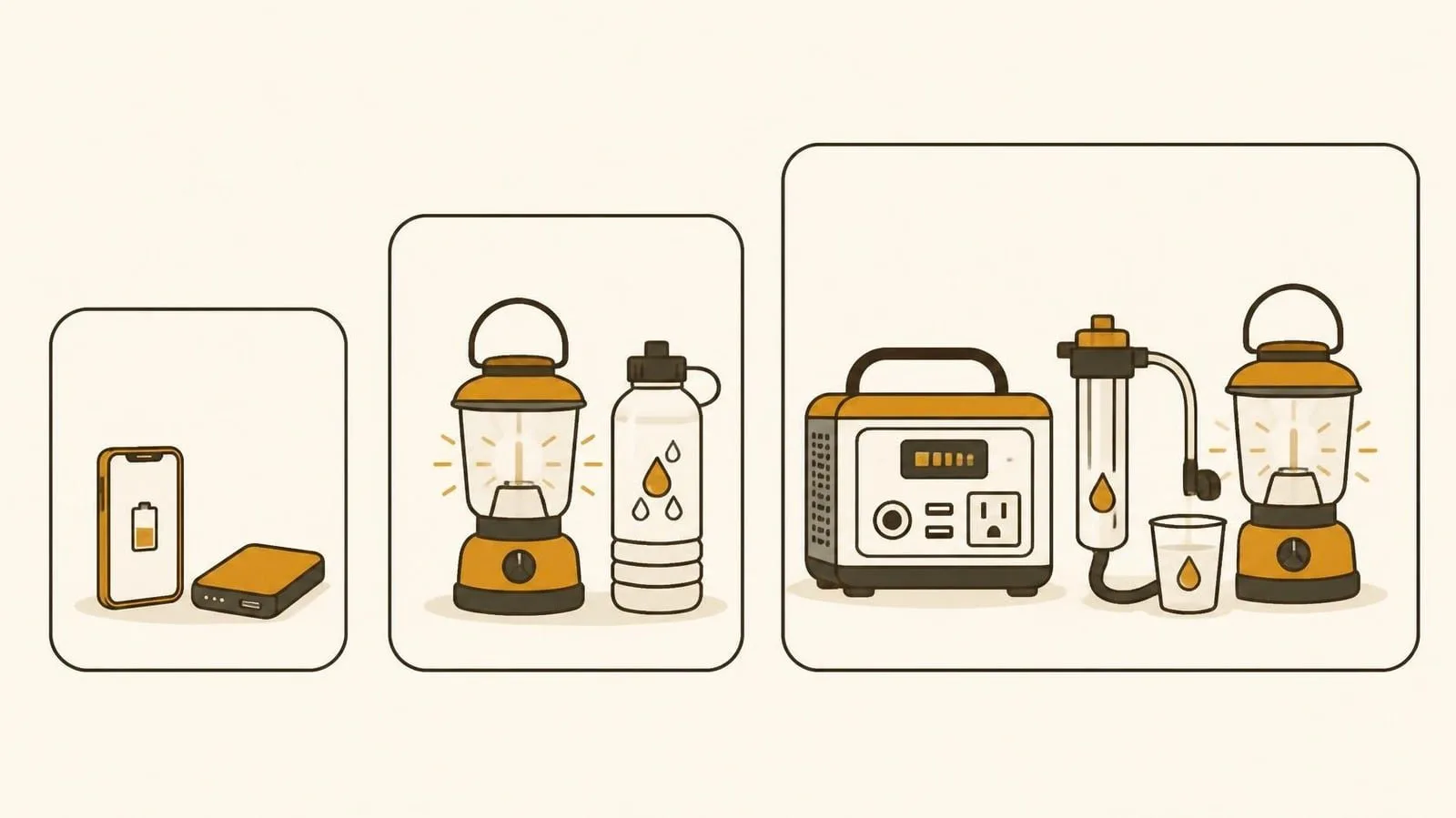
| Category | Already Have the Basics ($0) | Weekend Project | Building From Scratch ($300+) |
|---|---|---|---|
| Power | Charge every device to 100% before the storm arrives; know where your car keys are so you can top off a phone from the car if needed. | Buy a couple of large power banks and keep them charged permanently: good enough for phones and small electronics through a 1–2 day outage. | A dedicated portable power station, with no fuel, fumes, or noise. The Goal Zero Yeti 300 (via BattlBox) or the Barebones Block Tower runs a router and recharges devices; step up to the Jackery HomePower 1000 v2 if you need a CPAP or medical device running through the night. |
| Light | Locate every flashlight and candle you own now, before the power goes out and you’re doing it in the dark. | Add a battery-powered lantern and a headlamp to a designated “storm drawer” so nobody’s hunting for light with a dying phone flashlight. | A solar-rechargeable lantern: I cover the specific LuminAID models worth owning, and why they beat a camping lantern for this exact job, in my emergency lantern guide. |
| Water | Fill your bathtub and any clean containers you have before the storm, in case service is interrupted. | Store a few gallons per person and pick up purification tablets as cheap insurance against a boil-water advisory. | A real filtration setup like the Survivor Filter Pro, sized against your actual household number: run it through my water calculator and see the full comparison in my water filter guide. |
If you’re only doing one thing this week, do the “Weekend Project” column. It’s cheap, it takes an afternoon, and it covers the actual failure mode of a storm like this one. A multi-day outage, not a doomsday scenario. Not sure which bigger-ticket item fits your household? My 5-question kit finder will point you to a real starting list in about a minute.
The Non-Negotiable Checklist If You’re in the Storm’s Path Right Now
If a coastal storm is bearing down on your area right now, or you’ve just lost power, this is the short list that matters:
- Charge every phone, power bank, and device to 100% before you lose power.
- Fill your bathtub and a few large containers with water, in case service is interrupted or a boil-water advisory follows.
- Know exactly where your flashlights, headlamps, and batteries are: don’t wait until it’s dark to find out you don’t.
- Move anything loose outdoors (furniture, trash cans, planters) inside or somewhere it can’t become a projectile in high wind.
- If you’re on well water, expect your pump to fail with the power: store extra drinking water accordingly.
- Keep your car’s gas tank topped off; gas stations lose power too, and pumps need electricity to run.
- If anyone in your household depends on a powered medical device, have a plan for keeping it running before the outage starts, not after.
- Check on neighbors who may be more vulnerable to a multi-day outage: elderly residents, anyone on medical equipment, families with infants.
- Avoid downed power lines entirely, and assume every one is live until a utility crew says otherwise.
- Stay off flooded roads: it doesn’t take much moving water to strand or damage a vehicle, and depth is nearly impossible to judge, especially at night.
What Helps: Power, Light, Water
When I get asked what matters in a storm like this, as opposed to what sounds prepared but doesn’t get used, it comes down to three things: keeping essential devices powered, having safe light that isn’t a fire risk, and having water you can trust.
Power. A portable power station covers the realistic need for most households: phones charged, a router or hotspot running so you can get updates, and, critically for a lot of people, a CPAP or other medical device kept running without interruption. The Jackery HomePower 1000 v2 is my default recommendation for most households, and the one I’d pick if anyone in the house uses a CPAP. If you only need phones, a router and lights, the Goal Zero Yeti 300 is a smaller, lighter option; the more compact Goal Zero Venture 75 power bank (USB only, no AC outlet, so fine for phones and a router but not a CPAP) and the Barebones Block Tower are worth a look if you want something smaller and more grab-and-go: capacity needs scale a lot depending on whether you’re just keeping phones alive or also running a CPAP and a mini-fridge.
Light. Candles and fuel-burning lanterns are still a real fire and carbon-monoxide risk during extended outages, and that risk goes up, not down, in a house already stressed by a storm. A solar-rechargeable LED lantern gives you real light output with no open flame and no fuel supply to manage, and it recharges for free during daylight if the outage runs multiple days. I cover the specific models worth owning in my emergency lantern guide.
Water. This is the one people underprepare for most, because a power outage often means a well pump stops working, or, in the case of storm-related infrastructure damage, a boil-water advisory gets issued. The Survivor Filter Pro means you’re covered even if stored water runs out or you’re unsure about tap water quality; my water filter guide breaks down which setup fits which situation, and my water calculator will run the actual numbers for your household size.
Coastal Flooding: What to Check
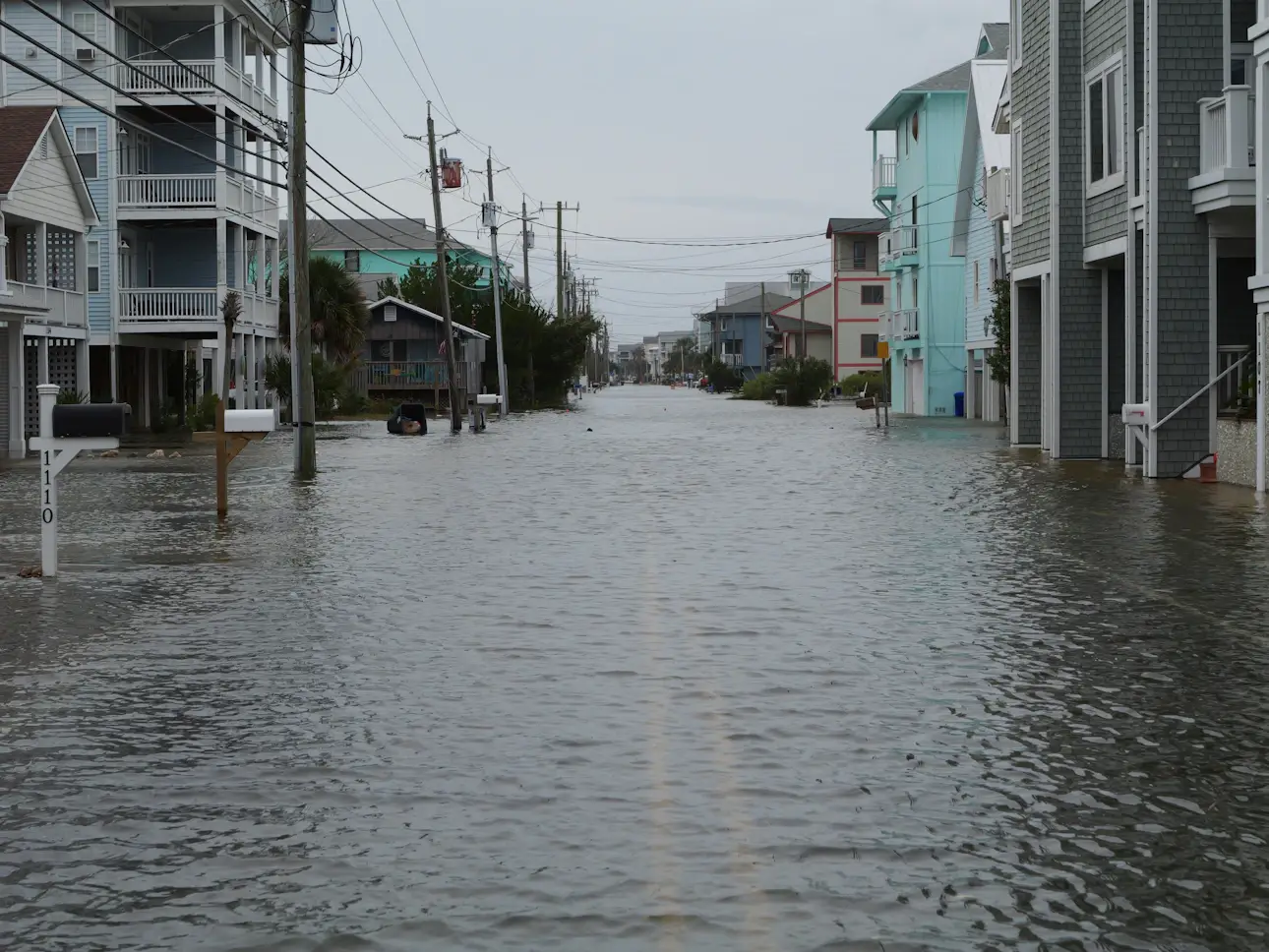
This storm’s coastal flood warnings covered New York City, Long Island, and coastal Connecticut, with 2 to 3-plus feet of surge inundation in vulnerable waterfront spots and 6 to 9-foot waves along exposed Long Island coastline. If you’re anywhere near tidal water (beachfront, tidal creeks, marshes, and low-lying streets that flood in a nor’easter even without a hurricane in the name) a few things matter more than the outage itself:
- Don’t drive through standing water, ever. It’s one of the most common ways people get into real trouble in a coastal flood event, and it’s entirely avoidable. You cannot judge depth or current by looking at it.
- Elevate what you can’t afford to lose. A power station, batteries, and any electronics stored at floor level in a basement or ground-floor utility room are at risk from even a modest surge. If you’re in a flood-warned area, that gear belongs upstairs before the storm arrives, not after.
- Check your local boil-water advisory status directly. Storm surge and heavy runoff can compromise water treatment infrastructure independent of whether your own power is back. Your county or municipal water authority’s own site or account is the fastest, most reliable source.
- If your home took on any water, treat basement electrical systems as hazardous until inspected. Don’t enter a flooded basement to “check the breaker.”
- Plan for restoration delays. Flood-related damage tends to push repair timelines longer than wind-only damage, because crews need safe, de-energized access before they can even start. If you’re in a flood zone, lean toward the longer end of the timeline above.
- Coastal flooding often outlasts the wind. The storm itself was forecast to weaken through Monday with broader improvement by Tuesday, but surge and drainage backups can leave streets impassable and water systems compromised longer than the wind event itself.
Building Your Own Plan Before the Next Storm
Every coastal storm season, I hear from the same two kinds of people: the ones who had a plan and rode it out with minor inconvenience, and the ones who were improvising at 11pm with a phone flashlight and a bad feeling. The difference usually isn’t luck. It’s a handful of things decided in advance, in a quiet week, not a warned one:
- Decide your power tier before you need it. A phone-and-router household needs something very different from a household running a CPAP or refrigerating medication. The picks above cover both ends of that.
- Know your real water number. Most people guess low. Run your household through the water calculator once, and you won’t be guessing during the next storm.
- Have light that doesn’t need batteries you forgot to buy. A solar-rechargeable lantern sits charged in a drawer between storms with zero maintenance: see the lantern guide for the models I’d put in my own house.
- If you’re not sure where to start, don’t overbuy. My 5-question kit finder matches what you need to your specific situation instead of pushing a one-size-fits-all list.
- Write down your utility’s outage-reporting number or app now. Doing this while the power’s on takes two minutes. Doing it during an outage, on a dying phone, takes twenty.
None of this needs to turn into a doomsday closet. It’s a power station charged and ready, a lantern that doesn’t need matches, and a way to make water safe to drink if the tap becomes questionable. A realistic, non-alarmist response to a storm that’s going to happen again, because on the U.S. Northeast coast, it always does.
Free Updates
I send an email when something’s genuinely worth your time: a new guide, a real price drop on something I recommend, or an actual safety alert. No spam, no daily digest, unsubscribe anytime.
FAQ
How many people lost power in this storm?
At the peak, more than 90,000 to 100,000 customers were without power across six-plus Northeast states, with New York reporting roughly 37,450 outages and Connecticut about 29,740. Suffolk County on Long Island alone accounted for more than 21,000 of those outages.
How long should I expect my power to be out after a storm like this?
It depends on the cause. Isolated line damage is often fixed within a day. Widespread tree damage across a neighborhood commonly takes 1 to 3 days. If flooding or substation damage is involved, restoration can stretch well past 3 days because crews need safe access before they can work. Planning around a 3-day baseline is a reasonable middle ground.
Do I need a generator, or is a portable power station enough?
For most households, a portable power station like the Jackery HomePower 1000 v2 covers the realistic need (phones, a router, and a medical device) without the fuel storage, ventilation requirements, and carbon-monoxide risk that come with a gas generator. If you need to run a full refrigerator, sump pump, or well pump for days at a time, that’s a bigger project and a different calculation. If you do run a generator, keep it outdoors and keep a battery-powered carbon monoxide alarm in the house.
Is my tap water safe to drink after coastal flooding, even if my power is on?
Not automatically. Storm surge and heavy runoff can affect water treatment and distribution independent of the electrical grid. Check your local water authority directly for any boil-water advisory rather than assuming power being back means the water is fine. If you want a backup regardless, my water filter guide covers filtration and tablet options that don’t depend on an advisory being lifted on any particular schedule.
What should I do if I see a downed power line?
Stay away from it and keep others away, and report it to your utility and, if it’s blocking a road or presents an immediate hazard, to local emergency services. Treat every downed line as energized until a utility crew confirms otherwise. This is true even well after the wind has died down.
How much food should I throw out after a long outage?
Use time, not appearance, as your guide. A closed refrigerator keeps food safely cold for about 4 hours; a full chest freezer for about 48 hours (roughly 24 for a half-full one). Anything perishable that’s been above 40°F longer than that window should be discarded, even if it looks and smells fine.
The Prep Verdict is reader-supported. If you buy through a link on this page, I may earn a commission at no extra cost to you. See my full disclosure for details. I only recommend products I’d put in my own emergency supplies.