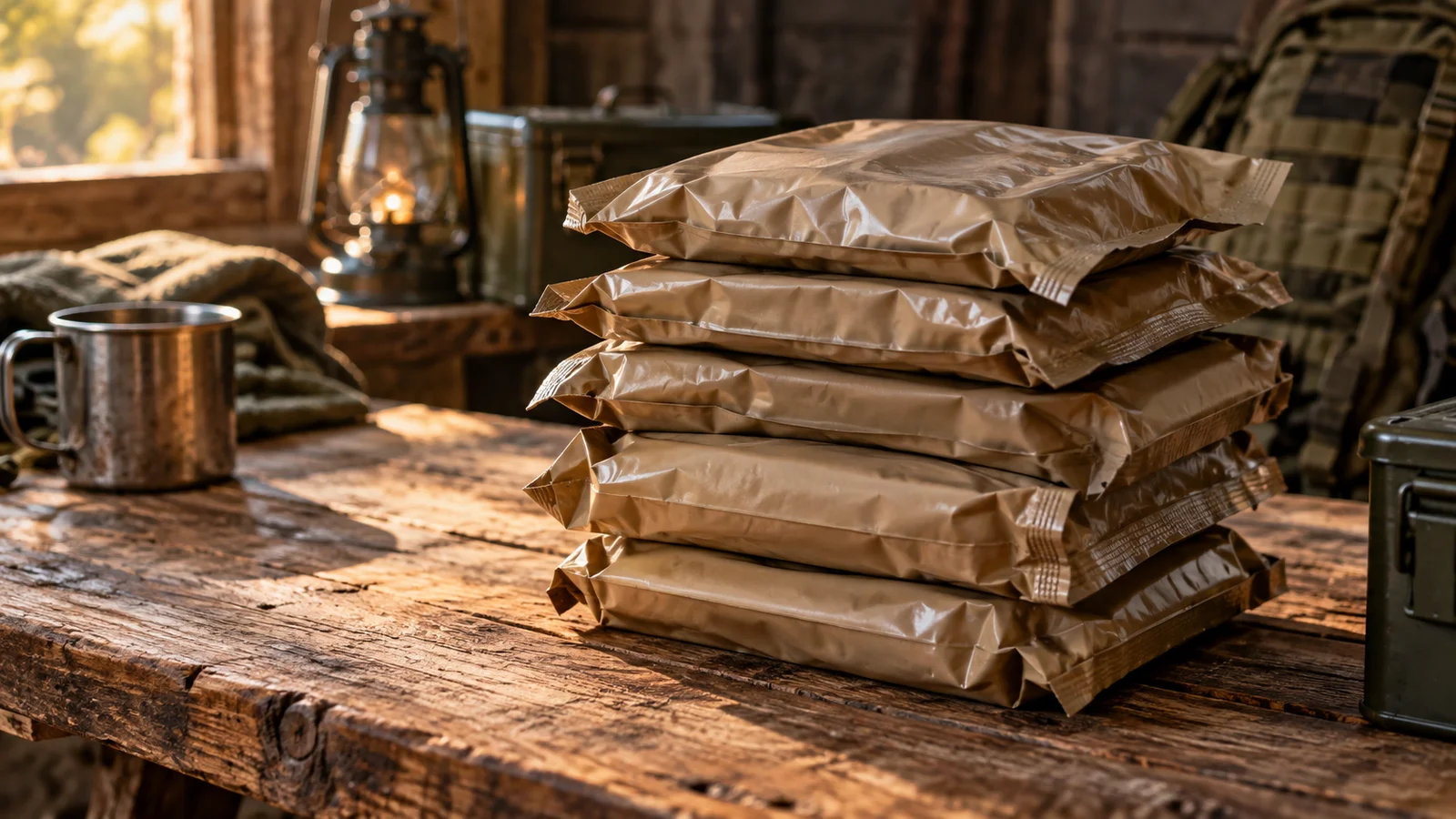
MREs (Meals, Ready-to-Eat) don’t carry a hard expiration date the way a carton of milk does. They’re rated by storage temperature, because heat is what breaks the food down inside the retort pouches. That means the question “how long do MREs last” doesn’t have one answer. It depends almost entirely on where you keep them.
Here’s the actual time-temperature relationship, how to check a specific case, which components fail first, and how MREs compare to freeze-dried food if long-term shelf life is your priority.
Reader-supported: I may earn a commission if you buy through links on this page, at no extra cost to you. Disclosure.
Quick Verdict
Typical indoor storage. Stays safe and palatable for roughly 3 years at a steady room temperature.
A basement or cool closet extends shelf life well past the 3-year room-temp baseline.
Free Updates
I send an email when something’s genuinely worth your time: a new guide, a real price drop on something I recommend, or an actual safety alert. No spam, no daily digest, unsubscribe anytime.
Why temperature matters more than the “expiration” date
MREs aren’t stamped with a hard expiration date the way a grocery product is. They’re rated by how long they hold up at a given storage temperature, because heat is what degrades the food inside the retort pouches. The rule of thumb the military and most retailers use:
| Storage temperature | Approximate shelf life |
|---|---|
| 120°F (attic, car trunk, uninsulated shed in summer) | ~1 month |
| ~80°F (typical room temperature) | ~3 years |
| 50°F (basement, cool closet, root cellar) | ~5 years |
| Consistently cool storage | Up to 10 years for some components |
The takeaway: where you store your MREs matters more than how long ago you bought them. A case sitting in a hot garage for two summers has aged faster than one sitting in a cool basement for five years.
How to check if a specific case is still good
Since 1997, U.S. military MRE cases ship with a Time-Temperature Indicator (TTI). A small circular sticker with a color-changing center. If the inner circle is still visibly lighter than the ring around it, the case has stayed within its safe temperature/time budget. If the center has darkened to match or exceed the outer ring, the contents have likely degraded faster than the date alone would suggest, even if it “looks” fine.
Beyond the TTI, check the individual retort pouches for:
- Swelling or ballooning: a sign of gas-producing bacterial activity inside the pouch. Discard immediately, don’t taste-test it.
- Punctures or tears: the pouch’s seal is what keeps it shelf-stable; a compromised seal means the contents are no longer protected.
- Off smell on opening: trust your nose before your fork.
Not every component ages the same way
An MRE isn’t one product: it’s a kit of several, and they don’t all degrade at the same rate:
- Entrees, crackers, peanut butter, pound cake, and nut-based items hold up the longest. Well-stored entrees have been reported still palatable more than a decade past their pack date, even if the texture or flavor has faded a bit.
- Cheese spread and applesauce-type pouches are the weak link: these tend to separate, discolor, or turn unappetizing well before the rest of the kit, often within 5-6 years even under good storage.
- Beverage powders and seasoning packets are essentially shelf-stable indefinitely if kept dry, since there’s no moisture for anything to grow in.
If you’re planning around a specific shelf life, the cheese/fruit spread components are the realistic ceiling, not the entree.
MRE vs. freeze-dried vs. dehydrated, which lasts longest?
MREs are built for portability and a 3-5 year practical window under normal storage, not maximum shelf life. If your priority is the longest possible shelf life rather than grab-and-go convenience, freeze-dried meals in Mylar pouches (like the ones we cover in our freeze-dried vs. dehydrated vs. MRE comparison) are usually rated for 25+ years when stored properly. A different tradeoff (lighter, longer-lasting, but needs added water and doesn’t include its own heating element the way some MREs do).
If you’re building a longer-term food supply rather than a grab-and-go kit, this is where a freeze-dried option like Nutrient Survival earns its place over MREs.
Its Blackout Basics Bucket ($199.99) packs 14 days of resealable pantry packs, averaging about 1,467 calories and 105 grams of protein a day, with a shelf life of up to 15 years unopened. It is designed to stretch your core food stores, not replace them. Check Price: Nutrient Survival Blackout Basics Bucket
How to store MREs so they last
- Cool and dry beats everything else. A basement, interior closet, or climate-controlled storage room will outperform a garage or attic by years.
- Avoid direct sun and temperature swings. Repeated heat-cool cycles degrade the pouches faster than steady heat alone.
- Rotate stock. Buy dated cases, store the oldest in front, and work through them periodically rather than letting a single batch sit untouched for a decade.
- Don’t rely on the printed date alone. Combine it with where the case has been stored and the TTI reading if it’s a genuine military-surplus case.
Free Updates
I send an email when something’s genuinely worth your time: a new guide, a real price drop on something I recommend, or an actual safety alert. No spam, no daily digest, unsubscribe anytime.
MREs are built for a different scenario than pantry staples: see how sugar holds up long-term, how long eggs last, and how freeze-dried, dehydrated, and MREs compare for a longer-term storage plan.
FAQ
Do MREs really last 10 years? Some components can, under ideal cool storage, but the weakest component (usually the cheese or fruit spread) will degrade well before that. Treat 3-5 years as the realistic planning window for a full kit unless you know it’s been stored cold the whole time.
Can eating an old MRE make you sick? It’s unlikely with a properly sealed, unswollen pouch. The failure mode is usually taste and texture, not safety. A swollen, punctured, or foul-smelling pouch is the exception; discard those without tasting.
Are civilian MREs the same as military-issue ones? Civilian/retail MREs are generally built to the same core standard but don’t always include a TTI sticker, so you’re relying more on storage conditions and the printed pack date.
What’s the single biggest thing that shortens MRE shelf life? Heat. A case stored in a hot car trunk or attic will age in months what a cool basement does in years.
The Prep Verdict is reader-supported. If you buy through a link on this page, I may earn a commission at no extra cost to you. See my full disclosure for details. I only recommend products I’d put in my own emergency supplies.