Picture this: a windstorm knocks the power out at 7 p.m. on a Tuesday. Dinner’s half made, the kids’ tablets are at 30%, your phone is at 41%, and the utility’s map says “estimated restoration: assessing.” (A made-up household, but it’s how a lot of outages start.) The trouble is rarely one big thing. It’s a dozen small things at once, and a kit handles them before they pile up.
The short answer: a good power outage emergency kit holds a headlamp or flashlight for each person, a solar or rechargeable lantern, a power bank, stored water (one gallon per person per day) plus purification tablets, food you can eat without a fridge or stove, warm blankets, a real first aid kit, a NOAA weather radio, a battery-powered carbon monoxide alarm, extra batteries and some cash.
Below, every item sits in one table with its job, what I’d buy, what it costs and when to skip it. Then come realistic totals for a starter, 3-day and 2-week kit. As a medic, I’ll also cover what most lists miss: medications, medical devices and carbon monoxide.
This Week: Tropical Storm Isaias
As of the 1 p.m. CDT advisory on October 7, 2026, Tropical Storm Isaias has 50 mph winds in the southern Gulf and is forecast to become a hurricane on Thursday. The National Hurricane Center has a Hurricane Watch from Bay St. Louis, Mississippi, to Indian Pass, Florida, a Tropical Storm Watch on both sides of that stretch, and a Storm Surge Watch from the mouth of the Mississippi River to Yankeetown, Florida. Tropical-storm conditions could reach the watch area by midday Friday and hurricane conditions late Friday. NHC expects 3 to 6 inches of rain, locally up to 10, from far southeastern Louisiana to the Florida Panhandle from Friday through the weekend, with storm surge of up to 5 to 7 feet possible between Ocean Springs, Mississippi, and Indian Pass, Florida. Hurricanes are one of the most common causes of multi-day outages, so if you live along the Gulf, check your kit now, before the stores get busy. For hour-by-hour updates, see the Live Storm Updates on my hurricane preparedness checklist. For the latest, follow the National Hurricane Center and your local emergency officials.
Reader-supported: I may earn a commission if you buy through links on this page, at no extra cost to you. Disclosure.
Quick Verdict: Where a Beginner Should Start
Phone power runs out first. 19,200 mAh, 60W USB-C, waterproof, and Goal Zero says it recharges about 5 smartphones. $119.95.
14 days of food for one person, up to 15-year shelf life. $199.99 on sale. The catch: it needs hot water.
Reusable, about 5 x 8 ft, $15.99. Layer it over your bedding. Add Aquatabs and you’ve covered warmth and water for under $40.
Free Updates
I send an email when something’s genuinely worth your time: a new guide, a real price drop on something I recommend, or an actual safety alert. No spam, no daily digest, unsubscribe anytime.
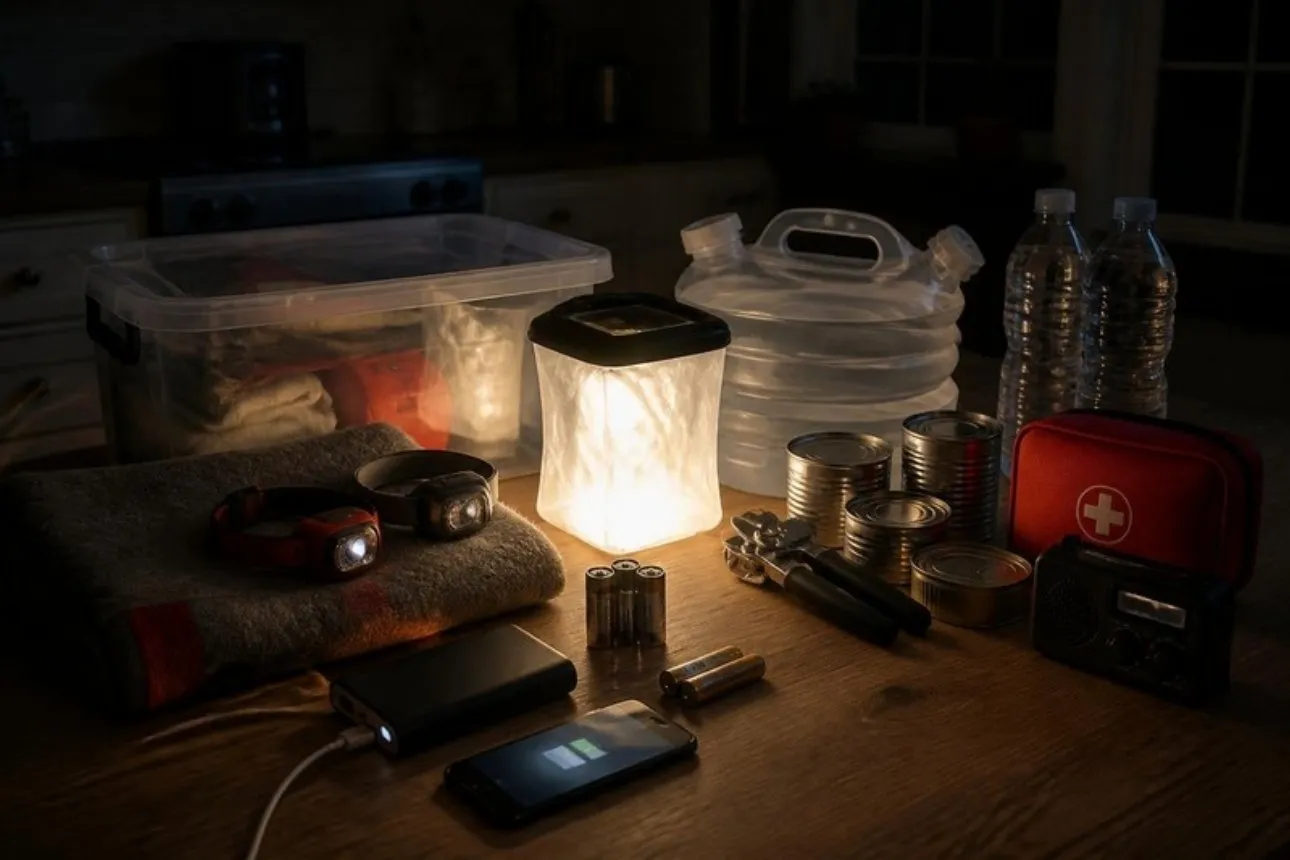
The Kit, Item by Item: The Comparison Table
The whole kit on one screen, organized by job. Named products were priced on the merchants’ sites in October 2026. For items without a specific pick, the cost is a typical range for a basic version, not a quote.
| Item | Job it does | What I’d buy | Approx. cost | Skip if |
|---|---|---|---|---|
| Headlamp or flashlight | Safe, hands-free light | Any LED headlamp that takes AA or AAA batteries | $10-$15 each | Never. One per person. |
| Room lantern | Lights a whole room | LuminAID PackLite Nova | $33 | You want one that also charges a phone |
| Lantern that charges a phone | Room light plus a phone top-up | LuminAID PackLite Max 2-in-1 | $60 | You’re buying a real power bank anyway |
| Power bank | Keeps phones alive for alerts, outage maps and 911 | Goal Zero Venture 75 | $119.95 | You already own a large one and keep it charged |
| Water storage | Holds and refills your daily gallons | HydraPak Seeker 10L plus sealed bottled water | $65 plus water | You already store enough sealed water |
| Water treatment | Backup for a boil-water notice or a dead well pump | Aquatabs (49 mg) | $12-$25 | Rarely. It’s cheap insurance. |
| Appliance thermometers | Settles “is the food still safe?” | One fridge and one freezer thermometer | $5-$10 each | Never |
| No-cook food and a manual can opener | Meals with no fridge or stove | Canned and shelf-stable food you already eat | $40-$60 (3 days, 2 people) | Your pantry already covers three days |
| Long-shelf-life food | A 2-week backup that keeps for years | Nutrient Survival Blackout Basics Bucket | $199.99 per person | You can’t safely heat water |
| Reflective blanket | Traps body heat over regular bedding | SOL Heavy Duty Emergency Blanket XL | $15.99 | Your outages only come in hot weather |
| Wool blanket | Real insulation, warm even when damp | Stansport Wool Blend Camp Blanket | $38.99 | You already own plenty of heavy blankets |
| First aid kit | Cuts, burns, sprains | Adventure Medical Kits Mountain Series Explorer | $86.49 | You already have a well-stocked kit |
| Weather radio | Alerts when cell and internet drop | A hand-crank or battery NOAA Weather Radio with tone alert (the Midland WR120B is one example) | $30-$60 | Rarely. FEMA lists it as basic. |
| Carbon monoxide alarm | Warns of CO from generators and stoves | A battery-operated CO alarm | $20-$40 | Your CO alarms already have battery backup |
| Odds and ends | Cash, batteries, phone list, whistle | Mostly things you own (list below) | $20-$40 plus cash | Never |
The pattern: the expensive items are optional, and the cheap ones aren’t. Headlamps, thermometers, a radio and a CO alarm together cost less than the power bank, and they solve problems nothing else on the list does.
Not sure what your household needs? My find your kit quiz narrows it down in a couple of minutes.
Size Your Kit First: Four Quick Questions
A couple in a city apartment and a family of five on a well need very different kits. Your answers decide which tier below you build.
- How long do outages last where you live? Go by your own history, not the worst headline. Rare, short outages: the starter kit. You’ve gone a day or more without power: the 3-day kit. Rural, ice storm or hurricane country, or wildfire-season shutoffs: build toward 2 weeks. (Planned shutoffs have their own Public Safety Power Shutoff checklist.)
- Who’s in your household? Kids need a light of their own and food they’ll eat. For older adults, falls in the dark are the risk I think about most, so light every room and hallway they use. Anyone on refrigerated medication or a power-dependent device (CPAP, oxygen concentrator, nebulizer) moves you up a tier, however short your outages usually are. Pets count in the food and water math.
- Where does your water come from? City water usually keeps running, so stored water covers a boil-water notice. A private well’s pump runs on electricity: no power, no water, so water becomes your top priority. In some taller apartment buildings, electric pumps move water upstairs; ask your building manager.
- Which season worries you more? Winter kits lean on blankets and layers. Summer kits lean on water, battery fans and a plan to get somewhere cool.
Build It in Tiers: What a Kit Really Costs
You don’t need everything at once. Most outages last hours, not weeks. Build the first tier this week and add the next when your budget allows.
| Tier | Gets you through | What it adds | Running total |
|---|---|---|---|
| Starter | A night in the dark | 2 headlamps (~$20-$30), PackLite Nova ($33), SOL blanket ($15.99), 2 thermometers (~$10), batteries (~$15), small Aquatabs pack (~$12) | About $105-$115 |
| 3-day kit | A long weekend without power | Venture 75 ($119.95), HydraPak Seeker ($65), NOAA radio (~$30-$60), CO alarm (~$25-$40), 3 days of no-cook food for two plus a can opener (~$40-$60) | About $385-$460 |
| 2-week kit | A major storm or long grid failure | Blackout Basics Bucket ($199.99 per person), PackLite Max ($60), wool blanket ($38.99), Mountain Series Explorer ($86.49), outdoor camp stove and fuel (~$40-$70), cooler and ice packs (~$40-$80), larger Aquatabs pack (~$25) | About $875-$1,020 |
A few honest notes on those numbers:
- No power bank yet? Swap the lantern, blanket and tablets in the starter tier for the Venture 75. That version runs about $165-$175, and your phone stays alive.
- The 3-day kit is where I’d point most households. It covers the core of FEMA’s basic kit list. Check the first aid kit you already own at this stage, too.
- The 2-week total assumes one food bucket. Add $199.99 per extra person, plus more stored water: 14 gallons per person for two weeks.
- Free additions at any tier: fill clean containers with tap water, charge every device, and put some cash in the bin.
Light
Start with a headlamp for every person. Hands-free light lets you carry a child, open a can or check a breaker while seeing what you’re doing. Pick a simple LED model that takes common batteries, and keep spares in the bin.
Then add one lantern for the room where everyone gathers. The LuminAID PackLite Nova ($33) is an inflatable solar lantern that packs flat. It doesn’t charge a phone, which makes it a good, cheap second lantern for a bedroom or a kid’s room.
No candles. The American Red Cross says to use flashlights, not candles, in a power outage. For a deeper look at lighting, see my guide to the best emergency lantern for a power outage.
Phone Power: The Thing Everyone Runs Out Of
In an outage, your phone is your lifeline: emergency alerts, your utility’s outage map, family, and 911. FEMA’s kit list includes a “cell phone with chargers and a backup battery.” When the phone dies, all of that goes with it.
My pick is the Goal Zero Venture 75 ($119.95):
- 19,200 mAh (71 Wh). Goal Zero says that’s about 5 smartphone recharges or 1 USB-C laptop.
- One USB-C port up to 60W (in and out) and 2 USB-A ports, so three devices charge at once.
- IP67 waterproof and dustproof, with a built-in 50-lumen flashlight.
- Rechargeable from a Goal Zero solar panel if the outage drags on.
The downsides are weight (20.35 oz) and price. If you already own a decent power bank, keep it charged and save your money.
Check Price: Goal Zero Venture 75
The LuminAID PackLite Max 2-in-1 ($60) is a solar lantern (150 lumens on LuminAID’s spec sheet, up to 50 hours of runtime, 12.5 oz) that can also charge a phone over USB-A. Its 2,000 mAh battery is smaller than most phone batteries, so treat it as an emergency top-up, not a power bank.
Running a fridge, a CPAP or a space heater is a different job. I cover power stations and generators in best backup power options for a home outage.
Water
Wells lose their pumps, and some cities issue boil-water notices. FEMA’s guideline is one gallon per person per day for several days, for drinking and sanitation. A family of four needs 12 gallons for three days. My emergency water calculator does the math for your household.
Sealed bottled water is the easiest base. Then add the HydraPak Seeker 10L ($65), a collapsible 10-liter container with a camp tap. It rolls up small, fills from the tap before a storm, and carries water home from a distribution point if it comes to that.
For backup treatment, keep Aquatabs (49 mg) in the bin. They’re chlorine-based tablets, about $12-$25 depending on pack size. Follow the package directions exactly. Weighing tablets against a filter? See water purification tablets vs. filters for a 2-week outage.
Food That Doesn’t Need the Fridge
First, know the rules for the food you already have. From FoodSafety.gov:
- A closed refrigerator keeps food safe for up to 4 hours.
- A full freezer holds about 48 hours (about 24 if half full).
- Safe means 40°F or below in the fridge and 0°F or below in the freezer.
- Throw out refrigerated perishables that have been above 40°F for more than 2 hours.
- “When in doubt, throw it out.” Never taste food to decide.
That’s why appliance thermometers are on the list. For $5-$10 each, they turn guessing into a reading. Keep them in the fridge and freezer year-round, and follow Ready.gov’s advice to keep the doors closed.
For the kit, start with canned and shelf-stable food you’d eat anyway: beans, tuna, fruit, peanut butter, crackers, granola bars. Pack a manual can opener; FEMA lists one in its basic kit for good reason.
For a longer backup, the Nutrient Survival Blackout Basics Bucket ($199.99, on sale from $264.99) holds 14 days of food for one person, about 158 servings, in a 5-gallon bucket. The maker says it averages 1,467 calories and 105 g of protein a day, with up to a 15-year shelf life unopened. Inside: shakes, powdered milk, instant potatoes, tomato soup powder and protein oatmeal.
The honest part: it needs hot water. With no power, that means a camp stove used outdoors only, or hot water poured into a good thermos before the outage. If you go the stove route, a small canister stove such as the Snow Peak GigaPower Stove 2.0 ($39.95, about 4 ounces) is enough to boil a pot of water; use it outdoors only, and keep a spare fuel canister with it. Canisters lose pressure in the cold, so test it before winter. If neither works for you, stick with canned food and skip the bucket.
Check Price: Nutrient Survival Blackout Basics Bucket
Comparing food types? See freeze-dried vs. dehydrated vs. MRE: what lasts.
Staying Warm (or Cool)
In a winter outage, pick one small room, close the doors and gather there. Dress in layers, hats included. For which heat sources are safe indoors and a checklist for every outage length, see how to stay warm without power.
- Reflective layer: the SOL Heavy Duty Emergency Blanket XL ($15.99) is reusable, waterproof, windproof and about 5 x 8 ft. SOL says it reflects up to 90% of body heat. Layer it over your regular bedding.
- Real insulation: the Stansport Wool Blend Camp Blanket ($38.99) is 60 x 80 in, 55% wool and water-repellent.
In summer outages, think battery or USB fans (your power bank can run one), shade on sunny windows, cool damp cloths and plenty of water. Check on older adults and babies first.
First Aid and Medications: The Medic’s Section
Outages bring predictable injuries: falls in the dark, cuts, burns from stoves and lanterns. A real first aid kit belongs in the bin. If you don’t have one, the Adventure Medical Kits Mountain Series Explorer ($86.49) covers cuts and sprains for one to four people. It has no burn gel and only 10 adhesive bandages, so add a tube of burn gel and a box of ordinary bandages. If you already own a decent kit, restock it instead.
Two things matter more than any kit:
- Medications that need refrigeration. If anyone uses insulin or another refrigerated medication, talk to your pharmacist ahead of time about storing it during an outage. Ready.gov advises having alternate plans for refrigerating medicines.
- Power-dependent medical devices. CPAP machines, oxygen concentrators and nebulizers need electricity, and Ready.gov advises alternate plans for using them. That means backup power sized for the device (see my backup power guide) or knowing exactly where you’ll go. Decide before the outage.
Keep a written list of everyone’s medications and doses in the kit. Phones die; paper doesn’t. And if you’re near Vancouver, WA or Portland, OR, I teach hands-on first aid and Stop the Bleed classes.
Information: A Weather Radio
Cell towers and home internet can go down with the grid. FEMA’s basic kit list includes a “battery-powered or hand crank radio and a NOAA Weather Radio with tone alert.” I haven’t tested any of these, so here’s what to look for:
- NOAA Weather Radio bands with a tone alert that sounds on its own.
- More than one power source: batteries, a hand crank, ideally solar.
- AM/FM for local news, and simple controls you can work in the dark.
Expect about $30-$60 for a solid basic model.
Safety Items People Forget
- A battery-operated carbon monoxide alarm. The CDC recommends battery-operated CO detectors. Plug-in alarms without battery backup go quiet right when people start running generators and stoves.
- Never run a generator, grill, camp stove or charcoal-burning device inside a home, garage or basement, or near a window. The CDC says to keep generators at least 20 feet from windows, doors and vents.
- Never use a gas range or oven to heat your home. The CDC is clear on this.
- Unplug electronics to protect them from a surge when power returns. Leave one lamp on so you know when it’s back.
CO poisoning can feel like the flu: headache, dizziness, nausea, confusion. If the alarm sounds or people feel sick, get everyone outside and call emergency services.
Odds and Ends
- Cash in small bills: card readers go down with the power.
- A paper list of numbers: family, doctors, pharmacy, your utility.
- Extra batteries for headlamps and the radio.
- A cooler and ice packs for food and medications.
- Trash bags and wet wipes, a whistle, a wrench for shutting off utilities, and a manual can opener.
What to Skip
- Pre-packed “outage kits” full of filler. Often a cheap flashlight, glow sticks and a thin foil sheet at a big markup. Buying from the table above gets you better gear for less.
- Candles. The Red Cross says flashlights, not candles.
- Gas-powered heaters not rated for indoor use. If it burns fuel and isn’t rated for indoors, it stays out.
- A generator you can’t run safely outdoors. No spot 20 feet from windows, doors and vents? It’s a liability, not a plan.
- Anything that needs the internet. Smart lights and app-only gadgets are dead weight when the router is off.
- Emergency food you can’t prepare. No safe way to heat water means it’s just a heavy bucket.
Where to Keep It and How to Maintain It
One bin, one known spot. A plastic tote in a hall closet works well. Make sure everyone in the house knows where it is and can reach it in the dark.
A flashlight or headlamp in each bedroom. Outages love 2 a.m., and nobody should have to cross a dark house to reach the bin.
Check it twice a year, at the daylight saving time changes. Test lights and the radio, swap old batteries, recharge the power bank, rotate water and canned food into your pantry, and check expiration dates.
Special Situations
- Apartments: elevators stop and generators are off the table. Lean on power banks, headlamps and one warm room. See my apartment and urban prepping guide.
- Homes on a well: no power usually means no water, including for flushing. Store extra water and keep Aquatabs handy.
- Medical needs: refrigerated meds and powered devices need a plan made in advance (see above).
- Kids and pets: a headlamp of their own helps kids, and pets count in your food and water math. My family and kids preparedness guide has more.
New to this? Start with my new to prepping guide and my FEMA, Red Cross and state emergency resources page.
Free Updates
I send an email when something’s genuinely worth your time: a new guide, a real price drop on something I recommend, or an actual safety alert. No spam, no daily digest, unsubscribe anytime.
FAQ
What should be in a power outage kit?
A headlamp for each person, a lantern, a power bank, water (one gallon per person per day) plus purification tablets, no-cook food and a manual can opener, warm blankets, a first aid kit, a NOAA weather radio, a battery-operated CO alarm, batteries and cash.
How do I prepare for a power outage?
Build a kit in one bin, keep a flashlight in each bedroom, put thermometers in your fridge and freezer, keep power banks charged, and plan ahead for refrigerated medications or medical devices.
How long does food last in the fridge without power?
Up to 4 hours with the door closed, per FoodSafety.gov. A full freezer holds about 48 hours (24 if half full). Toss perishables that have been above 40°F for more than 2 hours.
Is it safe to use candles during a power outage?
It’s not the safe choice. The American Red Cross recommends flashlights, not candles. A headlamp or solar lantern gives better light without the fire risk.
How can I charge my phone without power?
A charged power bank is simplest. A solar lantern with a USB port can add a small top-up. A car works too, but only outdoors, never running in a garage.
How much water do I need for a power outage?
FEMA says one gallon per person per day for several days. For three days, that’s 3 gallons per person. My water calculator works it out for your household.
What should I do first when the power goes out?
Grab a flashlight, see if it’s just your home or the whole street, report it to your utility, and keep the fridge and freezer closed. My power outage checklist covers the rest. For planned shutoffs, see my Public Safety Power Shutoff checklist.
The Prep Verdict is reader-supported. If you buy through a link on this page, I may earn a commission at no extra cost to you. See my full disclosure for details. I haven’t hands-on tested every product named here; picks are based on published specs, merchant information and my medic training. I only recommend products I’d put in my own emergency supplies.