It’s 9 p.m. Ice is ticking against the windows. The lights blink out, and a second later you notice the silence: the furnace has stopped. The house is still warm, for now. A house doesn’t go cold all at once, and you have more time and more options than it feels like.
Here’s the short answer to how to stay warm without power: pick one small room, close it off, get everyone and every blanket into it, and put on layers (including a hat) before you feel really cold. It costs nothing, it works in a house or an apartment, and it buys you a lot of time.
The other half of the answer matters just as much: never heat your home with a gas oven, a grill, a camp stove, or a generator running inside or in the garage. The CDC is blunt about every one of those. The cold is uncomfortable; carbon monoxide can kill.
Below are two tables, safe vs. unsafe heat sources and a tiered checklist by outage length, followed by detail on each row. If you’re cold right now, start with the first 30 minutes.
Reader-supported: I may earn a commission if you buy through links on this page, at no extra cost to you. Disclosure.
Quick Verdict: How to Stay Warm Without Power
Close off a small room with few windows, hang blankets over the doorway and windows, and get everyone into it wearing hats and dry socks.
Reusable reflective blanket ($15.99) that layers under your regular blanket. Tight budget: the North American Rescue Emergency Survival Wrap (~$8.99).
Battery power station (about $550), safe indoors. Runs a 100-watt electric blanket for most of a night, plus phones and lights. It won’t run your furnace.
Free Updates
I send an email when something’s genuinely worth your time: a new guide, a real price drop on something I recommend, or an actual safety alert. No spam, no daily digest, unsubscribe anytime.
Your First 30 Minutes: What to Do Right Now
It’s much easier to stay warm than to get warm again. Do these in roughly this order:
- Report the outage and check the restoration estimate on your utility’s outage map. Are you planning for hours or days?
- Check your carbon monoxide alarms. Plug-in or hardwired alarms without battery backup won’t work without power.
- Pick your warm room. Small, few windows, few outside walls, a door that closes.
- Close every other interior door and shut curtains, unless sun is shining in.
- Layer up now, hat and warm socks included, before anyone starts shivering.
- Gather every blanket, sleeping bag and winter coat into the warm room.
- Keep the fridge and freezer shut. Per the CDC, an unopened fridge keeps food safe for up to 4 hours; a full freezer holds for 48 hours (24 if half full).
- Switch to LED light instead of candles, and put phones in low-power mode.
- If it’s bitterly cold, open sink cabinets and let cold water drip.
- Decide your “leave” trigger now, while you’re thinking clearly (see when to leave).
Safe vs. Unsafe Heat Sources: The Comparison Table
The rule behind this table: if it burns fuel and isn’t permanently installed and vented outside, don’t use it for heat indoors. Body heat, insulation and battery power are safe.
| Heat source | Safe indoors? | The rule |
|---|---|---|
| Layers, blankets, sleeping bags, coats | Yes: your best tool | The CDC recommends extra blankets, sleeping bags and warm winter coats for outages. |
| One closed-off “warm room” with everyone in it | Yes | Body heat from people and pets adds up in a small, sealed space. |
| Reflective emergency blanket | Yes | Layer it under a regular blanket to hold body heat in. |
| Battery power station + electric blanket | Yes | No combustion, no CO. Runs a blanket for some hours, not a furnace or space heater. |
| Hot water bottle filled from a thermos | Yes, with care | Wrap it in a towel. Never put it on numb skin. |
| Fireplace or wood stove (already installed) | Only if maintained | Open the damper, use a screen, never leave it unattended. |
| Portable propane heater rated for indoor use | Only with strict precautions | Only a model the manufacturer specifically rates for indoor use. The CDC says to follow the manufacturer’s instructions; the CPSC says never refuel a heater while it’s running. Run a battery CO alarm. |
| Candles | Light only, not heat | An open flame you can fall asleep next to, for very little warmth. Use battery LED lanterns instead. |
| Gas range or oven | Never | CDC: “Never use a gas range or oven to heat a home.” |
| Generator | Never indoors | CDC: never inside your home, basement or garage, or less than 20 feet from any window, door or vent. |
| Charcoal grill or hibachi | Never | CDC: never inside a home, tent or camper. |
| Camp stove or fuel-burning lantern | Never | CDC: never inside a home, tent or camper. (Battery LED lanterns are fine.) |
| Patio or outdoor propane heater | Never | Not designed or rated for indoor use. |
| Car running in an attached garage | Never | A gasoline engine in a garage is on the CDC’s never list, even with the door open. |
| Blowtorch or open flame on frozen pipes | Never | Red Cross: no blowtorch, kerosene or propane heater, charcoal stove or open flame. |
Carbon Monoxide: The Rules That Don’t Bend
Carbon monoxide (CO) is invisible and has no smell. Read this box even if you skip everything else.
Carbon Monoxide Warning
The CDC says: “Never use a generator, pressure washer, or any gasoline-powered engine inside your home, basement, or garage or less than 20 feet from any window, door, or vent.” Never use a gas range or oven to heat a home. Never use a charcoal grill, hibachi, fuel-burning lantern or portable camping stove inside a home, tent or camper. Install battery-operated or battery-backup CO alarms near every sleeping area, since plug-in alarms without a battery stop working in an outage. The First Alert CO400 is a simple battery-powered option. The most common symptoms the CDC lists are headache, dizziness, weakness, upset stomach, vomiting, chest pain and confusion, and people who are asleep or have been drinking can die before they notice any. If a CO alarm sounds, or you suspect CO poisoning, leave the house immediately and call emergency services. Poison Control is 1-800-222-1222.
Two common mistakes: an open garage door doesn’t make a generator or running car safe (the CDC rules out the garage itself), and running the oven “just for a little while” is still on the CDC’s never list.
The Tiered Checklist: What to Do by How Long the Outage Lasts
Find your row. The free column handles most short outages; the others add margin, or are worth planning for before next winter. Prices were checked in October 2026.
| Outage length | Free | Under $50 | Bigger upgrade |
|---|---|---|---|
| First few hours | Close off unused rooms, shut curtains, layer up, keep fridge and freezer closed, check CO alarm batteries. | A North American Rescue Emergency Survival Wrap (~$8.99) for each person; spare batteries. | A charged power station ready for phones, router and light. |
| First night | Everyone sleeps in the warm room; hats and dry socks to bed; sleeping bags on top of blankets. | SOL Heavy Duty Emergency Blanket XL ($15.99) layered under a regular blanket. | Jackery HomePower 1000 v2 (about $550) running an electric blanket for most of the night, or the smaller Goal Zero Yeti 300 ($299.95) for part of it (see the runtime math). |
| Days 2 to 3 | Drip faucets, open sink cabinets, keep garage closed; regular meals; check on neighbors; revisit your leave trigger. | An LED or solar lantern (see my emergency lantern guide); foam pipe sleeves for exposed pipes. | Freeze-dried meals for warm calories; recharge the power station if you have solar or a safe outdoor source. |
| Beyond 3 days, or anyone struggling | Move to a warming center, friend or family. Call 211 for locations. | Gas money, a packed overnight bag, chargers. | A hotel; plan whole-home backup before next winter (see my backup power guide). |
A simple 3-day plan
- Day 1: Warm room, layers, pipe protection, fridge and freezer closed.
- Day 2: Keep the routine: meals, water, dry clothes, shelf-stable food. Check on neighbors who live alone.
- Day 3: Reassess honestly. If the house keeps getting colder, restoration keeps slipping, or anyone shows hypothermia signs, leave.
Set Up One Warm Room
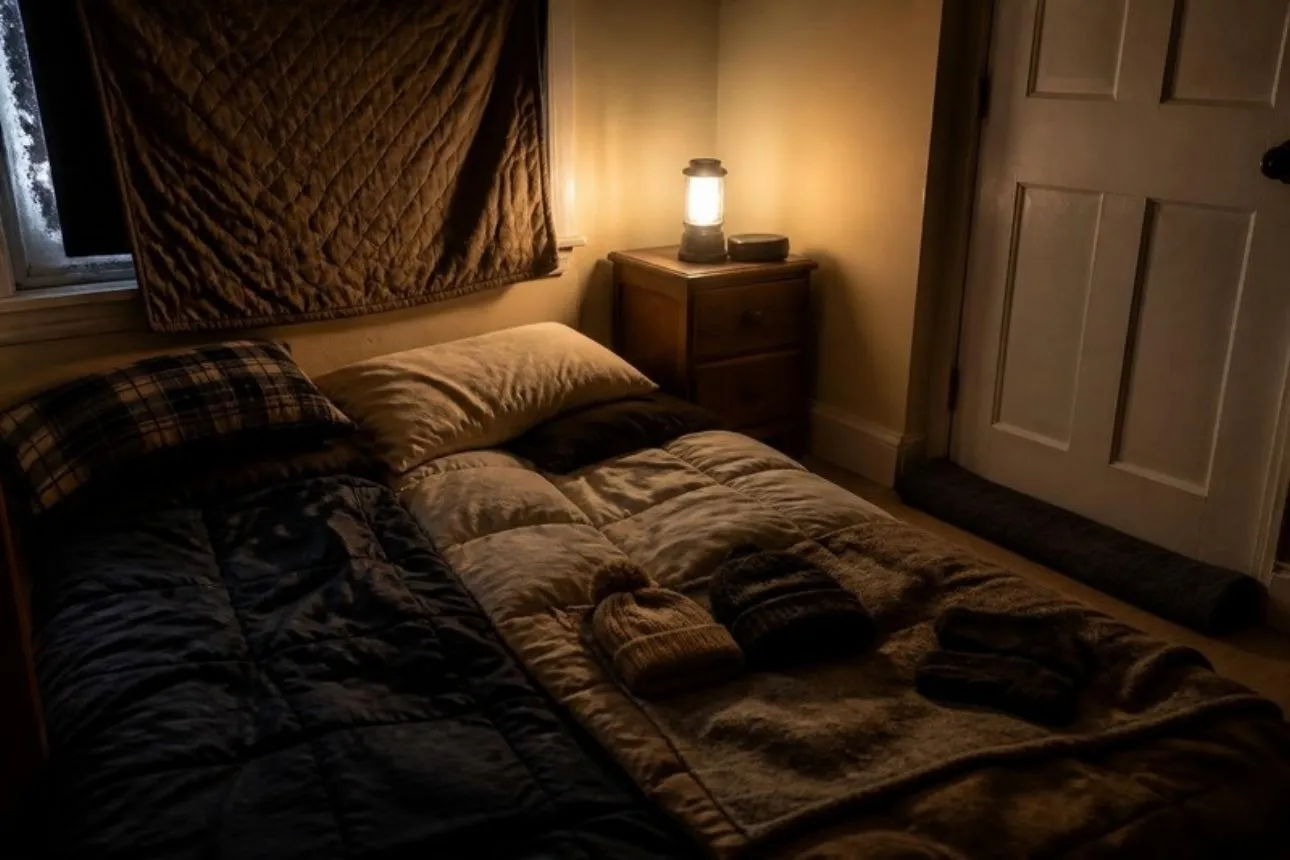
This is the heart of staying warm without power. Without a working heat source you can’t keep the whole house warm. You can keep one small room noticeably warmer than the rest, using body heat, the heat already in the house, and everything soft you own.
Picture it: instead of six rooms all slowly losing heat, you have one room with the door shut, blankets over the windows, the floor padded thick, and everyone inside, talking, breathing, and giving off heat. That room is your base camp until the lights come back.
Step 1: Pick the right room
- Small. A bedroom or den beats a living room with a vaulted ceiling. There’s less air to keep warm.
- Few exterior walls and windows. A room surrounded by other rooms is buffered on every side.
- On a lived-in floor. Skip the cold basement slab, and avoid a top floor under an uninsulated attic.
- Sunny, if possible. A south-facing room with the blinds open in afternoon sun picks up free heat.
- Near a bathroom, so nighttime trips are short.
Step 2: Close it off
- Shut the door and roll a towel against the gap at the bottom.
- If a doorway has no door, hang a heavy comforter across it with a tension rod, thumbtacks, or painter’s tape.
- Shut the doors to every room you’re not using.
Step 3: Cover the windows
Windows lose more heat than walls. Close the curtains, then add another layer over the glass: a quilt, a towel, or a piece of cardboard. Uncover sunny windows during the day and cover them again at sunset.
Step 4: Pad the floor
A cold floor draws heat out of anyone sitting or sleeping on it. Pile on area rugs, exercise mats, couch cushions, folded comforters, or flattened cardboard boxes. Nobody should be lying directly on a hard floor or thin carpet.
Step 5: Build a smaller space inside the room
This is the step where it starts to feel warm. The smaller the air pocket around you, the more your body heat counts.
- Pitch a camping tent indoors on top of the floor padding.
- Build a blanket fort over a table or between two chairs. Kids usually love this part.
- Push mattresses together on the floor and drape blankets over everyone.
Step 6: Stock it and stay in it
Everyone goes in, pets included. In a small closed room, that much body heat adds up. Keep supplies there so nobody has to keep opening the door: water, snacks, a battery lantern, a power bank, extra socks, and a trash bag.
One firm rule: sealing up a room is only safe because nothing in it is burning. Never put a fuel-burning heater, grill, stove, or generator in a closed-off room.
How long will a house stay warm without power?
It depends on how cold and windy it is outside, how well your home is insulated, and how much of it you’re trying to keep warm. A tight, well-insulated house holds heat far longer than an older, drafty one.
Rather than guess, keep a cheap thermometer in your warm room and check it every few hours. If it keeps falling and power isn’t coming back soon, start planning to leave.
Layering and Sleeping Warm
Dress in layers, and stay dry
- Base layer: wool or synthetic long underwear. Avoid cotton next to skin; it holds moisture. If you want to spend on merino, Woolpower makes base layers (affiliate link) in a lighter and a warmer weight, but ordinary wool or synthetic long underwear works fine.
- Middle layer: fleece, a wool sweater or a down vest.
- Outer layer: your winter coat if the room is really cold.
- Extremities: hat, warm socks and gloves or mittens.
- Change anything damp, including sweaty socks, and don’t overdress to the point of sweating.
Sleeping warm
- Put blankets under you as well as on top, or use a sleeping bag on the bed. Cold surfaces pull heat out of you.
- Layer a reflective emergency blanket between regular blankets. The SOL Heavy Duty Emergency Blanket XL is sturdier and reusable; a cheap mylar sheet works for a night or two.
- Wear a hat and dry socks to bed, and share a room with family.
- A towel-wrapped hot water bottle filled from a thermos warms a sleeping bag. Never put it on numb skin.
Check Price: SOL Heavy Duty Emergency Blanket XL
Fuel your own furnace
Your body makes heat from food. Eat regular meals and snacks, and keep drinking water. Skip alcohol: the CDC notes it makes your body lose heat more quickly and can cloud your judgment.
Battery Power Stations: What They Can and Can’t Do for Heat
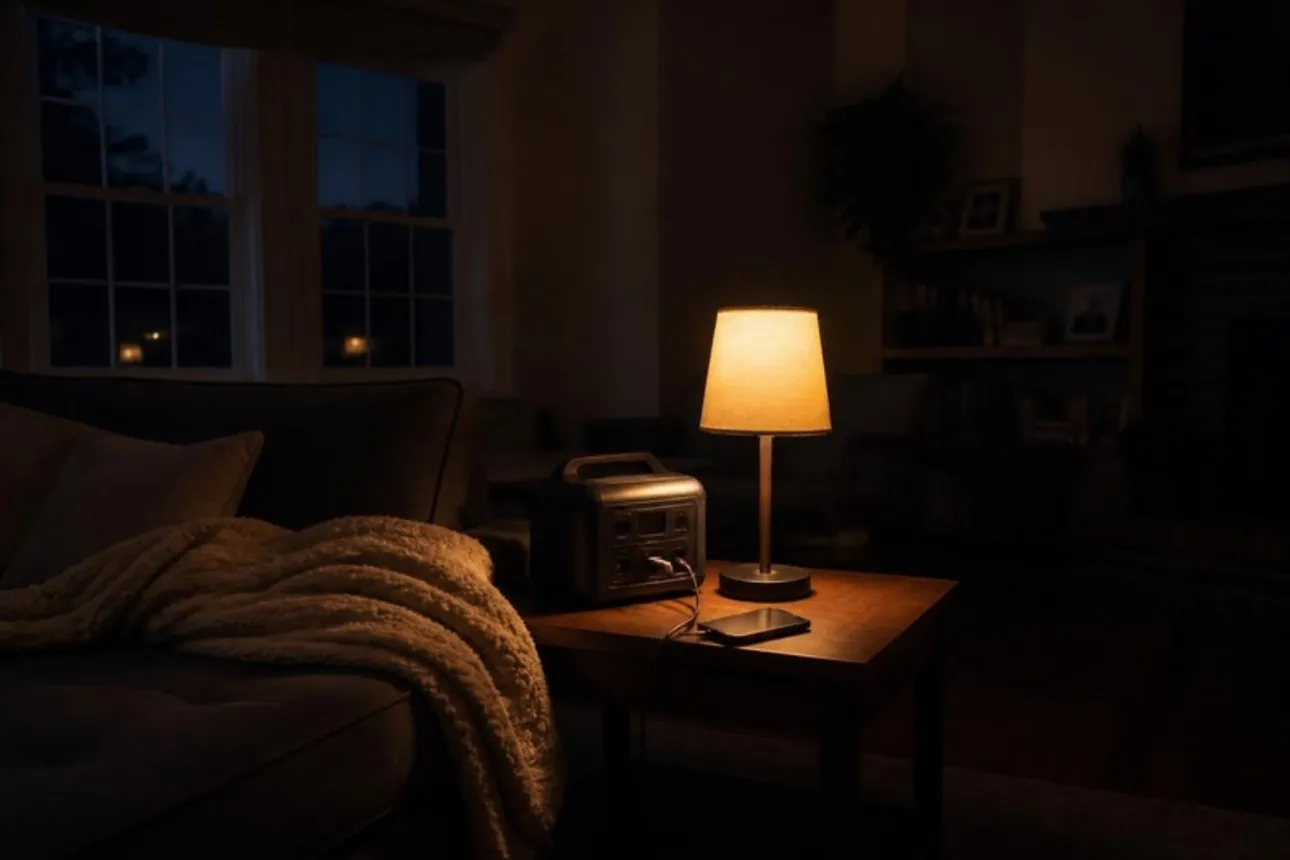
A portable power station is a big rechargeable battery with outlets. No engine, no combustion, no carbon monoxide, so unlike a generator it’s safe indoors.
The honest limit: it cannot run a furnace, a space heater or other electric heat for any meaningful time. Heating draws far more power than a portable battery holds.
What a unit like the Goal Zero Yeti 300 (a 297 watt-hour battery with a 350-watt outlet) can realistically do:
- Run an electric blanket or heated throw for some hours. Runtime depends on the wattage printed on your blanket’s label. Rough math: divide 297 by the blanket’s watts, then allow for some conversion loss. A 100-watt blanket on high works out to a bit under 3 hours; lower settings cycle on and off and last longer.
- Keep phones charged and your router and LED lights running.
- Run a CPAP for part of a night. Goal Zero’s own chart lists about 4 hours for a 65-watt CPAP. Your machine may draw more or less, so check with its maker, and if anyone depends on one overnight, plan to leave early.
Check Price: Goal Zero Yeti 300
The Jackery HomePower 1000 v2 holds a lot more: a 1,024 watt-hour battery with a 1,500-watt outlet, about three and a half times the Yeti 300. The same math gives a 100-watt blanket roughly 8 hours, which is most of a night, and a 65-watt CPAP a full night. It costs about $550 and weighs about 23 pounds.
Check Price: Jackery HomePower 1000 v2
To compare sizes, solar recharging and whole-home options, see my guide to backup power for a home outage.
Fireplaces, Wood Stoves and Indoor-Rated Heaters: The “Only If” Rows
Fireplaces and wood stoves
Use one only if it’s already installed and maintained. An outage is not the time to try one that hasn’t been inspected.
- Open the damper before you light it, and use a screen.
- Never leave the fire unattended, including overnight.
- Burn only what it’s designed for, and keep a battery CO alarm in the room.
Never burn anything in a space that isn’t vented to the outside.
Portable propane heaters rated for indoor use
Some portable propane heaters are manufacturer-rated for indoor use with oxygen-depletion sensors. They still carry real risk. If you use one at all: only a heater the manufacturer specifically rates for indoor use (never a patio or outdoor heater), follow the manufacturer’s instructions exactly (the CDC’s advice), never refuel it while it’s running (the CPSC’s), and run a battery CO alarm. If it’s a kerosene heater, the CDC also suggests checking with your local fire department that it’s legal where you live. I treat this as a last resort, behind layers, a warm room and a warming center.
How to Keep Pipes From Freezing if the Power Goes Out
In deep cold, a burst pipe can do more damage than the outage itself. The American Red Cross recommends:
- Open cabinet doors under sinks so warmer room air reaches the pipes.
- Let cold water drip from faucets in extreme cold.
- Insulate pipes in unheated areas like crawlspaces, attics and garages.
- Keep garage doors closed.
- If you leave, and heat is available, keep the thermostat no lower than 55°F.
If you’re leaving during a long outage in freezing weather, Purdue Extension’s winter power-failure guidance is to shut off the water at the main valve (or turn off the well pump) and open the faucets so the lines drain. If you’re not sure how, ask a plumber.
If a pipe is already frozen
- Keep the faucet open.
- Never use a blowtorch, kerosene or propane heater, charcoal stove or any open flame.
- If you can’t reach the frozen section, or a pipe has burst, call a plumber.
Kids, Older Adults and Pets
Babies and kids
- Know the infant warning signs from the CDC: bright red, cold skin and very low energy. If you see them, get medical help.
- Follow the American Academy of Pediatrics: keep blankets, quilts, pillows and other loose bedding out of the crib, and keep a baby warm with layers, a one-piece sleeper or a wearable blanket instead.
- That goes double for mylar emergency blankets. Like any thin plastic sheet, keep them away from babies and toddlers.
- Keep kids well away from any fireplace or wood stove.
More in my family and kids preparedness guide.
Older adults and anyone with medical needs
- Check on older neighbors and relatives, especially anyone who lives alone.
- Anyone who relies on powered medical equipment needs a plan to leave early, not late.
- Watch for confusion, drowsiness or slurred speech. Those are hypothermia signs, and they are easy to mistake for tiredness.
Pets
- Bring pets into the warm room, with bedding off cold floors and water that isn’t freezing.
Apartment vs. House: What Changes
The core plan is the same everywhere. The details shift.
| Issue | Apartment | House |
|---|---|---|
| Heat loss | Shared walls with neighbors’ units may slow heat loss. | More outside walls, roof and floor exposure. |
| Generator | Rarely an option: the CDC’s rule is at least 20 feet from any window, door or vent, which most balconies can’t meet. Check your lease and building rules too. | Possible outdoors only, 20+ feet from windows, doors and vents, with a battery CO detector inside. |
| Pipes | Tell management about frozen or burst pipes right away. | You’re responsible: drip, open cabinets, insulate unheated areas. |
| Getting out | Elevators may be down; leave early if stairs are hard for anyone in your home. | Driveway and roads may be icy; leave before dark if you can. |
For more on preparing in smaller spaces, see my apartment and urban prepping guide.
Food, Water, Light and Power While You Wait
- Food: Keep the fridge closed (safe up to 4 hours unopened) and the freezer closed (48 hours full, 24 half full), per the CDC. After that, rely on shelf-stable food. If you want warm meals, freeze-dried meals just need hot water from a thermos or a stove used safely outdoors. Here’s my comparison of freeze-dried vs. dehydrated vs. MREs.
- Water: If you’re on a well, the pump probably stops when the power does. Use my emergency water calculator to see how much your household needs.
- Light: Use battery or solar LED lanterns, such as LuminAID solar lanterns, instead of candles or fuel lanterns.
- Power: Save phone battery for alerts and calls. A power station handles phones, the router and lights.
For a full outage routine, see my nor’easter power outage checklist. To see what you’re missing, try find your kit.
When to Leave: Warming Centers, Family or a Hotel
Leaving isn’t giving up. In a long, cold outage, it’s often the safest choice. Go if:
- Your warm room keeps getting colder and power isn’t coming back soon.
- Anyone shows signs of hypothermia (below).
- Someone depends on powered medical equipment.
- A pipe has burst, or you can’t keep water flowing.
- You catch yourself considering an unsafe heat source from the table above.
Where to go: Call 211 or check your local emergency management office for warming centers, or go to family with power or a hotel outside the outage area. My FEMA, Red Cross and state emergency resources page lists official sources. In an ice storm, stay away from downed power lines and drive only when roads are safe.
Signs of hypothermia (CDC)
- Adults: shivering, exhaustion, confusion, fumbling hands, memory loss, slurred speech, drowsiness.
- Infants: bright red, cold skin and very low energy.
- If body temperature is below 95°F, get medical attention immediately.
Frostbite: when rewarming, the CDC says not to use a fireplace, heat lamp, radiator, stove, heating pad or electric blanket on numb skin. Numb skin can’t feel a burn. If someone has frostbite or hypothermia signs, get medical help rather than trying to treat it at home.
Free Updates
I send an email when something’s genuinely worth your time: a new guide, a real price drop on something I recommend, or an actual safety alert. No spam, no daily digest, unsubscribe anytime.
FAQ
How do I stay warm without power in my house?
Close off one small room with few windows, hang blankets over the doorway and windows, and get everyone into it wearing layers, hats and dry socks. Sleep under blankets and sleeping bags with a reflective emergency blanket layered in. Never use a gas oven, grill, camp stove or indoor generator for heat.
How long will a house stay warm without power?
It depends on outdoor temperature, wind and insulation: well-sealed homes hold heat much longer than drafty ones. Keep a thermometer in your warm room and check it every few hours. If it keeps dropping and power isn’t returning soon, plan to leave.
Is it safe to use my gas stove or oven for heat?
No. The CDC says plainly: “Never use a gas range or oven to heat a home.” It can produce carbon monoxide, which you can’t see or smell.
How do I keep pipes from freezing if the power goes out?
Following Red Cross guidance: open the cabinet doors under sinks, let cold water drip from faucets in extreme cold, insulate pipes in unheated areas, and keep garage doors closed. If a pipe freezes, keep the faucet open and never use an open flame to thaw it.
How do I survive 3 days without electricity in winter?
Set up one warm room on day one, layer up, protect your pipes, and keep the fridge and freezer closed. Eat and drink regularly. Each day, check the room temperature and restoration estimate, and leave if it’s getting colder or anyone shows hypothermia signs.
What should I do in an ice storm power outage?
Everything above applies. Also stay away from downed lines and decide early whether you’ll stay or go, before roads get worse or it gets dark.
Can a portable power station run a space heater?
Not for any meaningful time. Space heaters draw far more power than a portable battery holds. A power station is better used for an electric blanket for some hours, phones, a router and LED lights.
The Prep Verdict is reader-supported. If you buy through a link on this page, I may earn a commission at no extra cost to you. See my full disclosure for details. I haven’t hands-on tested every product named here; picks are based on published specs, merchant information and my medic training. I only recommend products I’d put in my own emergency supplies.