Picture the scene first: traffic on the highway has stopped moving, snow is coming down harder than the forecast promised, and your car isn’t going anywhere for the next several hours. Before you buy anything for a moment like that, answer one question: when this kit gets used, will you still be in your car, or will you be walking away from your house?
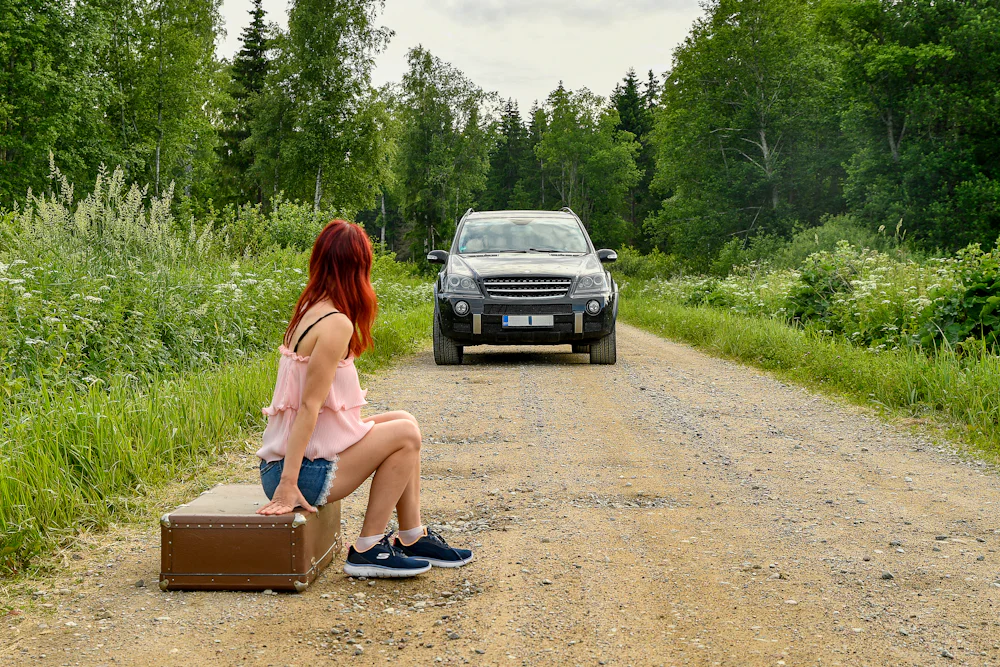
That single question is the whole decision. Get it right and the rest of the shopping list writes itself: jumper cables and an ice scraper for one answer, a load-bearing pack and multi-day food for the other. Get it wrong, and you end up with the thing most “emergency kit” content quietly hands you by default: a generic list that half-solves two different problems instead of fully solving either one. Search “car emergency kit checklist” and “bug out bag checklist” back to back and you’ll notice how much they overlap (a flashlight here, a first aid kit there) and how little that overlap tells you about which one to build first, or whether one can substitute for the other.
It can’t, and the reason comes down to that opening question. A car emergency kit is the answer when the scenario is “I’m stuck in or near my vehicle”. A breakdown on the interstate, a dead battery in a parking lot, a winter storm that closes the highway with you still on it. A bug-out bag is the answer when the scenario is “I need to leave home, possibly on foot”, and the bag itself has to double as your shelter and supply line until you’re somewhere safer. Different question, different kit. This guide walks through how to use that one question to decide what you need, then builds the car-kit side of it in full.
This piece is the companion to my guide on Building a Bug-Out Bag for Natural Disasters and Civil Unrest. If you already have a bug-out bag, use this as the “what does a car add on top of that” layer, not a repeat of what’s already there. If you’re starting from zero, let the diagnostic question above point you to the right guide first: car-and-winter risk more realistic near-term for you, start here; home evacuation more realistic, start with the bug-out bag guide.
Reader-supported: I may earn a commission if you buy through links on this page, at no extra cost to you. Disclosure.
Quick Verdict: Car Kit vs. Bug-Out Bag
Built for breakdowns, dead batteries, flat tires, and winter stranding: not for walking anywhere.
Built to leave your home on foot if it comes to that. See my bug-out bag guide.
Free Updates
I send an email when something’s genuinely worth your time: a new guide, a real price drop on something I recommend, or an actual safety alert. No spam, no daily digest, unsubscribe anytime.
Why these solve different problems
Run the diagnostic question against the actual moment each kit gets opened, and the split gets obvious fast.
Trigger scenario. A car kit gets opened when you’re already in, or standing right next to, your vehicle. A flat on a rural highway with no signal, a dead battery outside a store at 9pm, a snowstorm that leaves you parked in stalled traffic for hours. A bug-out bag gets opened when staying (at home, or in the car) isn’t the plan anymore: a hurricane evacuation, a wildfire closing the distance, a civil-unrest event where leaving the area is the right call.
Where it lives. A car kit stays in the trunk or cargo area, year-round, because it never has to go anywhere else. A bug-out bag stays by the door or in a closet, organized so it can be shouldered and out the door in minutes.
What it has to survive. In every car-kit scenario, the car is part of the shelter, not the problem you’re escaping. You’re not walking away from it, you’re waiting it out or fixing the specific thing keeping it from moving, so the kit’s job stays narrow and mechanical: get the car running again, or keep you safe and visible while you wait for someone who can. A bug-out bag has to work whether you’re driving away or, in the worst version of that scenario, walking. A genuinely different design problem, where weight and portability matter in a way they never do for something that sits in a trunk, and the supply window is measured in days away from home, not hours stuck in one spot.
The overlap is real, but it’s thinner than a side-by-side checklist makes it look. Both kits want a flashlight, a first aid kit, water, a way to charge a phone. Past that they pull apart hard: a car kit wants jumper cables and an ice scraper, neither of which has any business in a pack you’re carrying on foot; a bug-out bag wants a change of clothes and sturdy walking shoes, neither of which does anything useful sitting in a glovebox. Answer the diagnostic question honestly and you stop building one as a watered-down copy of the other, which is exactly what leaves people under-equipped for the scenario they didn’t plan for.
What a car emergency kit is for
A car kit exists to answer three narrower questions inside the bigger one, and naming them explicitly is what keeps the packing list honest instead of generic:
- Can I get the car moving again myself? A dead battery, a flat, or a stuck-in-snow situation is often a five-minute fix with the right tool on hand, and completely unsolvable without it, no matter how much time you’re given.
- Can I be seen and stay safe while I’m stopped somewhere I shouldn’t be? A car stalled on a shoulder, especially after dark or in poor visibility, is a hazard to itself and to everyone still driving past it until it’s visible.
- Can I stay warm, hydrated, and informed if this turns into hours, not minutes? Winter storms especially can turn a routine commute into an overnight wait, and a car stocked for that looks nothing like one that isn’t.
Ready.gov’s own vehicle-preparedness guidance (see their “Car” page) names most of this directly: jumper cables, flares or a reflective triangle, an ice scraper, a phone charger, a blanket, a paper map, cat litter or sand for traction. NHTSA’s winter driving guidance adds a snow shovel, warning flares, a first aid kit, and water, food, and any needed medications, plus one instruction that matters more than most people expect: if you’re stranded, stay with your vehicle, keep the exhaust pipe clear of snow, and run the engine only sporadically rather than continuously. Everything in the checklist section below is built around that specific list, not a generic “roadside kit” pulled off a big-box shelf.
What a bug-out bag is for
I cover this in full in my full bug-out bag breakdown: the pack itself, water and food sized for carrying rather than storing, first aid and medications, shelter and clothing, communication and documents, and a non-weapon safety section for the civil-unrest scenario specifically. I’m not re-running that list here; for the purposes of this decision, the short version is that a bug-out bag has to be light enough to carry for miles, self-sufficient through a multi-day evacuation window, and organized so you can grab it and be out the door in minutes. None of that is a car kit’s job, and trying to make one bag cover both jobs usually means it does neither one well.
Car kit vs. bug-out bag at a glance
| Car Emergency Kit | Bug-Out Bag | |
|---|---|---|
| Purpose | Get your vehicle moving again, or stay safe and visible while stuck in or near it | Leave your home, on foot if necessary, and be self-sufficient away from it for days |
| Trigger scenario | Breakdown, dead battery, flat tire, winter storm stranding, being stuck in traffic during an evacuation | Home evacuation: natural disaster or civil unrest, with real but limited or almost no warning |
| Typical contents | Jumper cables/jump starter, tire inflator or plug kit, ice scraper, reflective triangles or flares, small shovel, traction aid, wool blanket, phone charger, paper map, compact first aid | Load-bearing pack, water reservoir sized to carry, multi-day food, full first aid & medications, shelter & clothing, communication/documents/cash |
| Has to be carried on foot? | No: stays in the vehicle | Yes: has to be comfortable to carry for miles |
| Where it lives | Trunk or cargo area, year-round | A closet or entryway near the door, ready to grab |
What belongs in a car kit
This is where most “emergency kit” content gets it wrong for a car specifically: either it repeats a bug-out-bag list with a couple of swaps, or it stops at “jumper cables and a flashlight” and calls that done. Applying the diagnostic question item by item (does this solve “stuck in the car,” or is it here out of habit) is what separates a real car kit from a trunk full of miscellaneous gear. Here’s what earns a permanent spot, organized by which piece of the problem it solves.
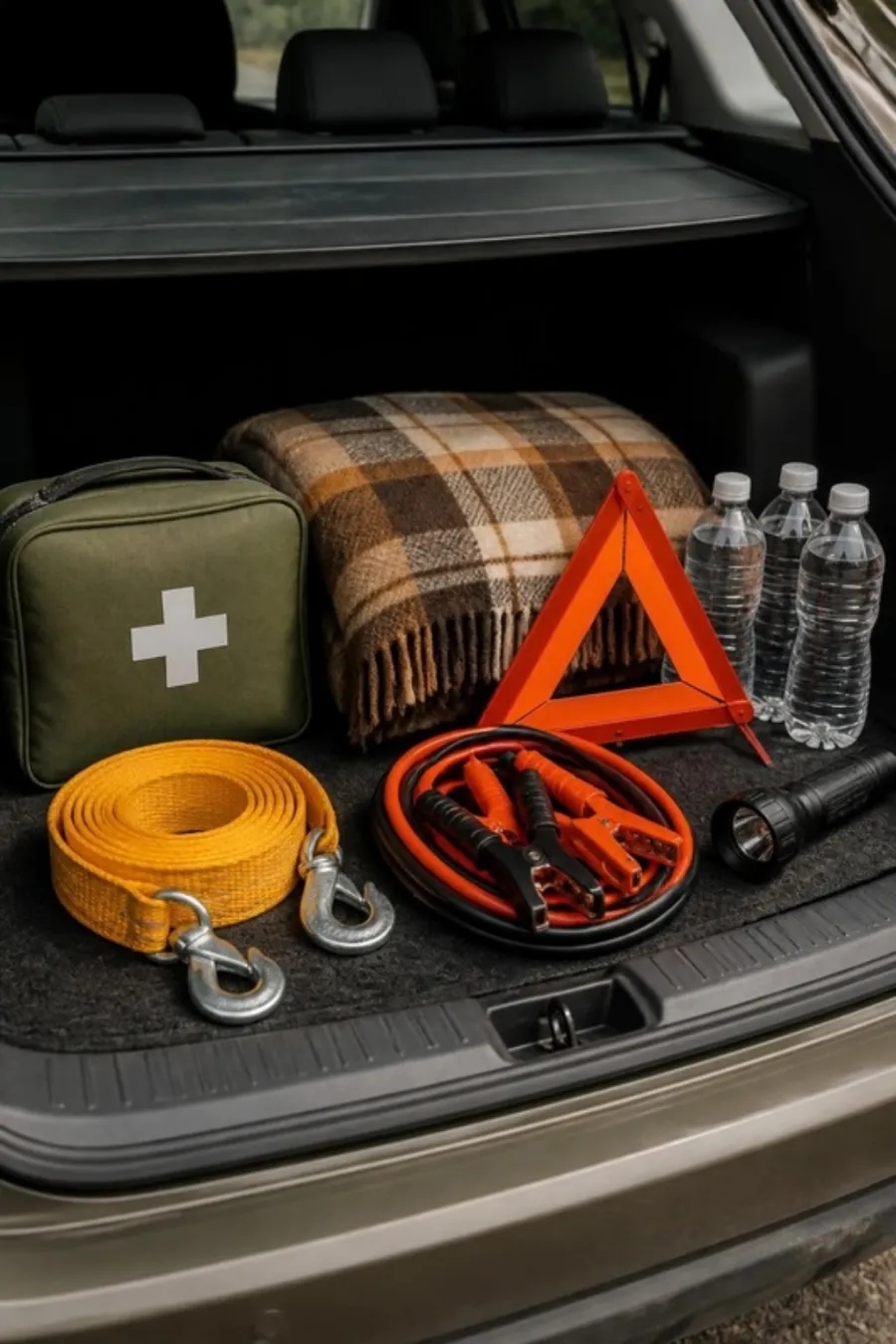
Getting the car moving again
- A portable jump starter, or traditional jumper cables. Cables work, but they need a second running car willing to help you. A portable jump starter doesn’t, which matters if you’re stuck somewhere with no other traffic around. Either one is useless buried under gear you never check, so keep it somewhere you’d find it in the dark.
- A tire inflator or a tire plug/repair kit. A slow leak or a small puncture is often drivable-again territory with the right tool; without one, a fixable flat becomes a full stop and a tow.
- Jumper/booster leads long enough to reach, if you go the traditional-cable route instead of a jump starter. A short set that can’t span two parked vehicles is a common, avoidable failure.
Whichever jump starter you choose, check that its peak amp rating suits your engine size, and recharge it every few months. A jump starter with a dead battery is extra weight in the trunk.
Traction, visibility & winter-specific gear
- An ice scraper with a brush attachment. Cheap, and the single most common item people forget to keep in the car until the first freeze of the season, at which point every store nearby is sold out.
- Cat litter, sand, or a purpose-made traction aid, plus a small folding shovel. Both are named directly in Ready.gov’s and NHTSA’s vehicle-preparedness guidance for the same reason: a car stuck in snow or ice usually needs traction under the drive wheels and a way to clear it. Not a tow truck.
- Reflective triangles or road flares. A stalled or stopped car is a hazard to itself and everyone behind it until it’s visible. This is squarely a car-kit item with no equivalent need in a bug-out bag.
- A wool or heavy fleece blanket, kept in the car rather than the bug-out bag specifically because a car blanket has to tolerate being left through summer heat and winter cold in a trunk for years. A harder environment than a closet.
Power, navigation & staying informed
- A car-specific phone charger, kept in the vehicle permanently rather than borrowed from the house. The number of dead-phone breakdowns that turn into a longer ordeal than they needed to be, simply because the charging cable was somewhere else, is entirely avoidable.
- A printed paper map of your region. It sounds almost old-fashioned next to a phone’s map app, until the app is the thing that’s unavailable: dead battery, no signal in a rural stretch, or, in an evacuation-by-car scenario, a cell network too congested to load anything. A folded paper map costs nothing and never needs a signal.
- A battery-powered or hand-crank radio, for the same reason it earns a spot in a bug-out bag: weather and traffic information when a phone can’t get one.
Basics that overlap with, but aren’t identical to, a bug-out bag
A few items genuinely belong in both kits, but the diagnostic question changes how you size and choose each one:
-
Water. A car kit doesn’t need to be sized for carrying on foot, so there’s more room to lean on bottled water or a larger container than the bug-out bag guide‘s carry-sized HydraPak Seeker 2L recommendation. A gallon or two of bottled water, rotated seasonally so it doesn’t freeze-crack a container or sit for years past a “best by” date, covers most roadside scenarios. Aquatabs are still worth a dozen in the glovebox as a zero-weight backup if you ever end up needing to treat water from an unexpected source.
-
Food. No cooking, no prep. A car kit’s food layer is strictly no-prep, shelf-stable calories: protein bars, nut butter packets, anything that survives a hot trunk in July and a freezing one in January without spoiling. A few Nutrient Survival pouches (which only need water, not a stove, to prepare) are a reasonable step up if you want something more substantial than a granola bar and have a way to add hot or cold water.
-
First aid. A compact kit covers the realistic car-kit injury profile (cuts, scrapes, a sprain from changing a tire on an angle, a headache during a long wait) without needing the fuller trauma-kit depth I recommend for a bug-out bag. Add one piece of real bleeding control: a North American Rescue C-A-T tourniquet ($34.99), or Mountain Man Medical’s small Sweetwater kit ($79.99 with the C-A-T option), which adds a pressure bandage, packing gauze, gloves and shears. My Sweetwater vs. Yellowstone comparison explains which kit to buy. For the everyday supplies, the Adventure Medical Kits Mountain Series Hiker ($34.49) is compact, at about 7 ounces.
-
A utility knife or multi-tool. Cutting a stuck seatbelt strap, opening packaging, general roadside repair. The same utility case made for a bug-out bag’s EDC knife applies here. Carry a folding blade, a fixed blade, or both; Buck Knives and SOG both make compact options that fit easily in a glovebox or console. A hatchet can be very useful in some scenarios, such as clearing a fallen branch, but it adds weight and bulk, so treat it as optional.
- A dedicated pouch or organizer to keep all of the above from turning into loose gear rolling around the trunk. A zippered packing cube or small duffel works fine; it doesn’t need to be purpose-built for this.
A car kit naturally invites a few “what if I’m trapped” additions: a seatbelt cutter, a window-breaking tool, a tire deflator for sand or snow, a small pry bar for a stuck door. All of those are genuine utility tools with a clear rescue or mechanical purpose, and I’m comfortable recommending them on that basis. What I won’t cover, here or anywhere on this site, is anything positioned as a weapon or self-defense tool. That’s a deliberate, consistent editorial line, not an oversight specific to this article. See my bug-out bag guide’s “A Note on Personal Safety” callout for the fuller reasoning.
The winter stranding risk, specifically
This is the scenario that makes a car kit genuinely life-safety-relevant rather than just a convenience item, and it deserves to be spelled out plainly rather than left implied.
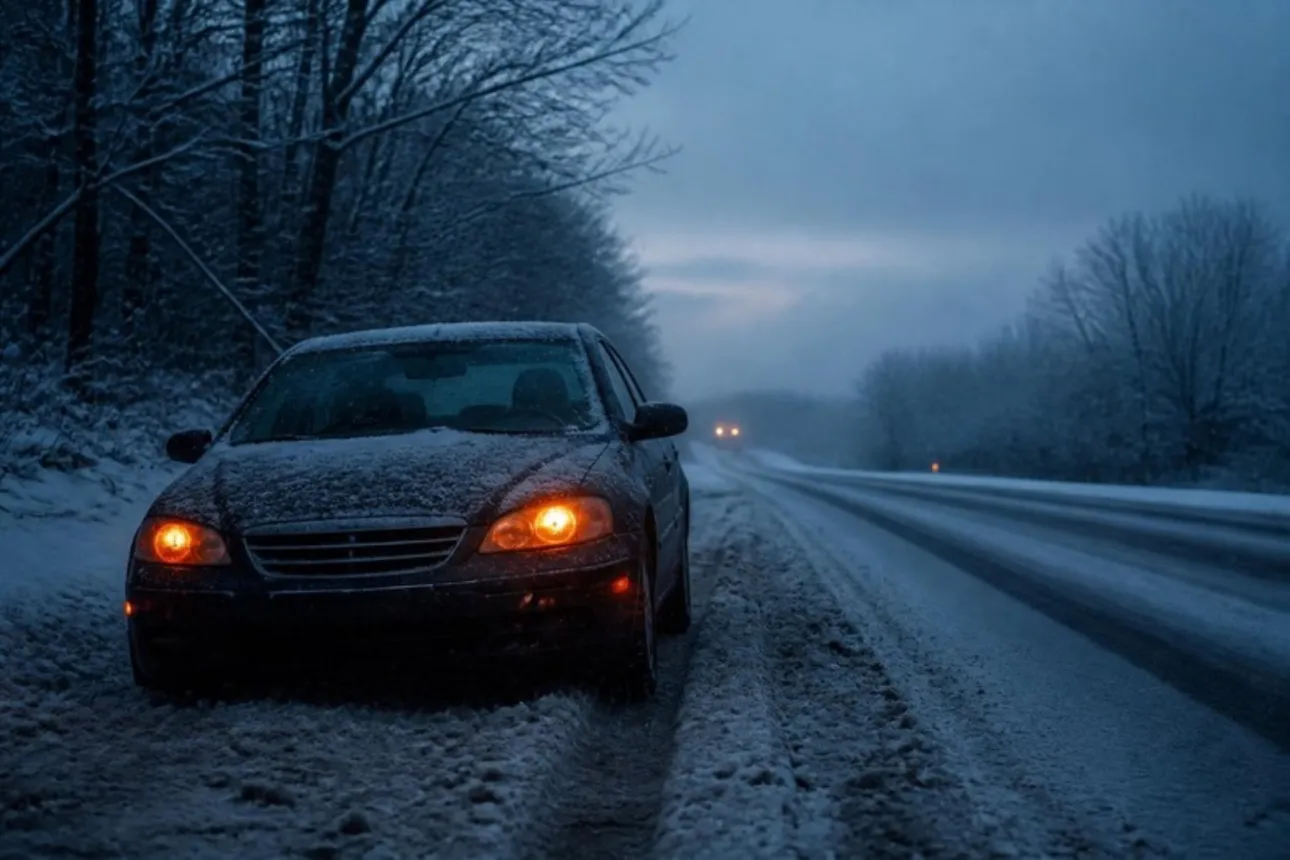
Getting stuck in snow or on an ice-closed road isn’t just an inconvenience: being stranded in a vehicle in cold weather carries a real risk of hypothermia if you’re not prepared to stay warm longer than expected, and a separate, less obvious risk: carbon monoxide buildup if snow packs in around a running vehicle’s exhaust pipe. The CDC has published specific winter-weather guidance on exactly this. A blocked tailpipe can let carbon monoxide back up into the passenger compartment even with the windows cracked, and it’s a risk people don’t think about until they’re already running the engine to stay warm in a snowbank. NHTSA’s winter driving guidance is direct about the fix: if you’re stranded, stay with your vehicle rather than trying to walk for help, periodically check and clear snow away from the exhaust pipe, and run the engine only sporadically (enough to stay warm, not continuously) rather than leaving it running the whole time you’re waiting.
That single piece of guidance is the clearest argument for why a car kit needs its own winter-specific layer rather than just being a smaller bug-out bag: the wool blanket, the extra layer, the traction aid to get unstuck before it becomes a multi-hour wait in the first place, and the shovel to keep snow clear of the tailpipe if it doesn’t. None of that is about walking anywhere. It’s about staying safe and warm in place, which is precisely the scenario a car kit is built to cover and a bug-out bag isn’t designed around.
Do you need both?
Go back to the diagnostic question one more time, where are you when this kit gets used, and the answer is yes, but for a specific reason: the two kits activate in genuinely different situations, not because it’s simply “better to be extra prepared.”
The car kit activates when the problem is the car, or being stuck in or near it. A flat tire, a dead battery, a winter storm closing the highway while you’re already on it. In every one of those, you’re not evacuating anywhere. You’re waiting it out or fixing the immediate problem, and the kit’s job is entirely about that narrow window.
The bug-out bag activates when the problem is your home, or your area, and staying isn’t the plan. A hurricane evacuation, a wildfire, a civil-unrest event. You might be driving when that happens (which is where the two kits genuinely overlap, see below) but the bag has to work even if driving stops being an option partway through.
Here’s the piece most people miss when they only ask the question once instead of at every stage: if you’re evacuating by car, your bug-out bag and your car kit work together, not as duplicates. The bug-out bag rides in the trunk alongside the car kit for that trip, and the car kit’s roadside-specific gear (jumper cables, an ice scraper, traction aid) covers you if the vehicle itself becomes the problem mid-evacuation, a real possibility on roads jammed with other evacuating traffic. But a stationary car kit sitting in the garage, on its own, doesn’t answer the “leave home” version of the question. It has no shelter, no multi-day food plan, nothing built for being carried if you end up on foot. The two kits solve adjacent problems well together; neither one quietly covers for the other.
Building your car kit: three budgets
Every tier below assumes the same non-negotiable basics regardless of budget: an ice scraper, jumper cables or a jump starter, a first aid kit, a paper map, and a phone charger. None of those add meaningful cost, so, like the bug-out bag guide’s own budget tiers, they’re not really a “tier” decision; they belong in every version of this kit.
Budget tier: Traditional jumper cables, a basic ice scraper, a bag of cat litter or sand for traction, a folding shovel, reflective triangles, a wool blanket from an existing closet, a printed map, a compact first aid kit, and a couple of Aquatabs and shelf-stable snack bars. This covers the real essentials for well under what most people expect a “car kit” to cost.
Mid-tier: A portable jump starter instead of cables, a tire inflator or plug kit, a dedicated organizer pouch to keep everything findable, a battery/hand-crank radio, a few Nutrient Survival pouches, and a compact first aid kit with a North American Rescue C-A-T tourniquet.
Premium tier: All of the above, plus a second, smaller version of the household’s bug-out-bag core supplies (water, a mylar blanket, extra medication) kept permanently in the trunk as a standing bridge kit: genuinely useful if an evacuation-by-car scenario ever means the car itself becomes part of the shelter for longer than planned.
Want to build it item by item? My free car emergency kit builder lets you check off your kit and print the list.
Bottom line
One question decides the kit: will you still be in the car, or will you be leaving the house? A car emergency kit and a bug-out bag answer different versions of that question, and neither one is a smaller or lighter substitute for the other. Build the car kit around what gets a stranded vehicle moving again or keeps you safe and warm while you wait: jumper cables or a jump starter, a tire inflator, traction aid, a blanket, and the winter-specific pieces that matter more than people expect until the one night they need them. Build the bug-out bag, covered in full in Building a Bug-Out Bag for Natural Disasters and Civil Unrest, around what it takes to leave home on foot if it comes to that. Most households that take preparedness seriously end up needing both, for genuinely different reasons. Not as redundant insurance, but as two kits built for two different bad days.
Free Updates
I send an email when something’s genuinely worth your time: a new guide, a real price drop on something I recommend, or an actual safety alert. No spam, no daily digest, unsubscribe anytime.
FAQ
Can I just keep my bug-out bag in the car instead of building a separate car kit?
Not as a full substitute. A bug-out bag doesn’t include jumper cables, an ice scraper, traction aid, or reflective triangles: none of which have any reason to be in a bag built for carrying on foot. If your bug-out bag lives in the car, it’s still worth adding a small, dedicated set of roadside items alongside it rather than assuming the bag already covers that ground.
What’s the single most-forgotten item in a car kit?
Based on the guidance above, it’s usually the ice scraper: cheap, easy to buy, and somehow always missing at the first freeze of the season when every store nearby is sold out. Buying one in late summer, before the seasonal rush, is a small, easy fix.
Is a portable jump starter better than traditional jumper cables?
For most people, yes: a jump starter doesn’t require a second running vehicle to help you, which matters if you’re stranded somewhere with little traffic. Cables are cheaper and don’t rely on a charged battery of their own, so there’s a reasonable case for keeping both if space allows.
Should I run my car’s engine if I’m stranded in the cold?
Only sporadically, per NHTSA’s winter driving guidance (enough to stay warm, not continuously) and only after confirming the exhaust pipe is clear of snow. A blocked tailpipe can let carbon monoxide build up inside the vehicle, a risk the CDC has published specific winter-weather guidance about. Staying with your vehicle rather than attempting to walk for help is the standard recommendation in a winter stranding.
Do I need a full first aid kit in my car if I already have one in my bug-out bag?
Yes, if your bug-out bag doesn’t live in the car: you want basic first aid coverage wherever you spend time, and a car and a home closet are two different places. A compact kit sized for a glovebox is enough; it doesn’t need the fuller depth of a bug-out-bag trauma kit.
How often should I check my car kit?
At least twice a year, timed to the seasons rather than a fixed date: once heading into winter (confirm the ice scraper, blanket, and traction aid are in the car, not left behind after a cleanout) and once heading into summer (check that water and any food items haven’t degraded from months of trunk heat, and that batteries in a radio or jump starter haven’t drained).
The Prep Verdict is reader-supported. If you buy through a link on this page, I may earn a commission at no extra cost to you. See my full disclosure for details. I only recommend products I’d put in my own emergency supplies.