Here’s the question worth answering before you spend a dollar on backup power: when the lights go out, what do you need to keep running, and for how long? Not “what’s the biggest power station I can afford”: what’s the real list. Phones charged so you can get alerts and call for help. A CPAP running through the night if someone in your house depends on one. A fridge full of food and medication that can’t afford to spoil. Maybe a laptop, a router, a few lamps.
A portable power station can cover some of that list. It cannot cover all of it, and I’d rather tell you that upfront than sell you a battery and let you find out the hard way during an actual outage. This guide walks through what a power station can realistically run, does the actual capacity math so you’re not guessing, and compares the options I recommend: Jackery’s HomePower 1000 v2 and Explorer 2000 v2, Goal Zero’s Yeti lineup (through BattlBox) and the Barebones Block Tower.
Reader-supported: I may earn a commission if you buy through links on this page, at no extra cost to you. Disclosure.
Quick answer: A portable power station won’t run your whole house, but it can keep the essentials going: phones, a router, lights, a CPAP and, with a big enough unit, a fridge. For most homes, start with the Jackery HomePower 1000 v2 (about 1,000 watt-hours, about $549 on sale). Step up to the Explorer 2000 v2 (about 2,000 watt-hours, about $999) to keep a fridge going about a full day, or down to the Goal Zero Yeti 300 ($299.95) if you only need phones, a router and lights.
Quick Verdict: Backup Power for a Home Outage
1,024Wh, 1,500W continuous / 3,000W surge. Enough for a CPAP with the humidifier through a full night, or a fridge for part of a day. about $549 on sale at Jackery (list $699).
2,042Wh, 2,200W continuous / 4,400W surge. The one to buy if keeping a full-size fridge cold through a day matters. about $999 at Jackery.
297Wh, 350W continuous. Phones, a router, lights and a CPAP without the humidifier. $299.95 at BattlBox.
88.8Wh, airline carry-on compliant. Right-sized for phones and small electronics, not a fridge or CPAP. $239.99.
If you’re not sure which to pick: start with the Jackery HomePower 1000 v2. At about 54 cents per watt-hour it costs roughly half as much per unit of stored energy as the Yeti 300, and it has the surge rating to start most fridges. Step up to the Explorer 2000 v2 if you need a fridge to last through a full day, or step down to the Yeti 300 if your real list is phones, a router and lights.
Free Updates
I send an email when something’s genuinely worth your time: a new guide, a real price drop on something I recommend, or an actual safety alert. No spam, no daily digest, unsubscribe anytime.
Set realistic expectations first
Every one of these products gets marketed with photos of a full kitchen running off sunshine and good vibes. That’s not what you’re buying. A portable power station is a battery with an inverter attached. It stores a fixed amount of energy (measured in watt-hours, Wh) and can push out power up to a fixed rate (measured in watts, W). Both numbers are small compared to what your house uses.
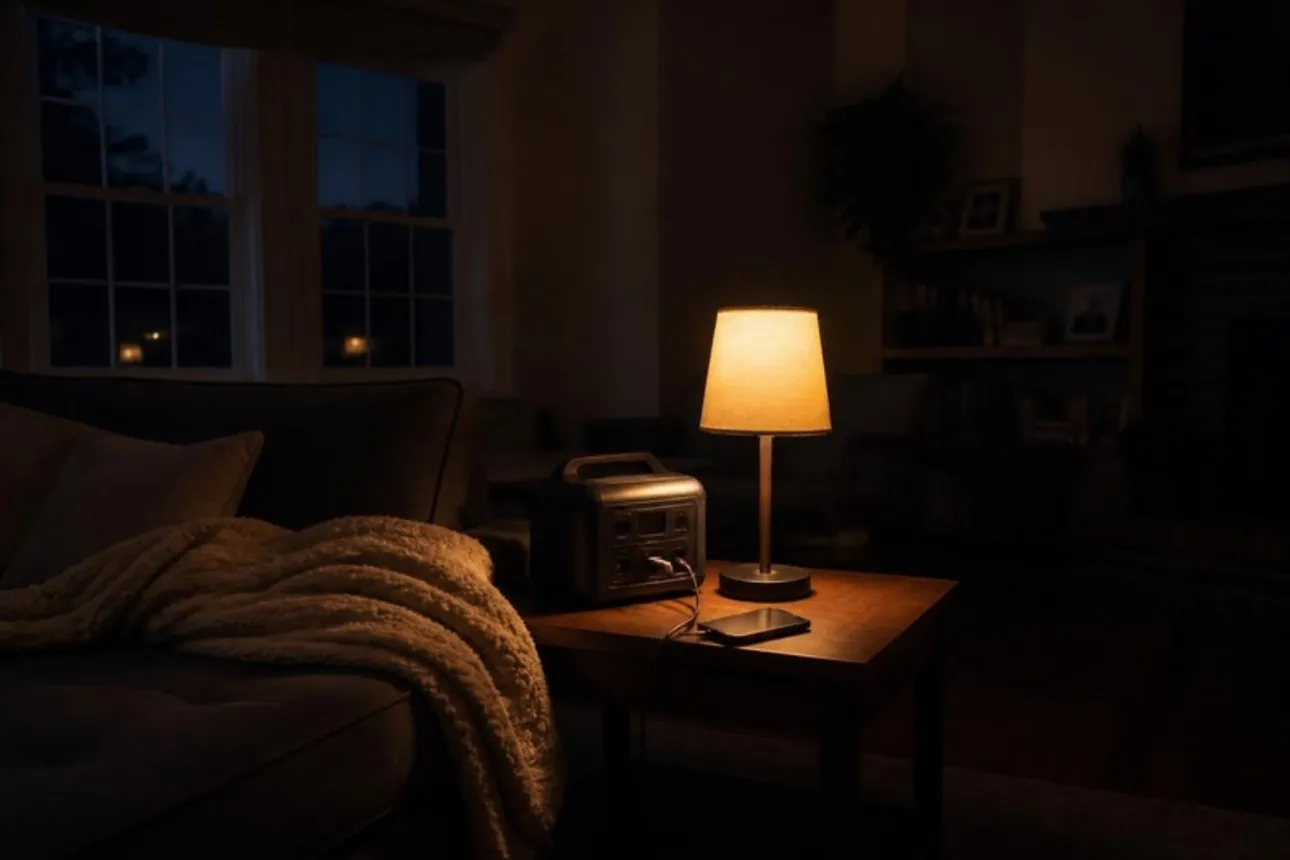
For scale: a typical U.S. home uses about 865 kWh a month, roughly 28 kWh a day (EIA, 2024). That averages out to about 1,200 watts around the clock, with much bigger spikes when AC, electric heat or a dryer kicks on. The largest unit in this guide, the Jackery Explorer 2000 v2, holds about 2 kilowatt-hours, roughly 7-8% of a typical day’s household electricity use, and can push out 2,200 watts continuously. That’s not a knock on the product; it’s just math. None of the products in this guide are a substitute for a whole-home standby generator or a large solar generator system. They’re a bridge for specific, important loads. Not a way to run your house through a multi-day outage like nothing happened. For the food-and-water side of that same planning problem, a genuinely different piece of an outage plan than power, see Water Purification Tablets vs. Filters: Which Do You Need for a 2-Week Power Outage?
Ready.gov’s power-outage guidance frames this well: plan around your household’s specific needs (medical equipment, food safety, communication) rather than trying to replace grid power wholesale. That’s the right mental model for everything below.
What you’re trying to power
Before comparing products, it helps to know roughly how much energy the things you care about pull. These are standard, widely published figures, not lab numbers from this site, and real devices vary by model, so treat them as planning estimates, not guarantees.
| Device | Typical draw | What that means for capacity |
|---|---|---|
| Smartphone (full charge) | ~10-15Wh | Even the smallest unit here (88.8Wh) covers roughly 5-7 full phone charges |
| Laptop (full charge) | ~50-70Wh | 1-2 charges on a small unit, 10 or more on a 1,000Wh unit |
| CPAP, no humidifier | ~30-40W continuous | A full 8-hour night is ~240-320Wh. Out of reach for the two smallest units here, close on a Yeti 300, two or more nights on a 1,000Wh unit |
| CPAP, heated humidifier running | ~60-80W continuous | A full night can run 480-640Wh. A 1,000Wh unit like the HomePower 1000 v2 covers it with margin; the smaller units don’t |
| Mini/compact fridge | ~60-100W running (cycles on/off) | Averaged over a day, expect real draw closer to 300-600Wh/24hr due to cycling. A 1,000Wh unit can carry one through a day; the small units buy hours |
| Full-size fridge | ~100-200W running, 800-1,200W+ startup surge | Plan on roughly 1-2kWh a day. Starting it takes a high surge rating: the Jackery units (3,000W and 4,400W surge) handle that easily. A HomePower 1000 v2 buys part of a day; the Explorer 2000 v2 gets an efficient fridge through about a full day |
Planning note: a power station delivers less than its rated capacity once inverter losses are counted. I plan on roughly 85% of the rated watt-hours when running AC devices.
The pattern that matters: phones and small electronics are well covered by any of these products. CPAP and refrigeration are where size matters. Under about 300Wh you’re bridging a few hours. At 1,000Wh and up, a full night of CPAP or a fridge for part of a day becomes realistic, and at 2,000Wh a fridge through about a full day.
The real options today
These are the three brands I recommend, and they make genuine portable power stations: actual battery-and-inverter units built to run real devices, not lanterns with a USB port or phone power banks marketed as more than they are. (The small Sherpa 100AC is the exception that sits closer to a power bank, as I explain below.)
Jackery sells its power stations direct. Jackery is one of the best-known names in this category, and its current lineup uses LiFePO4 (lithium iron phosphate) batteries, the longer-lasting chemistry you want in something that may sit in a closet for years between outages. I’m covering two models: the HomePower 1000 v2 and the Explorer 2000 v2.
BattlBox carries Goal Zero units: the Yeti 300 (6th generation), the Yeti 500 (6th generation), and the Sherpa 100AC. Goal Zero has been building this category for over a decade.
Barebones (Barebones Living) carries the Block Tower Power Station, a smaller, design-forward unit with brass and copper accents, a leather carry handle, and a dimmable analog display. It’s built for portability and small electronics, not for running appliances.
Jackery HomePower 1000 v2 vs. Explorer 2000 v2
These two are the reason this guide changed. They hold three to seven times the energy of the Yeti 300 at roughly half the cost per watt-hour, and their surge ratings are high enough to start a refrigerator compressor. If your outage plan includes a CPAP with a humidifier or a fridge full of food and medication, start here.
HomePower 1000 v2
1,024Wh, LiFePO4 battery rated for 6,000 cycles to 70% capacity, 1,500W continuous output and 3,000W surge, three AC outlets, about 23.4 lbs. It switches to battery in under 10 milliseconds when the grid drops, so you can leave a router, a computer or a CPAP plugged through it and they keep running when the power cuts out. Jackery says it recharges from the wall in about 50 minutes, which matters if power comes back for a few hours in the middle of a multi-day outage. Its Priority Routing feature can shut off less important outlets at a battery level you set, so the fridge or the CPAP keeps running longest.
In practice: a CPAP with the humidifier through a full night with margin, two or more nights without the humidifier, or a full-size fridge for part of a day. It’s about $549 on sale at Jackery at last check (list price $699), about 54 cents per watt-hour. Buying direct from Jackery also adds two free years to the standard three-year warranty, five years in total.
Explorer 2000 v2
2,042Wh, LiFePO4 battery, 2,200W continuous output and 4,400W surge, about 39.5 lbs. That’s twice the energy of the HomePower 1000 v2 and enough output to run a fridge, a microwave or a coffee maker. It switches to battery in under 20 milliseconds and recharges from the wall in about 1.7 hours. Jackery also says it holds about 95% of its charge after 12 months in storage, a useful trait in a unit that may sit charged in a closet between outages.
In practice: a full-size fridge through about a full day, or a fridge plus a CPAP plus phones and lights through a long night. It’s about $999 at Jackery at last check, about 49 cents per watt-hour, the lowest cost per unit of stored energy in this guide. The trade-off is weight: at nearly 40 lbs, it’s something you move from room to room, not something you carry far.
Jackery’s sale prices change often, so check the current price before you buy. The cost-per-watt-hour comparison holds even at list price: $0.68 per watt-hour for the HomePower 1000 v2 and $0.49 for the Explorer 2000 v2, against about $1.01 for the Yeti 300.
Goal Zero Yeti 300 vs. 500 vs. Sherpa 100AC
The Yeti 300 and Sherpa 100AC are both listed at BattlBox at $299.95, and the Yeti 500 at $499.95. As of this update, only the Yeti 300 is in stock. With the 300 and Sherpa at the same price, that comparison comes down entirely to capacity vs. port selection, not budget – the 500 is a separate, higher tier in both capacity and price.
Yeti 300 (6G)
297Wh, LiFePO4 battery, 350W continuous output, 600W surge. This is the entry point: enough to keep phones, a laptop, small lights, and a router running for a genuinely useful stretch, and enough continuous wattage to run a small appliance or a CPAP without a humidifier for close to a full night. It’s not going to reliably start a compressor-driven fridge. The 600W surge rating is on the low end for that job.
Yeti 500 (6G)
499.2Wh, LiFePO4 battery, 500W continuous output, 1,000W surge. The 1,000W surge rating gives it a real shot at starting some smaller fridges, and it has enough capacity for a CPAP through a full night without the humidifier, or part of a night with it. If you are choosing between it and the Jackery HomePower 1000 v2, the Jackery holds twice the energy for about the same price. At BattlBox it runs $499.95, roughly 67% more than the Yeti 300 for roughly 68% more capacity – a close-to-linear tradeoff, not a bargain, so pick it for the extra headroom, not the price. As of this update, the Yeti 500 is temporarily out of stock at BattlBox.
Temporarily Out of Stock at BattlBox
Sherpa 100AC
94.7Wh (25,600mAh), 100W AC inverter output (modified sine wave), dual USB-C (up to 100W PD), dual USB-A, and a 15W wireless charging pad. Worth being precise about what this is: Goal Zero and most retailers list it as a power bank, not a power station. It’s genuinely more comparable in scale to the Block Tower than to the two Yeti units above, just with Goal Zero’s brand and a broader port selection. It’s also the weakest value of the products in this guide. At $299.95 for under 95Wh, it costs the same as the Yeti 300 for about a third of the capacity, so the Goal Zero name is carrying real weight in that price. It’s a strong choice if your outage plan is specifically “keep a laptop and a phone alive with wireless charging and lots of ports,” not “run anything with a compressor or a heating element”, and not the pick if you’re comparing purely on capacity per dollar.
Temporarily Out of Stock at BattlBox
Barebones Block Tower
The Block Tower is the outlier in this guide in a good way: it’s not trying to be a mini generator. At 88.8Wh and roughly 60W continuous output, it’s sized and priced ($239.99) for personal electronics and small devices (phones, tablets, a camera battery, a string of lights) not appliances. What it does that the larger units here don’t is travel well: it’s explicitly built to meet airline carry-on battery regulations, weighs 3.6 lbs, and its wireless charging pad can handle up to five devices at once. The brass-and-copper, leather-handled design is genuinely a selling point here. This is a power station built to sit on a counter, ride in a bug-out bag, or go in a suitcase without looking like lab equipment.
For a household specifically planning around a multi-day outage with a CPAP or fridge in the mix, the Block Tower isn’t the right primary tool. It doesn’t have the capacity or continuous output for either job. For an apartment, a dorm, a bug-out bag, or anyone who wants a genuinely portable backup for phones and small electronics that travels as easily as it sits on a shelf, it’s a legitimately good fit.
Head-to-head: capacity, price, and who each is for
| Spec | HomePower 1000 v2 | Explorer 2000 v2 | Yeti 300 (6G) | Yeti 500 (6G) | Sherpa 100AC | Block Tower |
|---|---|---|---|---|---|---|
| Capacity | 1,024Wh | 2,042Wh | 297Wh | 499.2Wh | 94.7Wh | 88.8Wh |
| Continuous output | 1,500W | 2,200W | 350W | 500W | 100W | ~60W |
| Surge output | 3,000W | 4,400W | 600W | 1,000W | N/A | N/A |
| Weight | ~23.4 lbs | ~39.5 lbs | N/A | N/A | N/A | 3.6 lbs |
| Price | about $549 on sale (list $699) | about $999 at Jackery | $299.95 | $499.95 (out of stock) | $299.95 (out of stock) | $239.99 |
| Price per Wh | ~$0.54 | ~$0.49 | ~$1.01 | ~$1.00 | ~$3.16 | ~$2.70 |
| Best fit | CPAP with humidifier for a full night, fridge for part of a day, phones and router for days | Fridge through about a full day, plus CPAP, phones and lights | Phones, laptops, router, CPAP without humidifier | The above, plus short-window fridge backup | Laptop-and-phone travel backup, wireless charging | Ultra-portable phone and small-device backup, travel |
| Not built for | Running a fridge for days without recharging | Carrying any distance | Fridges, appliances with a real startup surge | All-day appliance running without recharge | Any compressor-driven appliance | Any compressor-driven appliance, CPAP for a full night |
Prices checked October 6, 2026. Jackery prices are the sale prices on jackery.com that day.
Two things stand out doing this math side by side. First, the Jackery units cost about half as much per watt-hour as the Goal Zero units, and they’re the only ones here with the surge rating and the capacity to handle a full-size fridge in a meaningful way. Second, the Sherpa 100AC is the weakest per-dollar value of everything here. It shares the $299.95 price with the Yeti 300 but holds about a third as much energy. It earns its place on port selection and wireless charging alone.
Who should buy which:
- A household with a CPAP or a fridge full of food and medication → Jackery HomePower 1000 v2. A full night of humidified CPAP, or a meaningful stretch of fridge time, for about $500.
- A household that wants the fridge cold through a full day → Jackery Explorer 2000 v2. Twice the energy, the highest output here, and the lowest cost per watt-hour.
- A household that mainly wants phones, a router, and lights covered → Goal Zero Yeti 300. Lighter and smaller than the Jackery units, with enough output for electronics and a CPAP without the humidifier.
- Someone who travels or works remotely and wants a laptop backup with lots of ports → Sherpa 100AC, for the wireless charging and USB-C, not the capacity. It’s out of stock at BattlBox as of this update.
- An apartment, dorm, or minimalist setup that only needs phones and small electronics → Block Tower. Right-sized, portable, and airline carry-on compliant.
Medical devices and power-dependent equipment
If anyone in your household depends on electricity for a medical device (a CPAP, a nebulizer, a portable oxygen concentrator, refrigerated insulin or other medications) treat backup power as a real planning problem, not an afterthought bolted onto a general emergency kit. The CDC’s guidance on power-dependent medical equipment during an outage is worth reading directly (see its “Power Sources” page under Prepare Your Health). It recommends knowing your device’s actual wattage, having a plan for where to go if your backup power runs out, and talking to your medical supplier or physician about backup options specific to your equipment, since needs vary enormously by device and by person.
The math in this guide points to a clear threshold: for a CPAP with a humidifier, or any device pulling more than roughly 60-80W continuously, you want about 1,000Wh or more. That’s where the Jackery HomePower 1000 v2 and Explorer 2000 v2 come in. The smaller units here are a partial-night bridge for those devices, not full-night coverage. Even with a large unit, plan for what happens if an outage outlasts the battery: a way to recharge (solar, a car or a generator running safely outdoors), a stay with family, or a hospital or shelter with power.
This is general planning guidance, not medical advice. Every device, and every person’s medical needs, are different: talk to your physician or your durable medical equipment (DME) supplier about backup power requirements specific to your situation before relying on any product in this guide to cover a real medical need.
What these can’t do, and what can
Being honest about the ceiling here is the point of this guide, not a footnote. None of these products will:
- Run HVAC, a well pump, a sump pump, or an electric water heater for any meaningful stretch of time. Even the Explorer 2000 v2 would be drained quickly by any of those, and some exceed its output entirely.
- Power a household through a multi-day outage without a way to recharge. Every unit here is a battery, not a generator. Once it’s empty, it’s empty until you plug it back into the wall, a car outlet, or a solar panel.
- Replace a whole-home standby generator or a home battery system wired into your electrical panel. Those operate in a different capacity, installation and price class from anything covered here.
What they’re good at: keeping communication alive (phones, a router, a radio), keeping small lighting running (see Best Emergency Lantern for a Power Outage for the lighting side of this same planning problem), running a CPAP or small medical device through the night, keeping a fridge cold for part of a day or, with the Explorer 2000 v2, about a full day, all without touching your car’s gas tank or running a combustion engine near your house.
One underrated advantage worth naming directly: these are battery-based, not fuel-based, so there’s no carbon monoxide risk from using one indoors, a real and serious hazard with gas generators. The CDC’s generator safety guidance is explicit that fuel-powered generators must run outdoors, far from windows and doors, because of CO poisoning risk. A portable power station has no such restriction; it’s safe to run inside your home. Whatever you run, keep a working carbon monoxide alarm on each level of your home, and test it when you test your other emergency gear.
If your household’s need is bigger than this, such as running a fridge for several days, a well pump or heating, a gas or dual-fuel generator run safely outdoors, or a larger home battery system, is the honest answer. Jackery also makes larger HomePower units that I haven’t covered here yet. I’ll add them if there’s real demand.
For light-duty, budget backup, a spare charge or two for a phone with no AC output at all, TLO Outdoors’ Dark Energy Poseidon Pro power bank is worth a mention as a supplementary, not primary, option: a rugged, IP68-rated 10,200mAh power bank, useful as a backup-to-the-backup for phones. It’s a different category from everything else in this guide, with no AC inverter, so it’s not a substitute for a real power station, just a cheap, tough extra.
Building a backup power plan on a budget
Under $250: The Barebones Block Tower on its own. Right-sized if your real need is phones, small lights, and short-duration coverage, not appliances.
Around $300: The Goal Zero Yeti 300 through BattlBox. Phones, a router, lights and a CPAP without the humidifier, in a smaller and lighter package than the Jackery units.
Around $500: The Jackery HomePower 1000 v2. This is where I’d start for most households, and the setup I’d recommend for anyone with a CPAP or a fridge full of food and medication who isn’t ready to invest in a generator.
Around $850: The Jackery Explorer 2000 v2, for a fridge through about a full day plus everything else on the list.
Bottom line
A portable power station is a real, useful piece of an outage plan, not a replacement for one. For most households, the Jackery HomePower 1000 v2 is the one to buy: about 1kWh of LiFePO4 storage, a 3,000W surge rating, and a price of around 54 cents per watt-hour. If keeping a full-size fridge cold through a full day matters, step up to the Jackery Explorer 2000 v2. If your list is phones, a router and lights, the Goal Zero Yeti 300 through BattlBox is the smaller, lighter choice, and the Barebones Block Tower is the pick when portability matters most. Whichever you choose, go in knowing the ceiling: these keep the essentials running for hours to a day, not a household running for a week.
Free Updates
I send an email when something’s genuinely worth your time: a new guide, a real price drop on something I recommend, or an actual safety alert. No spam, no daily digest, unsubscribe anytime.
Sources
- Ready.gov: Power Outages
- CDC: Power Sources (medical devices that need power)
- CDC: Generator Safety Fact Sheet (carbon monoxide)
- U.S. Energy Information Administration: 2024 household electricity use
- Jackery, Goal Zero and Barebones product pages (capacity, output and price)
FAQ
Can a portable power station run my whole fridge during an outage?
For a while. It takes a high surge rating to start a fridge compressor, and the Jackery units in this guide (3,000W and 4,400W surge) handle that easily. Plan on roughly 1-2kWh a day for a full-size fridge: the HomePower 1000 v2 covers part of a day and the Explorer 2000 v2 about a full day. The smaller units here are not built for it.
Is a portable power station safe to use indoors?
Yes. Unlike a gas or dual-fuel generator, a battery-based power station produces no exhaust and carries no carbon monoxide risk, so it’s safe to run inside your home. Gas generators must run outdoors, away from windows and doors, per CDC guidance.
How long will one of these last on a CPAP?
It depends on the humidifier. Without it, a CPAP typically draws 30-40W, so the Yeti 300 gets you close to a full night and the Jackery HomePower 1000 v2 two or more nights. With a heated humidifier, draw roughly doubles, and you want about 1,000Wh for a full night: the HomePower 1000 v2 or the Explorer 2000 v2. Check your machine’s actual wattage and talk to your DME supplier about your specific medical needs.
Why Jackery and not EcoFlow or Bluetti?
Jackery’s current models use LiFePO4 batteries, carry a five-year warranty when bought direct, and cost about half as much per watt-hour as the Goal Zero units here. EcoFlow and Bluetti make comparable products that I haven’t covered here.
Do I need a power station if I already have a gas generator?
They solve different problems well together. A gas generator covers bigger loads for longer, but has to run outdoors and needs fuel on hand. A power station can sit charged and ready indoors, requires no fuel, and is the better choice for short outages, nighttime use, or as a quiet backup for medical devices and electronics while a generator handles heavier loads.
What’s the difference between a “power bank” and a “power station”?
Mostly output and use case, not a hard technical line. A power bank (like the Sherpa 100AC or the Dark Energy Poseidon Pro) is generally smaller-capacity and built around USB charging first, sometimes with a modest AC outlet added on. A power station is built around AC output and running small appliances, with USB charging as a bonus. The Jackery units and the Yeti 300 and 500 are power stations in the fuller sense; the Sherpa 100AC sits closer to the power-bank end despite Goal Zero’s branding.
The Prep Verdict is reader-supported. If you buy through a link on this page, I may earn a commission at no extra cost to you. See my full disclosure for details. I only recommend products I’d put in my own emergency supplies.